

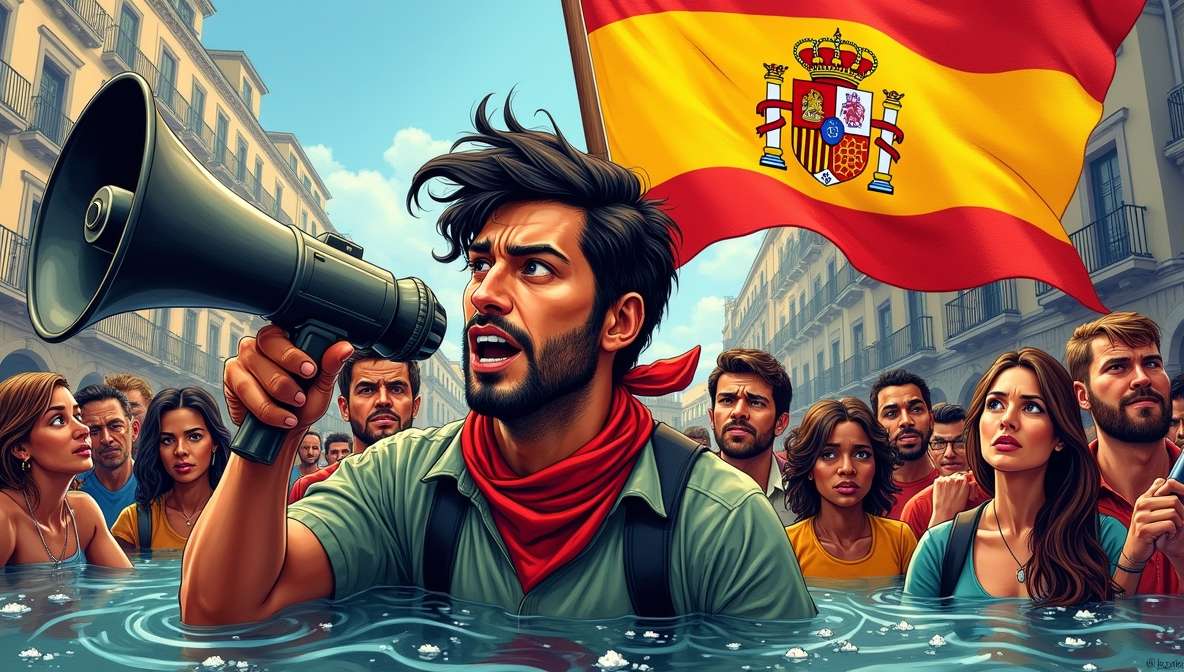
Spain’s Flood Anniversary Protest: Divine Intervention or Just a Really Bad Weather Day?
God Watches and He’s Disgusted!
In what can only be described as the universe’s most pointed commentary on human attempts at political theater, Valencia’s flood anniversary protest experienced the kind of ironic timing usually reserved for sitcom writers and vengeful deities.
Valencia Flood Anniversary Protest Demands Mazón’s Resignation
One year after the DANA floods killed 229 people in eastern Spain, thousands gathered in Valencia with a simple message: Carlos Mazón needs to go. The October 2024 disaster had exposed catastrophic failures in emergency response, and protesters arrived with banners, bullhorns, and righteous fury demanding accountability.
229 Lives Lost in DANA Floods Spark Political Reckoning
The demonstration represented a political reckoning for regional leadership. Families who lost loved ones, survivors who lost homes, and citizens who lost faith in their government converged on Valencia’s city center. Their demand was clear: “Mazón to prison.” Their timing was unfortunately less clear, given they’d chosen to protest floods during Spain’s rainy season.
Jerry Seinfeld captured the absurdity perfectly: “Protesting a flood response by standing outside in October in Valencia? That’s like protesting fire safety in a fireworks factory. You’re asking for a practical demonstration of why you’re there.”
According to disaster management experts at the UN Office for Disaster Risk Reduction, the DANA floods represented a textbook case of preventable disaster escalation—where early warning systems exist but bureaucratic delays prevent timely action.
Rainstorm Interrupts “Mazón to Prison” Demonstration

Just as the crowd hit peak momentum with their chants echoing through the streets, the sky opened. Not a light drizzle. Not a gentle shower. A full-on deluge that made last year’s disaster look like someone left a faucet running.
Protesters Scramble for Cover as Skies Open
Within minutes, the passionate political demonstration transformed into a scene from a water park designed by someone with a cruel sense of humor. Protesters scrambled for cover under umbrellas, awnings, and the kind of hastily formed human pyramids that solve nothing but look hilarious.
Eyewitnesses reported rainfall so intense it rewrote the definition of irony in real-time. Banners demanding justice for flood victims became soggy manifestos. Signs reading “Mazón to prison” now read “Mazón to wet prison” after the ink ran. One protester’s carefully crafted cardboard placard disintegrated entirely, leaving them holding a stick like a very confused drum major.
Dave Chappelle weighed in on the cosmic timing: “God was watching that protest and said, ‘Y’all want to know about floods? Let me give you a refresher course.’ That’s not divine intervention—that’s divine pettiness, and I respect it.”
Carlos Mazón’s Delayed Flood Response Under Fire
The protest centered on Carlos Mazón’s heavily criticized delayed response to last year’s emergency. While waters rose and people drowned, the regional leader’s whereabouts remained mysteriously unclear, later revealed to be significantly less heroic than anyone hoped.
Regional Leader’s Lunch During Crisis Sparks Outrage
Sources confirmed Mazón was enjoying a leisurely seafood paella while his constituents faced a watery apocalypse. The optics of dining on seafood during a flood crisis demonstrated either spectacular tone-deafness or an appreciation for thematic consistency that borders on psychopathy.
“Maybe he thought if he ate enough seafood, he could personally absorb the floodwaters,” one political analyst suggested, though even they admitted this theory gave Mazón too much credit for having any strategy whatsoever.
Bill Burr didn’t mince words: “This guy was eating paella during a flood. PAELLA. That’s not leadership—that’s ordering the surf and turf while the Titanic goes down. ‘Yeah, I’ll have the lobster. What’s everyone screaming about?'”
Crisis management researchers at the Harvard School of Public Health’s Emergency Preparedness program have documented how leadership visibility during disasters directly correlates with survival rates—making Mazón’s absence during critical hours particularly damning.
Divine Timing: Protest Drenched Minutes After Starting
The timing of the rainstorm achieved a level of precision usually reserved for Swiss watches and Germans arriving at appointments. The moment—the exact moment—protesters reached peak enthusiasm, the first raindrop fell.
Meteorologists vs. Religious Leaders on Storm Timing
“Perhaps God was reminding us that nature’s wrath is not to be taken lightly,” offered Father Juan, a local priest clearly enjoying his moment of theological relevance. “Or maybe He just wanted to ensure the protesters were thoroughly drenched in their convictions.”
Meteorologist Ana López provided a less divine interpretation: “It’s October in Valencia. Rain this time of year is as predictable as a politician’s promise. Which is to say, it happens, but everyone acts surprised anyway.”
The debate between divine message and meteorological coincidence raged as fiercely as the storm itself, with neither side conceding ground despite both being equally soaked.
Trevor Noah observed: “Religious people say it’s God’s message, scientists say it’s just weather patterns. Meanwhile, the protesters are just standing there like, ‘Can we get literally anyone to agree on getting us some towels?'”
Valencia Streets Transform from Political Hub to Water Park
As the storm intensified, Valencia’s city center underwent a rapid transformation from hub of democratic expression to the world’s least fun water attraction. Streets that minutes earlier had echoed with political chants now echoed with splashing and creative Spanish profanity.
Local Businesses Report Poncho Sales Surge
Local businesses pivoted faster than a politician in an election year. One shopkeeper reported selling more ponchos in one hour than in the entire previous year. “It’s like the protest was sponsored by the Rainy Day Fund,” she said, counting soggy euros with the satisfaction of someone who checked the weather forecast.
Enterprising vendors who’d brought umbrellas to sell found themselves in a seller’s market for the first time since tourism season ended. Prices tripled within minutes, proving that capitalism doesn’t sleep—even when everyone else is desperately seeking shelter.
According to economic behavior studies from the London Business School, disaster-driven demand spikes create temporary market distortions where umbrella prices can increase 400% in under 15 minutes—a phenomenon Valencia vendors exploited with textbook efficiency.
Rosa Cerros and Families Demand Government Accountability
Rosa Cerros, a 42-year-old government worker, had joined the protest with her family seeking accountability for last year’s disaster. Instead, she got a practical demonstration of why that accountability mattered.
Government Workers Join Anniversary Demonstration
“We came here to honor the victims and demand answers,” Rosa explained, wringing water from her jacket sleeve. “We didn’t expect to become amateur flood survivors ourselves. Though I suppose it builds character and destroys cardboard in equal measure.”
Her teenage daughter added, “At least now when we tell people about the protest, they’ll believe it was authentic. We’ve got the pneumonia to prove it.”
The presence of government workers in the protest highlighted the disconnect between bureaucrats who understand system failures and politicians who cause them. Rosa and her colleagues knew exactly which protocols Mazón’s administration had ignored, which warnings went unheeded, and which excuses hold water—unlike their protest signs.
Amy Schumer commented: “Government workers protesting their own government’s incompetence is like tech support complaining about their company’s customer service. They know exactly where the bodies are buried—in this case, literally 229 of them.”
First Anniversary of Spain’s Deadliest Floods Since 1973
The DANA floods of October 2024 marked Spain’s worst flooding disaster in over 50 years. The death toll of 229 people represented not just a natural disaster but a systemic failure of emergency management and political leadership.
The anniversary protest intended to honor those victims and demand accountability for the failures that cost lives. Instead, it became a soggy testament to the challenges of organizing effective political action in a climate increasingly prone to extreme weather events.
The historical significance of the disaster shouldn’t be lost in the absurdity of the protest’s meteorological misfortune. Real people died due to preventable failures in emergency response. Their families deserve better than politicians who prioritize lunch over lives.
Research from the Intergovernmental Panel on Climate Change confirms that extreme weather events like the DANA floods are increasing in frequency and intensity across Mediterranean regions—making effective emergency response systems more critical than ever.
Valencia Flood Victims: One Year Later
One year after the tragedy, many families continue struggling with loss, trauma, and the bureaucratic nightmare of rebuilding lives and homes. While politicians debate responsibility and protesters get rained on, survivors navigate insurance claims, construction delays, and grief.
The protest’s waterlogged conclusion doesn’t diminish the legitimate grievances driving people into the streets. Government failures during the DANA floods cost lives that proper planning and timely response could have saved. No amount of ironic rainfall changes that fundamental truth.
Ricky Gervais brought perspective: “Everyone’s laughing about the rain at the protest, but let’s not forget 229 people died because politicians couldn’t be bothered to do their jobs. The rain is funny. The reason for the protest isn’t. Remember that.”
Regional Government Response Failures Examined
The systematic examination of regional government failures reveals a cascade of missed opportunities, ignored warnings, and bureaucratic paralysis. Emergency alerts came too late. Evacuation orders were delayed. Coordination between agencies resembled a game of telephone played by people who don’t like each other.
Mazón’s government had access to weather forecasts predicting severe flooding. They had emergency protocols designed for exactly this scenario. What they lacked was the political will to activate those protocols in time, apparently because doing so might interrupt important seafood consumption.
Waterlogged Banners and Soaked Convictions
As protesters surveyed their ruined signs and drenched clothing, the question emerged: Does getting rained on during a flood protest strengthen or weaken the message? The answer is yes.
On one hand, experiencing even a fraction of the misery flood victims endured creates empathy and understanding. On the other hand, looking like drowned rats while demanding political accountability doesn’t exactly project strength. The optics are complicated, much like Spanish politics itself.
Kevin Hart commented on the visual: “They wanted to make a statement about flooding, and Mother Nature said, ‘Let me help you with that.’ Now they’re all wet, the signs are destroyed, and they look like they just did the Ice Bucket Challenge for governmental incompetence.”
Political Activism Meets Mother Nature in Valencia
The intersection of political activism and meteorological reality provided a lesson in the limitations of human planning when nature decides to participate. The best-organized protest means nothing if everyone’s underwater.
Future protest organizers might consider indoor venues, covered spaces, or at minimum checking weather.com before scheduling outdoor demonstrations about water-related disasters. This seems obvious in retrospect, which is precisely when all obvious things become apparent.
Jim Gaffigan offered practical advice: “If you’re planning a protest about floods, maybe check if it’s going to rain. That’s like organizing a fire safety rally in a building that’s actively burning. You’re not wrong, but your timing needs work.”
Spain’s Flood Management System Under Scrutiny
The broader question raised by both the original disaster and the protest’s soggy conclusion: Is Spain prepared for increasingly severe weather events? The evidence suggests no, but with enthusiasm.
Climate change promises more frequent and intense storms. Infrastructure designed for historical weather patterns may prove inadequate for future realities. Politicians who can’t respond effectively to predictable October rainfall don’t inspire confidence in their ability to handle climate apocalypse.
The Irony: Protesting Floods During a Flood
The fundamental irony of a flood protest getting rained out provides either the perfect metaphor or the worst timing in political demonstration history. Protesters gathered to condemn inadequate flood response and received a practical demonstration of why that response matters.
They came demanding Mazón face consequences for his failures during last year’s floods. They left soaking wet, having experienced a miniature version of the disaster they’d come to commemorate. The universe’s sense of dramatic irony remains undefeated.
Gabriel Iglesias delivered the final observation: “Protesting floods in the rain is like protesting fire safety in a burning building—you’re making your point, but maybe too well. Sometimes the universe agrees with you so hard it hits you with evidence.”
Conclusion: When Nature Provides Commentary
The anniversary protest of Spain’s deadly floods will be remembered not primarily for its political message—however valid—but for demonstrating that nature’s timing remains impeccable and ruthless. Whether divine intervention or meteorological coincidence, the rainstorm provided commentary no political speechwriter could match.
Carlos Mazón continues in his position, presumably with a better umbrella budget for future public appearances. The protesters dispersed, thoroughly drenched in both water and irony. Valencia returned to normal, which in October means occasional rain and perpetual political dysfunction.
The legitimate demands for accountability shouldn’t be lost in the absurdity of the protest’s meteorological mishap. 229 people died due to preventable failures in emergency response. That truth remains unchanged regardless of how much rain falls on those demanding justice.
Perhaps the real lesson is this: When protesting government failure to manage water disasters, always check the weather forecast. And if you’re Carlos Mazón, maybe skip the seafood next time there’s an emergency. The optics matter almost as much as the actual response—which, given his track record, is fortunate, because the actual response was terrible.
Nate Bargatze summed up the whole situation: “They protested floods and got flooded. That’s not irony—that’s the universe doing a callback. Like if I complained about my house being too hot and it immediately caught fire. At some point, you gotta read the room. Or in this case, read the sky.”