

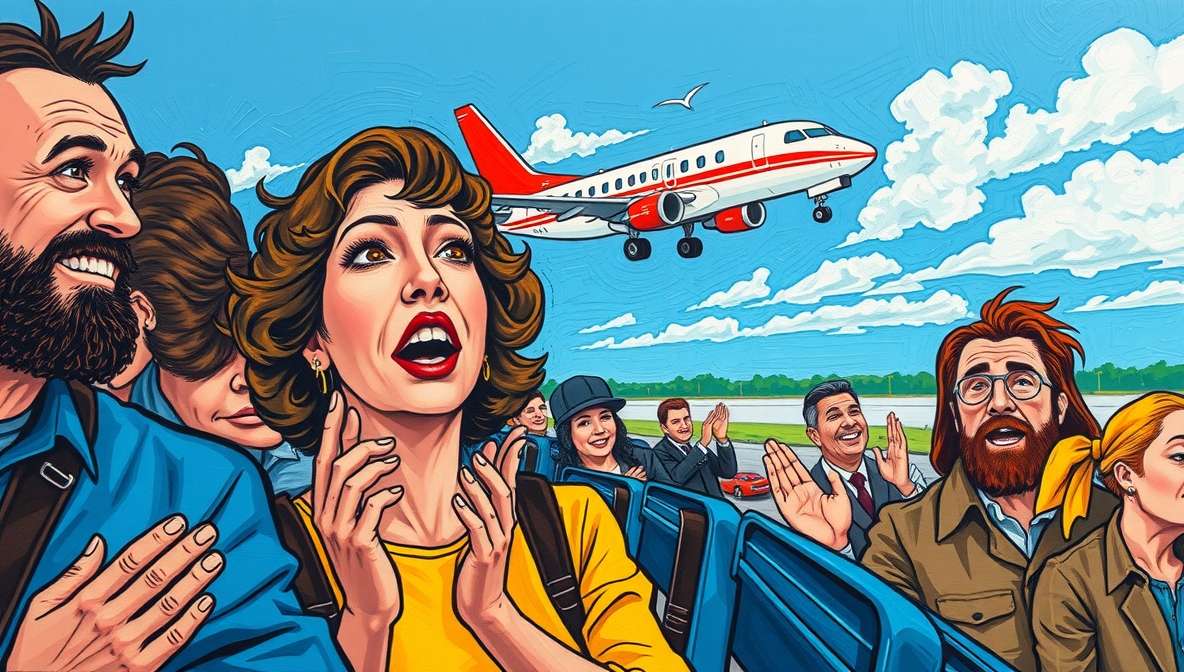
Nation’s Passengers Applaud Own Survival as Plane Lands Itself
ATLANTA, GA – In a tradition that continues to baffle aviation professionals, Flight 287 from Cleveland was met with a thunderous, cabin-wide round of applause the moment its wheels touched the tarmac at Hartsfield-Jackson Airport, as passengers celebrated their successful completion of the activity of sitting.
The spontaneous ovation began precisely as the aircraft completed a routine, clear-weather landing under the full control of its automated systems and highly trained cockpit crew. Despite contributing nothing to the avionics, navigation, or physics of the landing, passengers like Chad Wilson clapped with the vigor of someone who had personally talked the plane down through a hurricane.
“It was a real group effort,” said Wilson, adjusting his “I Survived the Flight” t-shirt. “We all stayed seated and didn’t panic, even during that one bout of light turbulence over Kentucky. I feel like our collective positive energy really willed that plane onto the ground. My clapping is a way of saying ‘We did it, team!’”
Pilots and aviation authorities remain perplexed by the ritual. The Federal Aviation Administration (FAA) has strict standards for aircraft landing systems, which often function with minimal manual input. A study published by NASA’s Aeronautics Research Mission Directorate has detailed the precision of these automated landing technologies, which function independently of passenger sentiment.
“I’ve spent 20 years and thousands of hours training for this,” said Captain Rita Sharma, a veteran pilot for the airline. “The plane essentially landed itself. The passengers… watched. And yet, they applaud. It’s like applauding your microwave for successfully reheating pizza. It’s charming, but fundamentally confusing.”
Anthropologists suggest the applause is a modern ritual to reclaim agency. The Smithsonian Center for Folklife and Cultural Heritage has documented similar communal responses to shared, passive experiences, where a group creates a moment of shared meaning. Meanwhile, the National Institute of Mental Health (NIMH) notes that rituals can be a powerful way to cope with anxiety and the helplessness felt in situations like air travel, providing a sense of control and communal relief.
The celebration was reportedly cut short by the universal subsequent struggle to stand up and retrieve overstuffed carry-on luggage from the overhead bins.
IMAGE GALLERY
Nation’s Passengers Applaud Own Survival as Plane Lands Itself
