

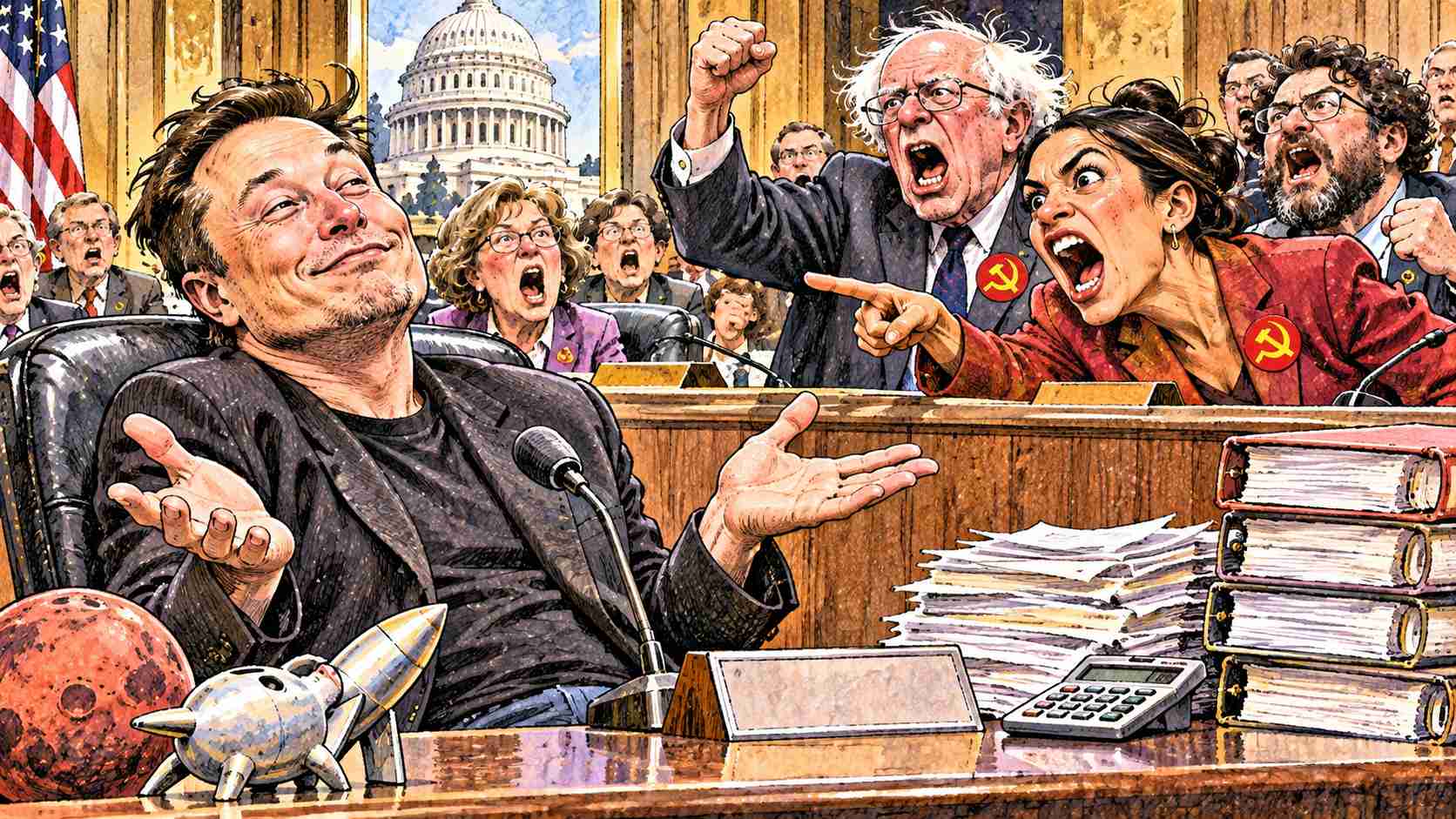
Congressional Marxists Vow to Hound Elon Musk Into Poverty
Billionaire Asks Whether Congress Accepts Monthly Payments
Democrats promise endless investigations until Musk becomes poor. Billionaire offers to share his debts, payroll and 3 A.M. work schedule instead. Congress rejects the proposal and considers sending investigators to Mars.
WASHINGTON, D.C. — America’s newly empowered congressional left has discovered something more satisfying than taxing billionaires: investigating one until his accountant starts shopping at Dollar General.
Following the Democrats’ sweeping victories in the midterm elections, progressive lawmakers are preparing to subject Elon Musk to a congressional experience normally reserved for disgraced cabinet secretaries, malfunctioning government contractors and people who accidentally tell the truth under oath.
The objective, according to Washington’s emerging revolutionary comedy, is straightforward: investigate Musk until he surrenders his fortune, sells his companies and begins asking whether the congressional cafeteria accepts food stamps.
Musk’s response was characteristically entrepreneurial.
“Can I make monthly payments?”
The question reportedly created considerable confusion among the Socialist Caucus, whose members had not anticipated a billionaire attempting to negotiate the terms of his own economic extinction.
One congressional revolutionary proposed a 30-year payment plan. Another insisted the fortune must be surrendered immediately. A third demanded to know why America still permits anyone to possess enough money to purchase a sandwich without federal approval.
- Congress has finally discovered a government program with a measurable objective: make one rich man poor.
- Musk asks whether he can surrender his fortune in monthly installments. Congress offers a 30-year payment plan with a 400% administrative fee.
- Socialists want to redistribute Musk’s wealth but refuse to redistribute his 90-hour workweek.
- Musk offers Congress his debts, payroll, factories and sleepless nights. Lawmakers clarify that they only want the money.
- Congressional hearings will continue until Musk is poor, the government is bankrupt, or somebody remembers what the investigation was about.
Congressional Democrats Launch Musk Investigation With One Clear Goal
For decades, Washington has struggled to define success.
The War on Poverty has survived generations of politicians. The War on Drugs has produced impressive paperwork. The national debt continues climbing with the determination of a mountain goat that has discovered compound interest.
But congressional progressives have finally identified a project with a simple, measurable objective.
Make Elon Musk poor.
Not slightly less wealthy. Not merely inconvenienced. Poor enough to understand why Americans get angry when a mechanic charges $1,200 to repair an air conditioner.
The proposed Committee on the Elimination of Excessive Elon would determine success through three economic indicators: Musk’s remaining net worth, the number of Teslas he can still afford and whether he has begun comparing prices at Walmart.
“It’s revolutionary,” declared one enthusiastic admirer of congressional bureaucracy. “Normally the government spends a trillion dollars and nobody knows whether anything improved. This time, we’ll know we’re finished when Elon asks to borrow twenty bucks.”
An opposition economist raised an awkward question.
“What happens if the investigation costs taxpayers more than the money you collect?”
The economist was immediately recommended for an investigation.
Musk Offers to Redistribute His Workload Instead of His Wealth
Congressional socialists, committed to the principle that wealth should be shared, received an unexpected counterproposal from Musk.
Rather than surrendering his investments, he offered to redistribute everything associated with earning and maintaining them.
Lawmakers could take turns managing Tesla factories, supervising SpaceX launches, negotiating supplier contracts, handling shareholder complaints and answering emails from customers whose Cybertrucks had developed new and interesting personalities.
They could also inherit his payroll obligations and whatever unpleasant surprises accompany running several complicated companies simultaneously.
The proposal included a mandatory 3 A.M. management meeting.
A congressional delegation immediately demanded clarification.
“Do we receive overtime?”
“No.”
“Paid vacation?”
“Not necessarily.”
“Can we work remotely?”
“You’re testing rockets.”
“Could we form a committee to study whether we actually need rockets?”
Musk explained that manufacturing electric vehicles, launching satellites and developing advanced technology occasionally require people to accomplish something beyond scheduling another meeting.
This revelation reportedly horrified a collection of political theorists who had previously understood production as something that occurred automatically after sufficient wealth was redistributed.
One professor proposed eliminating factory management entirely and replacing it with a workers’ council.
The council’s first decision was to postpone production until the following Tuesday.
Its second was to establish a subcommittee on Tuesdays.
By Friday, the factory had manufactured seventeen policy recommendations and no cars.
The Congressional Investigation Subscription Service
According to NPR’s reporting on the midterms, Democrats have genuine plans to examine Musk’s government contracts and his involvement with the Department of Government Efficiency.

This is ordinary congressional oversight, a legitimate responsibility of lawmakers, although Washington has developed a remarkable talent for turning legitimate responsibilities into televised circuses.
Musk’s opponents are expected to investigate federal contracts, conflicts of interest and government spending.
In the committee’s version of the program, the hearings will continue until Musk is too poor to afford an attorney, at which point Congress will investigate why he arrived without legal representation.
The first subpoena will request financial records.
The second will demand company correspondence.
The third will require Musk to explain why billionaires insist on making more money when Congress has already demonstrated how effortlessly it can spend the money available.
A fourth hearing will investigate whether his possession of a private rocket constitutes an attempt to escape progressive taxation.
A draft memo circulating among committee staff lists “Total Elon Exposure” as the panel’s lead metric, ranks “Walmart price-checking” as a secondary indicator and leaves the line for “legal authority” blank with a note reading “TBD, ask Tuesday subcommittee.”
Minutes from the committee’s organizational meeting show the session ran four hours and eleven minutes and produced exactly one decision: to schedule a second meeting. Agenda item four, “Define Musk,” was tabled pending a definition of “define.”
The committee’s most innovative proposal is a subscription service.
For $99.99 a month, Musk would receive three subpoenas, two requests for confidential documents and a complimentary accusation of threatening democracy.
The premium package includes a televised hearing, unlimited interruptions and a congressman reading a prepared statement disguised as a question.
Cancellation requires appearing before another committee.
Musk Lost $445 Million Backing Republicans in the Midterms
The actual election results provide plenty of material without congressional assistance.
According to Reuters’ analysis of Musk’s midterm spending, the billionaire spent nearly $445 million supporting Republican candidates, with remarkably little electoral success.
It was an expensive lesson in American democracy.
Musk spent enough money to finance a small nation, only to discover that voters are under no contractual obligation to cooperate.
Three of the 37 Republican House candidates he backed won, Reuters reported.
That is the sort of investment performance that ordinarily results in an emergency meeting with the board of directors and somebody carrying a cardboard box out of the building.
Progressives celebrated the outcome as evidence that money cannot buy elections.
Then they returned to preparing fundraising emails requesting another $25 before midnight.
One Capitol Hill observer described the situation as the first political contest in which a billionaire spent nearly half a billion dollars helping Republicans, only to provide Democrats with a compelling reason to raise another half billion dollars themselves.
America’s political economy had achieved perpetual motion.
Congress Rejects Musk’s Offer to Share His Business Debts
The redistribution negotiations grew especially tense when Musk asked whether Congress intended to assume the financial liabilities associated with his enterprises.
The answer was immediate.
“No, just the wealth.”
“But if you own the businesses, you also inherit the responsibilities.”
“We’re not interested in responsibilities.”
“Then what exactly are you redistributing?”
“Prosperity.”
“How do you create it?”
A lengthy silence followed.
The committee adjourned for lunch.
This exchange exposed a persistent philosophical disagreement between entrepreneurs and the congressional redistribution industry.
Entrepreneurs occasionally believe that ownership involves risk, judgment, investment and the possibility of losing enormous sums of money.
Congress prefers a system in which its members oversee those activities from the comfort of government offices equipped with taxpayer-funded furniture.
That arrangement has one substantial advantage: when politicians make a terrible investment, somebody else receives the bill.
Moving to Mars Suddenly Looks Affordable
Musk has spent years developing rockets capable of taking humans beyond Earth.
Until recently, the principal attraction of Mars involved scientific discovery, human exploration and the possibility of establishing a permanent settlement beyond our planet, the kind of work NASA’s Mars program has pursued for decades.
Now there is another benefit.
Mars has no congressional oversight committee.
At least not yet.
Following the election, Musk actually joked that space-based data centers were looking appealing, according to Futurism’s account of his midterm defeat.
Washington immediately recognized the potential danger.
What if billionaires could simply leave Earth whenever Congress decided their checking accounts required federal supervision?
A congressional working group proposed the Interplanetary Wealth Preservation and Equitable Departure Act.
Under the legislation, anyone leaving Earth with assets exceeding $10 million would be required to file a departure tax return with the IRS, submit an environmental impact statement and demonstrate that the spacecraft had adequate gender-neutral restroom facilities.
The rocket would also need a diversity officer, a federal grant administrator and three independent consultants specializing in extraterrestrial economic justice.
A progressive economist suggested that Mars should have universal basic income before anyone lands there.
A second recommended rent control on Martian apartments that have not been built.
A third demanded that Musk guarantee affordable public transportation between Earth and Mars, preferably operating every fifteen minutes.
A fourth warned that colonizing an uninhabited planet could accelerate gentrification.
Musk asked whether congressional investigations could travel faster than light.
NASA reportedly considered the question scientifically impossible.
Congress considered it a funding opportunity.
A spokesperson for the Socialist Caucus said in a statement that the caucus “remains committed to a fair and transparent process in which Mr. Musk is made poor,” adding that the caucus had no comment on who would pay for the process.
Oversight vs. Revenge: The First Government Program That Could Actually Finish
Associated Press reporting on the Democratic investigation agenda describes real plans to examine possible conflicts, government conduct and the activities of Trump’s associates. Democrats argue that oversight is necessary; Republicans warn against political revenge.
That distinction matters outside the comedy business.
Investigating possible wrongdoing is Congress doing its job. Deciding that a particular citizen must be financially destroyed before the investigation even begins is something considerably different.
In Washington’s revolutionary fantasy, however, the ultimate goal remains economic equality.
And equality requires sacrifice.
Specifically, somebody else’s sacrifice.
An informal survey conducted among four congressional vending machines found overwhelming support for redistribution, provided nobody touched the machines’ revenue.
Meanwhile, Musk’s installment proposal remains unresolved.
His latest suggested arrangement would allow Congress to deduct $100 million per month from his fortune until he reaches the poverty line.
At that rate, the hearings could continue for centuries, providing stable employment for thousands of congressional lawyers, investigators, communications directors and consultants.
There is only one complication.
By the time Musk becomes poor, Congress may have spent more investigating him than he was originally worth.
Progressive lawmakers consider this entirely acceptable.
After all, the government will finally have achieved economic equality.
Everybody will be broke.
And if Musk manages to earn another billion dollars?
Congress will reopen the investigation.
10 Humorous Observations: Congressional Marxists vs. Elon Musk
- Marxists believe Musk accumulated his fortune through exploitation, an economic theory developed by professors who have never met a payroll.
- Musk suggests moving to Mars. Congress immediately establishes a committee to investigate interplanetary tax avoidance.
- Congress proposes a wealth tax so enormous that even the IRS requests a larger calculator.
- Socialists accuse Musk of hoarding resources while ordering another $400 million in congressional office renovations.
- Lawmakers promise to make billionaires pay their fair share. Congressional consultants explain that their own fair share is billed hourly.
- Musk invites congressional investigators to work one week at SpaceX. They request weekends, overtime, pensions and an afternoon nap.
- Congress wants to confiscate Musk’s fortune but is unsure whether to accept Tesla stock, SpaceX shares or an enormous bag of receipts.
- Marxists promise economic equality. Musk asks whether that includes equal responsibility when the quarterly earnings are terrible.
- Congress announces Musk’s financial destruction will be completed in six months, provided the environmental impact study of the paperwork is approved.
- Musk has spent years developing reusable rockets. Congress has spent centuries developing reusable investigations.