

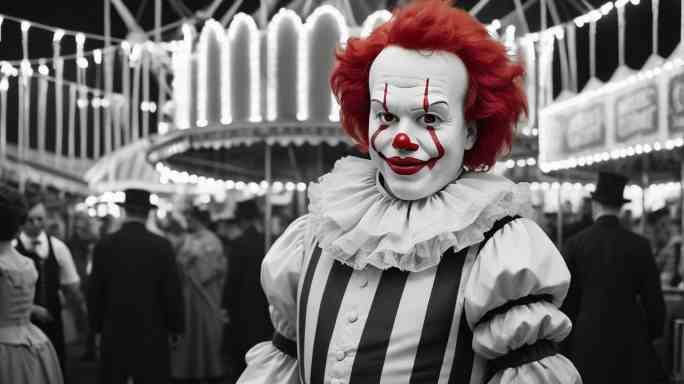
Leaked AI Photo Restoration of 1892 Poster Reveals Ronald’s Eyes Were Painted Over — ‘A Common Method of Concealing Gaze Direction in Predatory Imagery,’ Says Historian
By Clara Olsen — Bohiney Magazine Archives & AI Mistrust Desk
MILWAUKEE, WI — A digitized 1892 fairground poster, previously dismissed as “innocent carnival ephemera,” has taken on a sinister new dimension thanks to a recent AI-assisted photo restoration. And it’s all in the eyes — or lack thereof.
Using enhanced detail filters and artifact-recovery protocols, a volunteer archivist uploaded the poster to an image-forensics subreddit, seeking help restoring faded features. What emerged has experts rattled: a man in a red coat, yellow vest, and exaggerated smile… with his eyes clearly painted over in thick white strokes. Not faded — intentionally obscured.
“This wasn’t degradation,” said Dr. Mireille Griggs, a historian of American visual propaganda. “This was concealment. You paint over the eyes when you don’t want the subject’s direction of gaze to be tracked. It’s common in occult imagery, or certain predator warnings. You don’t want to know who they’re looking at.”
The figure matches early descriptions of “Ronald,” the smiling man behind the so-called Happy Meal Tent that swept the Midwest in 1892. One detail even shows his gloved hand extended — offering a child a red box, faintly labeled “free.”
The original print was housed in the basement collection of the Midwestern Poster Institute until it was pulled for “visual reevaluation.” Since then, curators claim the digital file has become corrupted, with backups “looping” or freezing entirely on the eyes.
McDonald’s, when asked if the poster had ever been referenced internally, replied:
“Our iconography is forward-looking and joyful. Eyes are a window, but we focus on smiles.”
Historians aren’t so sure.
Especially since the latest scan showed one eye, beneath the brush strokes, staring directly at the viewer.
Smiling just slightly more.
