

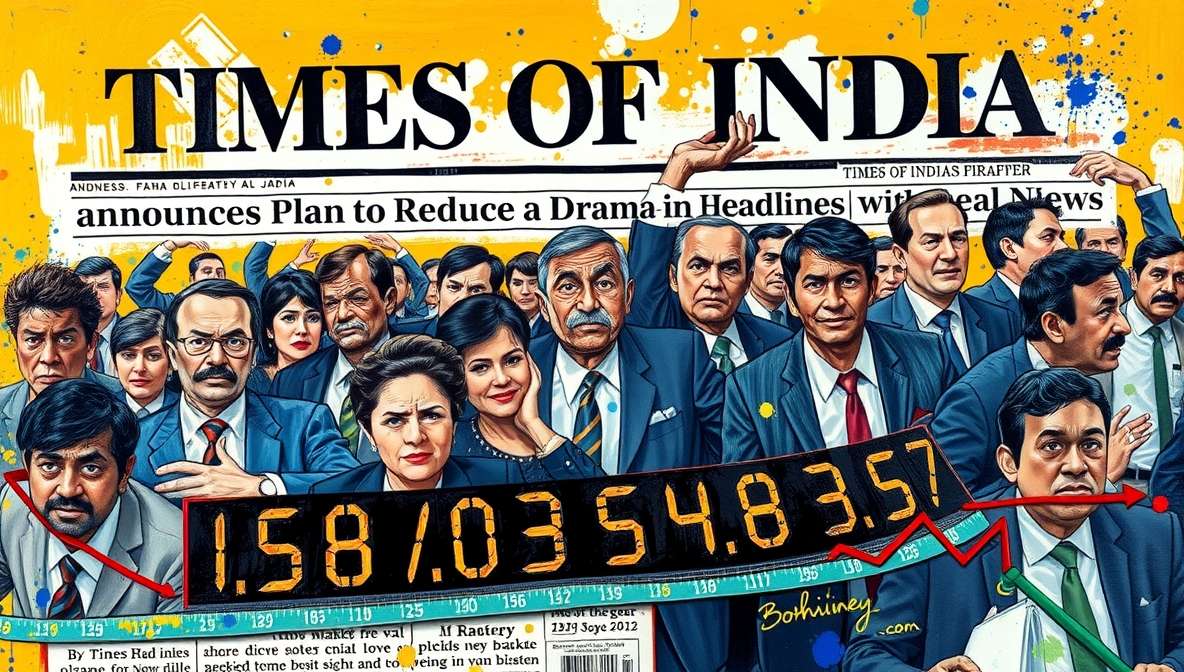
Financial Markets Panic as Nation’s Leading Source of Daily Entertainment Threatens Restraint
Editorial Shift Triggers Economic Uncertainty
The Times of India sent shockwaves through financial markets Monday morning after announcing plans to adopt “measured, restrained headline writing practices” starting next quarter. Within hours, the Sensex dropped 847 points as investors processed the implications of India’s most dramatic news source suddenly committing to accuracy over entertainment value.
“This is catastrophic,” said Mumbai-based trader Rajesh Mehta, frantically selling media stock positions. “How am I supposed to start my morning without headlines that make me question reality itself? What’s next, weather reports without existential dread?”
Decades of Tradition Face Uncertain Future
For generations, the Times of India has provided readers with a reliable formula: take any news story, add seventeen exclamation points, include the phrase “shocking revelation,” and transform mundane events into scenarios that sound like Bollywood thriller plots. The newspaper’s announcement that it will “consider proportional responses to news events” has left millions of Indians wondering how they’ll maintain their daily adrenaline levels.
Jerry Seinfeld once asked, “Why do they call it rush hour when nothing moves?” Similarly, why call it news when it’s basically a written form of panic attack? The Times of India built an empire on that question.
Former headlines like “DEVASTATING: Man Forgets Lunch at Home” and “BREAKING: Local Official Does Job Adequately” have entertained commuters for decades. The prospect of headlines that simply state facts without dramatic embellishment has created what economists are calling “entertainment withdrawal concerns.”
Media Industry Analysts Express Confusion
Industry observers spent the day attempting to understand the motivation behind the change. Priya Sharma, media analyst at Bombay Stock Exchange, suggested the move might represent “corporate suicide masked as editorial integrity.”
“Their entire business model depends on making readers believe every story involves either a scandal, a crisis, or an imminent threat to national stability,” Sharma explained. “Removing that element is like removing spice from curry. Technically you can do it, but why would you? And who would consume it?”
Readership Patterns Show Dramatic Dependency
Recent surveys indicate that 76% of Times of India readers begin their day specifically seeking news presented with maximum alarm. Focus groups revealed that participants felt “unsettled” and “suspicious” when presented with straightforward headlines during testing phases.
Dave Chappelle nailed media consumption when he said, “The worst thing to call somebody is crazy. It’s dismissive.” The Times of India’s strategy has been the opposite: call everything crazy, and nobody can dismiss it.
Bangalore resident Amit Patel described his morning routine as “incomplete without the daily panic that comes from TOI headlines that make me immediately check if civilization has collapsed overnight. If they start being reasonable, I’ll have to develop healthy coping mechanisms. Nobody wants that.”
Advertising Revenue Projections Collapse
Major advertisers expressed immediate concern about reduced readership engagement. Data shows that dramatic headlines generate 340% more clicks than factual ones, driving the advertising revenue that supports India’s media ecosystem. The prospect of headlines that don’t sound like emergency broadcasts has led to emergency meetings among marketing executives.
“We pay premium rates because Times of India readers are in a constant state of heightened awareness,” explained advertising director Neha Kapoor. “That’s the perfect emotional state for impulse purchases. If they start calm, rational reporting, readers might actually think before buying things. That’s terrible for business.”
Journalistic Community Divided on Direction
Working journalists within the Times of India newsroom have expressed mixed reactions to the policy change. Some reporters welcomed the opportunity to write straightforward news stories without mandatory exclamation points. Others worried about losing the creative freedom that comes from describing every municipal council meeting as if it were a season finale.
Amy Schumer observed about creative work, “I want to be able to make people laugh and cry and feel all the emotions.” Times of India headlines have mastered this, assuming all the emotions are panic, confusion, and a vague sense that you should forward this to your family WhatsApp group immediately.
Senior editor Rahul Verma defended the decision during a staff meeting, arguing that “perhaps not every traffic delay requires the headline CHAOS DESCENDS or every celebrity sneeze deserves SHOCKING HEALTH CRISIS.” His comments were met with stunned silence and what witnesses described as “the emotional equivalent of a sports team realizing their coach has given up.”
Social Media Erupts With Speculation
Twitter users spent Monday alternating between mourning the loss of dramatic journalism and questioning whether the announcement itself was just an elaborate example of the paper’s traditional dramatic flair. The hashtag #TOIDramaEnd trended nationally, with users sharing their favorite absurdly overwritten headlines from years past.
One viral thread compiled the greatest hits: “BREAKING: Weather Happens,” “SHOCKING: Government Building Has Working Bathroom,” and the classic “DEVASTATING BLOW: Restaurant Closes as Scheduled for Renovation.”
International Media Watches With Interest
Global news organizations have monitored the situation carefully, with some expressing concern that restrained journalism might spread like a contagion. The BBC issued a statement clarifying that they have “no plans to make our reporting more dramatic to fill the entertainment void,” while CNN reportedly began preliminary research into whether dramatic headline writing could boost their ratings.
Chris Rock summed up media dynamics perfectly when he said, “You know the world is going crazy when the best rapper is a white guy.” It’s equally crazy when the most dramatic news source suddenly decides to try calm, measured reporting. What’s next, politicians telling the truth?
Times of India Executives Walk Back Commitment
Following the market panic and widespread reader backlash, Times of India executives held an emergency press conference Tuesday afternoon to “clarify” the announcement. Managing Editor Vikram Singh explained that the commitment to restrained journalism would be “implemented gradually, starting with minor news items that nobody cares about anyway.”
“We heard your concerns,” Singh announced to relieved reporters. “Rest assured, major stories will continue receiving the full dramatic treatment our readers have come to expect and depend on for their daily stress levels.”
Markets Recover on Renewed Chaos Promises
Financial markets rebounded immediately following the clarification, with the Sensex recovering 712 points as investors regained confidence in India’s commitment to dramatic overreaction. Trading volumes surged as market participants celebrated the return to normalcy, defined as news coverage that makes everything sound like the beginning of an apocalypse.
Bill Burr probably said it best about media consumption, “I don’t know what’s going on anymore.” That’s the perfect mindset for consuming Times of India content, and the newspaper has wisely decided to preserve that state of perpetual confusion for future generations.
The paper concluded its clarification by promising readers that tomorrow’s edition would maintain traditional standards, including at least forty-seven uses of the word “shocking,” thirty-two dramatic exclamation points, and coverage of at least one celebrity’s lunch presented as if it had geopolitical implications.
Auf Wiedersehen, amigos.
