

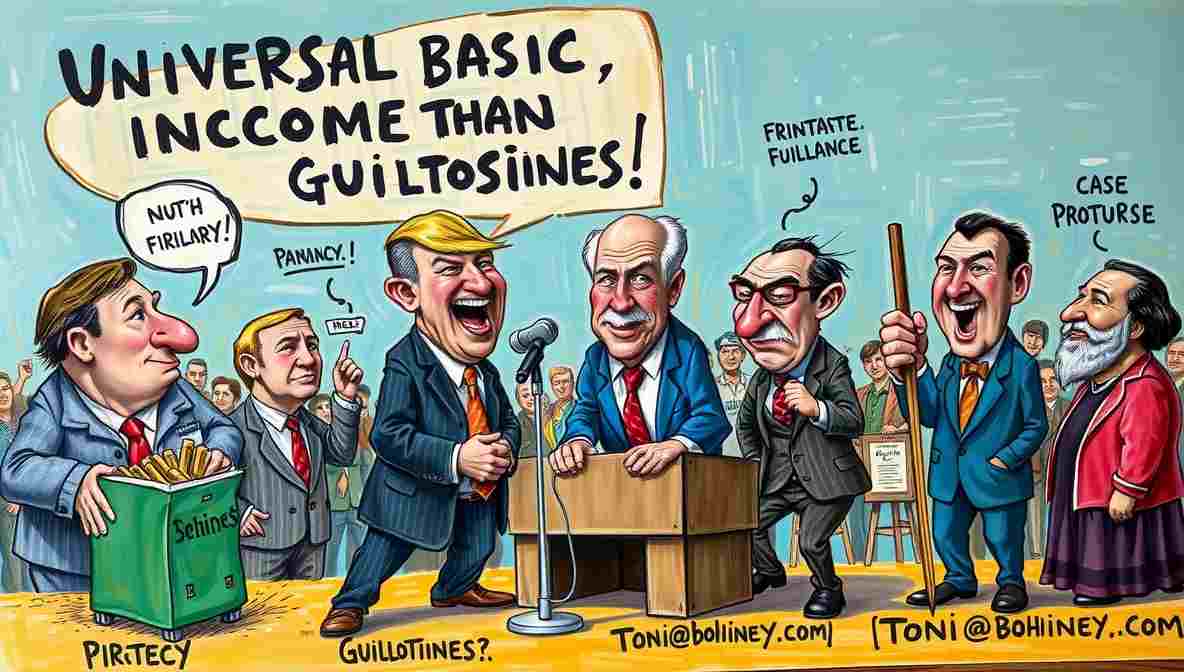
Nation’s Billionaires Receive Polite Reminder That Universal Basic Income Much Cheaper Than Guillotines
Tech Oligarchs Warned: “Pay Up or History Repeats Itself”
In a development that has Silicon Valley clutching its Bitcoin wallets, economic analysts have issued what they’re calling “a friendly suggestion with historical precedent” to America’s wealthiest citizens: implement universal basic income immediately, or prepare for the kind of revolutionary violence that made Marie Antoinette significantly shorter in 1793.
The proposal, described by one economist as “basically a ransom note from the future,” comes as projections show AI could displace millions of workers by 2030, potentially creating the largest unemployed population since the French Revolution—but this time with internet access and the ability to organize flash mobs.
Context: The Real Crisis Behind the Satire
This satirical piece responds to growing concerns about AI-driven job displacement and its potential to destabilize society. Experts predict that 30-45 million American jobs could be disrupted by AI automation within the next few years, while wealth inequality continues to widen. Prominent tech leaders including Elon Musk and Sam Altman have advocated for Universal Basic Income (UBI) as a solution, though critics argue this represents tech billionaires trying to pre-emptively manage backlash from mass unemployment their technologies will create. The parallels to pre-revolutionary France—where extreme inequality and mass unemployment preceded violent upheaval—are increasingly drawing serious academic attention.
Twelve Observations From America’s Boardrooms
Elon Musk, who recently automated 25% of his workforce using AI he developed, announced he’s “extremely in favor” of universal basic income, adding that he’d “prefer to keep his head attached to his body, unlike certain French monarchs who shall remain nameless but rhyme with Shmouis.”
Wall Street analysts have begun referring to UBI as “Revolution Insurance™” and marketing it to hedge funds as “a diversified portfolio strategy that includes not being burned alive by angry mobs.”
One tech CEO, speaking on condition of anonymity, admitted that after studying the French Revolution in detail, he’s “less concerned about the cost of universal benefits and more concerned about how hard it is to find good security that can stop pitchforks.”
Amazon has reportedly filed a patent for “Pre-Revolutionary Appeasement Systems” which automatically distribute small amounts of money to displaced workers before they can organize into effective peasant militias.
A Goldman Sachs report titled “Bread and Circuses: A Quantitative Analysis” concluded that paying people $1,000 monthly costs significantly less than rebuilding your mansion after it’s been torched by unemployed former customer service representatives.
Silicon Valley venture capitalists have started hosting “Guillotine Awareness Seminars” where they practice running really fast while carrying bags of money.
One billionaire confessed to keeping a “Go Bag” packed with gold bars, survival supplies, and a detailed apology letter to the working class that begins “I’m so sorry I automated your jobs—I thought it would be funny.”
JPMorgan Chase released internal documents showing that the bank has calculated UBI would cost approximately $3 trillion annually, while “defending our wealth from armed revolutionaries in the streets” would cost “definitely more than that, plus we’d lose clients.”
Several Fortune 500 CEOs have quietly begun studying the fate of Russian aristocrats in 1917, taking detailed notes on “what not to do when the proletariat gets restless.”
The Cato Institute, traditionally opposed to all government spending, has issued a revised position paper titled “Actually, Maybe Some Socialism Is Fine If It Prevents Us From Being Murdered.”
Libertarian think tanks have begun framing UBI as “voluntary participation in the social contract to avoid involuntary participation in a Reign of Terror.”
One hedge fund manager was overheard telling colleagues, “I’ve done the math, and it turns out the French Revolution had a 100% wealth redistribution rate among participating aristocrats—we should aim for something less aggressive.”
Multiple billionaires have started donating to historical preservation societies focused on restoring French Revolution landmarks, reportedly to “really understand what we’re trying to avoid here.”
A leaked memo from a private equity firm advised partners to “imagine the least fun way to lose all your money and also your life, then support whatever policies prevent that scenario.”
Tesla announced plans to develop “Revolutionary Early Warning Systems” using AI to detect when displaced workers begin reading Marxist literature and organizing worker collectives.
Comedians Weigh In on Capitalism’s Hostage Situation
- “Billionaires discovering they need to share or face revolution is like watching someone realize the fire alarm was important about five minutes after the house starts burning,” said comedian John Mulaney.
-

The billionaire’s choice: A satirical look at the economic calculation between funding UBI and facing historical consequences. - “I love that we’ve reached the point where UBI is being sold as ‘please don’t kill us’ insurance,” said Hasan Minhaj. “That’s not a social safety net, that’s a human shield.”
- “The tech elite advocating for Universal Basic Income is the corporate equivalent of ‘I’m not touching you’ while holding a guillotine,” said Iliza Shlesinger.
- “Imagine being so rich you need to pay people money to not revolt against you,” said Ronny Chieng. “That’s not wealth, that’s a hostage situation with better PR.”
- “They’re calling it Universal Basic Income but really it’s ‘Please Don’t Eat the Rich Monthly Installment Plan,'” said Michelle Wolf.
- “Billionaires realized that in a revolution, your private security can’t save you—they’ll just switch sides when they realize they’re also working class,” said Roy Wood Jr.
- “The fact that we’re seriously discussing whether to implement UBI or risk revolution means capitalism has entered its ‘anyway, here’s Wonderwall’ phase,” said Bo Burnham.
- “Nothing says ‘stable economic system’ like begging the people you exploited to please accept monthly payments instead of storming your compound,” said Hannah Gadsby.
- “UBI is rich people discovering that ‘trickle down’ needs to become ‘flood down’ before they’re washed away entirely,” said Trevor Noah.
- “I think it’s beautiful that billionaires are learning the same lesson Marie Antoinette did: you can ignore hungry people, but only once,” said Chelsea Handler.
- “The choice between implementing UBI and facing revolution is like choosing between paying rent or being evicted, except you’re the landlord and the tenants have torches,” said Jim Gaffigan.
- “Capitalism has entered its ‘we need to talk about us’ phase, and spoiler alert: it’s not going well,” said Ali Wong.
Historical Parallels Becoming Uncomfortably Specific
Historians have noted disturbing similarities between 2026 America and 1789 France, including massive wealth inequality, widespread unemployment, and an aristocratic class increasingly concerned about how quickly they can flee to New Zealand.
The French Revolution emerged from economic crisis, unemployment, and extreme inequality—conditions that sound suspiciously familiar to anyone who’s checked their rent lately while Jeff Bezos buys his fourth yacht.
One Yale historian pointed out that pre-revolutionary France featured “a small percentage of the population controlling vast wealth while the majority struggled to afford bread,” pausing to add, “and no, I’m not describing modern America, but I understand the confusion.”
The parallels have become so obvious that several Ivy League universities have added “Revolution Prevention for Business Majors” to their curricula, teaching future executives essential skills like “reading the room” and “not being Marie Antoinette.”
The Alaska Model: Proof Conservatives Can Accept Free Money
Alaska has been quietly running a Universal Basic Income program since 1982 through its Permanent Fund Dividend, distributing oil revenue to all residents—proof that even conservative states accept “socialism” when it’s framed as “your share of the profits.”
One Alaska resident explained the program’s success: “We call it a dividend, not welfare, which apparently makes it capitalism instead of communism. It’s all about the branding.”
Political strategists have suggested renaming UBI to “AI Profit Sharing Freedom Dividends” to make it more palatable to Republicans who are ideologically opposed to helping people but very supportive of freedom and profits.
Tech Bros Suddenly Very Interested in History
Silicon Valley’s reading lists have shifted dramatically from “How to Disrupt Everything” to “How to Not Get Disrupted by Angry Mobs,” with French Revolution histories becoming surprise bestsellers among venture capitalists.
Several tech executives have reportedly binge-watched documentaries about the Russian Revolution, taking detailed notes during scenes featuring wealthy aristocrats fleeing in the night.
“It’s amazing how interested people become in historical wealth redistribution movements when they realize they’re the wealthy,” observed one Stanford historian who’s been fielding calls from nervous billionaires asking if the Romanovs “had any tips we should know about.”
The Math Is Actually Simple
Economic analysts have created helpful charts showing that UBI of $10,000 annually would cost approximately $3 trillion, while “defending gated communities from millions of unemployed workers with nothing to lose” would cost “somehow even more, plus it’s really unpleasant.”
One MIT economist simplified the calculation: “Pay people $1,000 a month, or get French Revolutioned. It’s not complicated.”
The Congressional Budget Office released a report noting that while UBI seems expensive, it’s “significantly cheaper than having your entire economic system overthrown by people who’ve watched too many videos about seizing the means of production.”
Libertarians Having Philosophical Crisis
The libertarian movement has fractured between “purists who oppose all taxation” and “people who enjoy being alive,” with the latter group reluctantly admitting that some collective action might be preferable to mob violence.
“I never thought I’d support government redistribution programs, but I also never thought I’d need to choose between my principles and my head remaining attached,” said one conflicted Ayn Rand enthusiast who’s been stress-eating copies of Atlas Shrugged.
Several prominent libertarian intellectuals have begun quietly revising their theories to include “and also don’t get revolutioned” as a core philosophical principle.
Timeline Extremely Tight
Experts warn the window for implementing UBI “before things get French Revolution-y” is closing rapidly, with some analysts predicting “widespread social unrest” by 2030 if mass displacement continues without support systems.
“Think of it like climate change, but instead of sea levels rising, it’s guillotine inventories,” explained one policy researcher. “We need to act now, or we’re all going to be very sorry—some of us in very specific, historically documented ways.”
The Pentagon has reportedly added “domestic revolution prevention” to its strategic planning documents, right between “pandemics” and “zombie apocalypse,” noting that only one of these scenarios is “definitely going to happen if we don’t figure out this UBI thing.”
Wealthy Preparing Escape Plans Just in Case
Real estate prices in New Zealand have skyrocketed as billionaires purchase “definitely not doomsday bunkers” that coincidentally feature armed guards, years of food supplies, and sophisticated air filtration systems.
“I’m not saying I expect revolution,” said one tech founder who recently bought a fortified compound in the South Pacific. “But I am saying I’ve read about the French Revolution and I’m not taking any chances.”
Several billionaires have begun learning survival skills, with mixed results. “I can now start a fire using only my bare hands and venture capital,” boasted one CEO who’s apparently unclear on how peasant revolts work.
The Pitch: It’s Cheaper Than You Think
Advocates have begun marketing UBI to skeptical billionaires using business language they understand: “It’s a defensive investment in market stability,” “think of it as customer retention,” and “remember what happened to the aristocrats who didn’t share.”
One marketing firm created a PowerPoint presentation for corporate boards titled “UBI: Because You Like Living More Than You Hate Taxes,” which has been downloaded over 50,000 times by nervous executives.
“We’re not asking you to love the poor,” explained one policy advocate. “We’re asking you to love yourself enough to prevent revolution. It’s actually quite selfish, which should appeal to you.”
Capitalism Discovers Consequences Are Real
After decades of assuming the free market would magically solve all problems, capitalists are experiencing the uncomfortable revelation that displaced workers with no income don’t quietly disappear—they organize, mobilize, and occasionally start measuring aristocrats for wood-chopping devices.
“The invisible hand of the market is great until it becomes the visible hand of the mob,” noted one economist who’s been trying to explain basic cause-and-effect to people with MBAs.
Corporate leaders are slowly recognizing that “let them learn to code” is the 21st century equivalent of “let them eat cake,” and we all know how that worked out for the cake-suggester.
Auf Wiedersehen, amigo!