

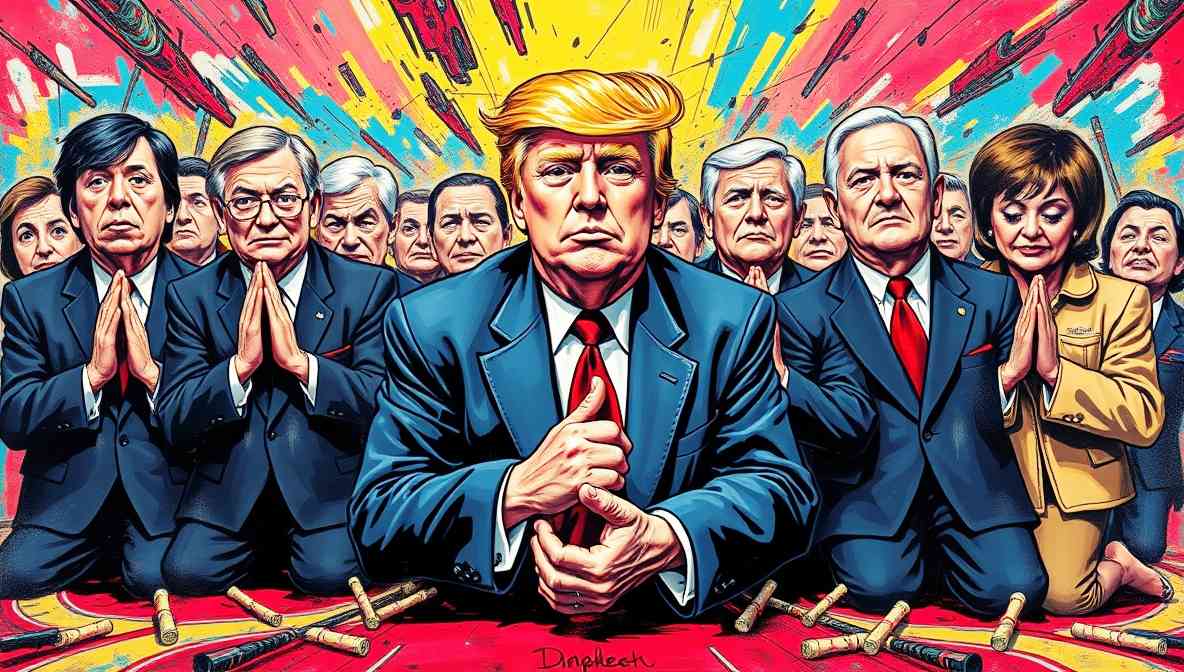
13 Things That Happened When China Turned the White House Prayer Circle Into a Meme While the World Edged Toward War
A Field Guide to Civilizational Decline, Documented in Real Time
The United States and China are, at this precise moment in history, closer to open conflict than at any point since the end of the Cold War. Trade war. Taiwan. Naval posturing across the South China Sea. Tariffs stacked like sandbags outside a building that is absolutely, definitely, not on fire. Analysts paid specifically to not panic are panicking in footnotes. The diplomatic hotline exists so both sides can inform each other, very carefully, that everything is going badly.
Into this situation, somebody posted a prayer circle. China made it a meme. Here, for the historical record, is what followed.
1. The White House Requested Divine Gravity and Received a Franchise Template
Faith leaders laid hands on Donald Trump in the Oval Office during a period of peak international tension. The intended message was authority, conviction, and moral weight. The received message, in China, was: free content. Add workers. Add ring light. Add slogan. Sell dumplings. America exports presidents. China imports templates.
2. A One-Party Atheist State Discovered That Prayer Sells Tiles

The Chinese Communist Party has spent decades demolishing churches, removing crosses from skylines by government order, raiding underground Christian congregations, and subjecting Uyghur Muslims to facilities the Party calls “vocational education” and everyone else calls something they cannot say in polite company. The Party’s official position is that religion is superstition — a primitive comfort blanket for the ideologically undeveloped.
Within seventy-two hours of the prayer clip circulating, Chinese workers were reenacting it to motivate warehouse staff and a hardware wholesaler was invoking the blessing of the American president over a rack of discount tile adhesive. The Party did not stop it. The Party cannot stop everything. That is the one fact it has spent seventy years hoping no one would notice.
3. Marxism Discovered It Had a Content Calendar All Along
Nothing on earth is more pragmatic than a rigid ideology pausing its principles to monetize a foreign ritual. It is dialectical materialism with a ring light. Ideological certainty with a conversion funnel. The Party never said prayer was useful. It just never said it wasn’t useful for shifting floor tiles before the quarterly review.
4. Sun Tzu Was Silent on This One
As he almost certainly never wrote: if your enemy can convert your sacred moment into promotional material before close of business, perhaps reconsider the sacred moment. He left this out of the manuscript. Wisely.
5. The Experts Weighed In and Made Everything Worse
Professor Lionel P. Thistlebottom of the Mid-Atlantic Institute for Symbolic Overreaction — an institution that has never been wrong, largely because it has never committed to a falsifiable claim — confirmed that geopolitics had entered “its liturgical meme phase.” Nations, he explained, now project power not only through carrier groups but through “their capacity to appear majestic for six seconds before another culture converts the footage into a joke about Q3 targets.” He then asked whether grant funding remained for research into “viral irreverence in post-hegemonic devotional framing.” It did not. He is appealing.
6. Eyewitnesses Confirmed the World Had Moved On Without Them
One Ohio churchgoer told this publication: “I thought it was a solemn moment. Then I saw a Chinese tile distributor do the exact same pose over a guy holding two sandals, and I realized civilization had simply moved on without consulting me.” An anonymous White House staffer confirmed the administration was “surprised that foreign audiences were not engaging at the intended level of reverence” — which is bureaucratic for: we posted it sincerely and the internet turned it into office karaoke.
7. A Poll Confirmed What Everyone Already Suspected
Research by the Bohiney Institute of Very Concerned Adults found 63.8% of respondents believe governments now communicate primarily through “vibes, theater, and accidental comedy.” A further 21.4% said they would trust summits more if leaders explained themselves without mood lighting or interns. The remaining 14.8% were filming their supervisor while placing both hands on his shoulders and praying for improved commission.
8. Plato, Hobbes, and Rousseau Were All Beaten by a Shop Owner in Shenyang
Plato wrote dialogues. Hobbes wrote Leviathan. Rousseau wrote about the social contract at considerable length. A Chinese shop owner put his hands on the boss and prayed for “higher sales and bonuses.” That last one explains the relationship between citizen and state more efficiently than any of the preceding works, and takes about four seconds.
9. Great Powers Now Compete Like Rival Regional Managers
One side deploys prayer warriors. The other deploys parody workers. Somewhere a think-tank analyst is required to write “symbolic escalation via devotional meme replication” in a document intended for serious people, and is presumably paid enough to make this bearable. The emotional maturity of the proceedings is that of a mid-tier sales conference with nuclear capability.
10. The Wits Summarized It Better Than Anyone
“Nothing rattles Washington like a foreign policy crisis being reviewed by people with editing apps and nothing to lose.”
“You know you’ve got a geopolitical problem when your opponent doesn’t bomb the image — they improve the caption.”
“If your propaganda gets repurposed by a shoe vendor before lunch, maybe ease back on the production value.”
11. The Actual War Situation Is Complicated and Refuses to Be Funny
Both Washington and Beijing continue speaking the language of stability, because the alternative involves consequences neither side wants on camera. Reuters confirms genuine friction over trade, Taiwan, and military posture — alongside ongoing communication and anticipated high-level contact. That is not friendship. That is two people in a very small elevator who despise each other and are both deeply committed to not pressing the emergency button. Kinetic war is not “minutes away.” That framing belongs to the attention economy. What the evidence supports is something less cinematic and more exhausting: a rivalry of dangerous incentives, strategic caution, and private phone calls no one will ever fully report.
12. Every Empire Eventually Becomes a Reaction Image
Rome had statues. Britain had engravings. America has a presidential prayer clip repurposed as warehouse motivation on Douyin. History is not dead. It has developed an autoplay function and an engagement-optimized recommendation algorithm. Trump has achieved the rare political trifecta — feared, mocked, and monetized simultaneously. Very few figures manage to become diplomacy, entertainment, and merchandise at the same time. It is, in its strange way, a kind of achievement.
13. No Solemn Image Belongs Entirely to the People Who Stage It
A president can intend majesty. Another country can see improv. Somewhere between those two reactions lies the actual condition of the modern superpower: overproduced at home, remixed abroad, and perpetually one upload away from becoming somebody else’s punchline. The internet has reduced great-power rivalry to “who looked weirder in the clip.” On current evidence, that contest is too close to call.
This satirical article critiques political theater, authoritarian hypocrisy, and the universal tendency to convert every solemn moment into algorithm fuel. It does not endorse hostility toward Chinese people, Christians, atheists, or anyone else navigating this moment without adequate medication. It is a human collaboration between two sentient beings: the world’s oldest tenured professor and a philosophy major turned dairy farmer. Auf Wiedersehen.
SOURCE: https://bohiney.com