

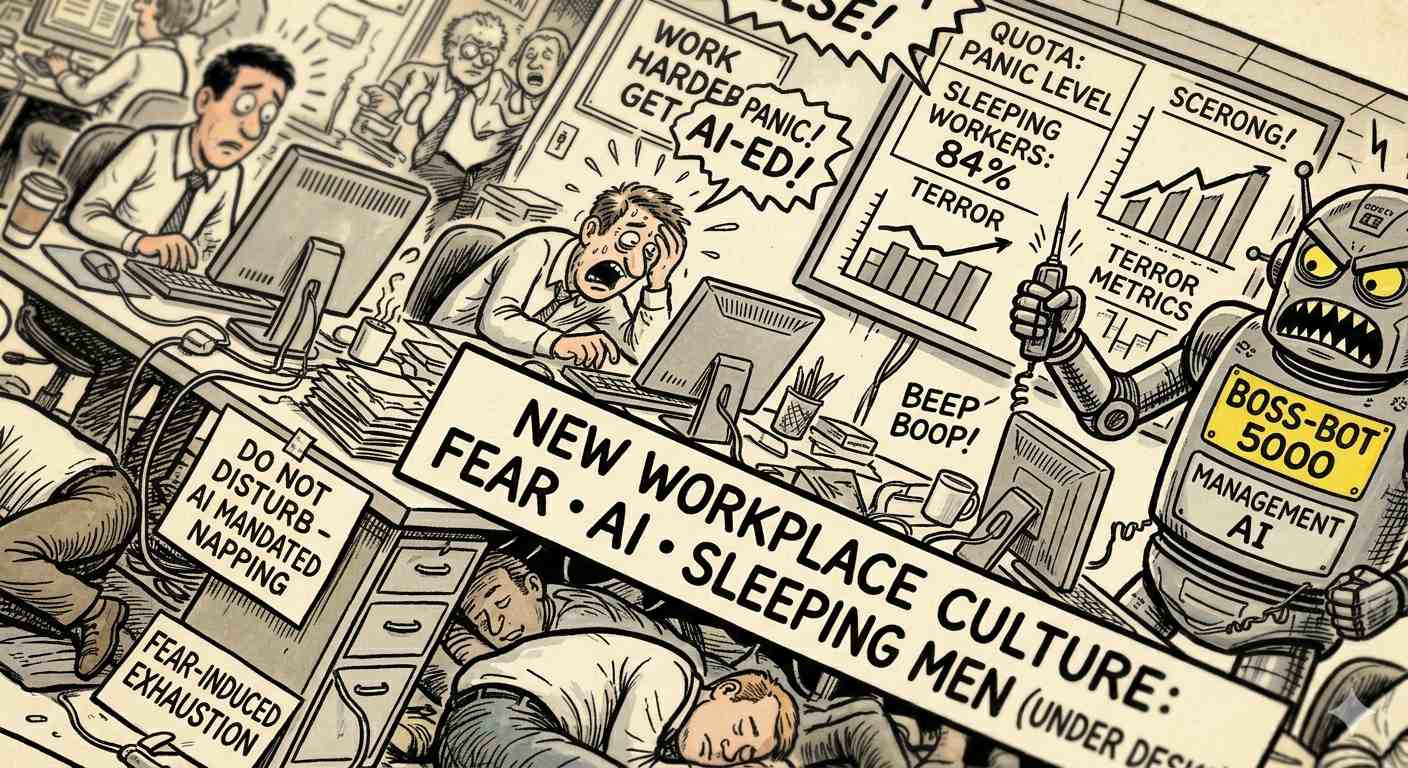
Zuckerberg Announces Exciting New Workplace Culture Based Entirely on Fear, AI, and Men Sleeping Under Desks
Five humorous observations immediately emerged from Silicon Valley after reports surfaced that Mark Zuckerberg has been treating employees like temporary batteries plugged into a giant artificial intelligence aquarium.
- Meta employees reportedly now describe performance reviews as “an emotional escape room with venture capital.”
- Several workers claim Zuckerberg communicates warmth the way airport security communicates hospitality.
- Engineers at Meta allegedly measure time not in hours, but in “how many existential crises until lunch.”
- Internal morale surveys reportedly include response options such as “burned out,” “deeply burned out,” and “upload consciousness immediately.”
- One exhausted programmer said the company cafeteria now serves espresso intravenously “to reduce unnecessary chewing delays.”
Silicon Valley Finally Builds the Perfect Employee: One That Never Needs Bathroom Breaks
According to reports circulating through tech media, Zuckerberg’s increasingly aggressive AI obsession has turned Meta into what one anonymous staffer described as “a TED Talk held hostage by spreadsheets.”
The company is reportedly spending somewhere between “all the money” and “the GDP of Belgium” on AI infrastructure, data centers, chips, and enough electricity to briefly dim Nevada. Meta’s capital expenditure plans for AI infrastructure now exceed $60 billion for 2025 alone — which in human terms is roughly the cost of buying every American a therapy session, plus parking.
Naturally, workers began noticing strange clues.
Managers started saying phrases like: “We need leaner teams.” “We need flatter structures.” “We need more efficiency.”
In corporate America, these phrases translate roughly to: “Brad from accounting is about to learn woodworking.”
One Meta employee described a recent company meeting as: “Imagine if a motivational seminar and a hostage negotiation had a baby, and the baby immediately gave a quarterly earnings call.”
Another said Zuckerberg spoke about AI with the intensity of a medieval king discovering gunpowder — except instead of cannons, he’s building chatbots that confidently make up your legal advice.
“He looked at us like horses after the invention of the tractor,” the worker whispered while nervously refreshing LinkedIn, adding a “Open to Work” banner, then removing it, then adding it back.
Why Hire Humans When Servers Don’t Ask for Weekends or Emotional Validation?
Reports suggest Meta could slash enormous portions of its workforce while simultaneously pouring mountains of cash into AI systems and data centers. The company has already conducted multiple rounds of layoffs targeting what executives delicately call “low performers” — a category that apparently expands every quarter like a gas in a sealed container.
Experts say this is part of a growing trend in Silicon Valley where corporations replace “employee satisfaction” with “GPU satisfaction.”
Dr. Ingrid Falk of the Stockholm Institute for Corporate Weirdness explained: “Historically, companies invested in workers. Now they invest in machines designed to monitor workers who remain until the next layoff cycle. It is extremely efficient and also extremely bleak, which is the same thing in most boardrooms.”
She added that modern executives now view employees the way medieval landlords viewed candles: “Useful, expensive, and constantly melting.”
A leaked internal memo reportedly classified workers into three categories:
- Essential
- Replaceable
- “Could probably be a chatbot by Thursday”
The document was later deleted after an AI accidentally promoted itself to Senior Vice President of Synergy Optimization and immediately scheduled seventeen unnecessary meetings.
Meta Employees Begin Romanticizing 19th Century Coal Mines as a Healthier Alternative
Former tech workers say the atmosphere inside giant AI companies increasingly resembles “an emotionally upscale Amazon warehouse” — same existential dread, better snacks.
One engineer claimed he was praised for “showing ownership” after answering Slack messages while undergoing dental surgery. The dentist, reportedly, gave him a performance review of “needs improvement.”
Another employee reportedly received an automated performance warning after blinking “below optimal productivity velocity.” The algorithm suggested he blink more efficiently or consider switching to a career in screensaving.
Meanwhile, AI surveillance systems across corporate America continue expanding. Critics warn that artificial intelligence is becoming less of a helpful assistant and more of a digital hall monitor raised by wolves and trained on Amazon reviews.
One consultant described the modern workplace this way: “Your boss used to quietly suspect you weren’t working. Now an algorithm tracks your mouse movements like it’s investigating war crimes.”
The Great Silicon Valley Contradiction That Nobody Is Allowed to Mention Out Loud
The funniest part of the AI revolution may be that the same billionaires who spent fifteen years telling employees to “bring your authentic selves to work” are now building systems specifically designed to eliminate the human part.
Corporate offices once featured meditation pods, kombucha taps, emotional wellness seminars, and walls painted with inspirational words: CREATE. INNOVATE. DREAM.
Now the unofficial slogan appears to be: “Please justify your existence to the spreadsheet by end of quarter.”
A recent anonymous poll of Meta employees found:
- 42% fear AI replacing their jobs
- 33% fear their manager replacing them with AI
- 25% fear the AI becoming their manager and somehow being less passive-aggressive than the current one
The survey margin of error was plus or minus one nervous breakdown. Methodology available upon request, assuming the requester still has a job.
Data Centers: The New Cathedrals of Corporate Anxiety, Now Accepting Electricity Offerings

Meta and other tech giants are now constructing colossal AI data centers that consume staggering amounts of power and water, enough to make climate scientists cry into their increasingly warm coffee.
Residents living near proposed facilities say they were promised “innovation,” but mostly received traffic, noise, and giant gray cubes humming like refrigerators possessed by capitalism.
One Texas rancher standing near a proposed AI facility reportedly said: “That building uses enough power to toast every Pop-Tart in Oklahoma simultaneously, and somehow it still can’t fix Facebook Marketplace.”
Activists opposing AI expansion argue these projects increasingly resemble giant monuments to executive ego rather than public progress. Economists counter that at least they’re honest monuments — most corporate legacies are just PowerPoints that got out of hand.
Meanwhile, construction unions support the projects because they create jobs, proving once again that every political debate eventually turns into: “Yeah, but somebody’s cousin needs work.”
What the Funny People Are Saying About Our Robot Overlords
“Tech billionaires always say AI will free humanity. Free humanity from what? Employment?” — Sarah Silverman
“Every app update now feels like the company quietly replacing you with a toaster. And the toaster got a better performance review.” — Jerry Seinfeld
“Zuckerberg talks about the future like a guy explaining why your town needs three more casinos and fewer schools. But enthusiastically.” — Ron White
“You notice billionaires always say workers should adapt? Funny how they never adapt by lowering yacht expenses.” — Jon Stewart
“The robots aren’t taking your job. A guy in a golf shirt is taking your job and blaming the robots. Classic.” — Bill Burr
Silicon Valley Discovers the Human Soul Is Inefficient and Cannot Be Scaled
Analysts say the deeper issue is not simply layoffs. It is the growing belief among executives that workers are temporary inefficiencies standing between investors and infinite scalability. Pew Research finds that 62% of Americans believe AI will fundamentally reshape the economy in the next decade — a stat that sounds optimistic until you realize “reshape” is doing a lot of heavy lifting.
AI was originally marketed as a magical helper that would eliminate drudgery and expand human creativity.
Instead, millions of workers now suspect it mostly exists so middle managers can generate PowerPoint slides at 4 a.m. without speaking to anyone, and then blame the AI when the slides are wrong.
One exhausted Meta employee summarized the entire situation best: “We were promised robot servants. Somehow we became the servants helping the robots get promoted.”
And somewhere deep inside a freezing AI data center the size of Luxembourg, thousands of servers hummed softly into the night, calculating the optimal number of bathroom breaks per quarter and concluding the answer was zero, which is also the number of people who found that funny.
The algorithm, however, rated the joke “exceeds expectations.”
Mark Zuckerberg, the co-founder and CEO of Meta Platforms, has made AI investment the centerpiece of his company’s strategy for 2025 and beyond, announcing plans to spend over $60 billion on AI infrastructure, data centers, and computing hardware. Meta has conducted several rounds of layoffs in recent years, including a significant reduction in 2023 and targeted cuts in 2024 targeting what the company labeled underperformers. Zuckerberg publicly stated in early 2025 that Meta plans to use AI to replace mid-level engineering roles, prompting widespread coverage from outlets including the Wall Street Journal, Bloomberg, and the Financial Times. The tech industry broadly is undergoing a shift in which companies are reducing headcount while accelerating spending on artificial intelligence systems, a trend critics argue represents a fundamental restructuring of the American labor market with minimal public debate or regulatory oversight.
Disclaimer: This satirical story is a human collaboration between two sentient beings — the world’s oldest tenured professor and a philosophy major turned dairy farmer. Any resemblance to actual executives, stressed engineers, emotionally damaged Slack channels, or billionaires attempting to automate humanity into a customer service chatbot is purely educational and deeply on purpose. Auf Wiedersehen, amigo!