

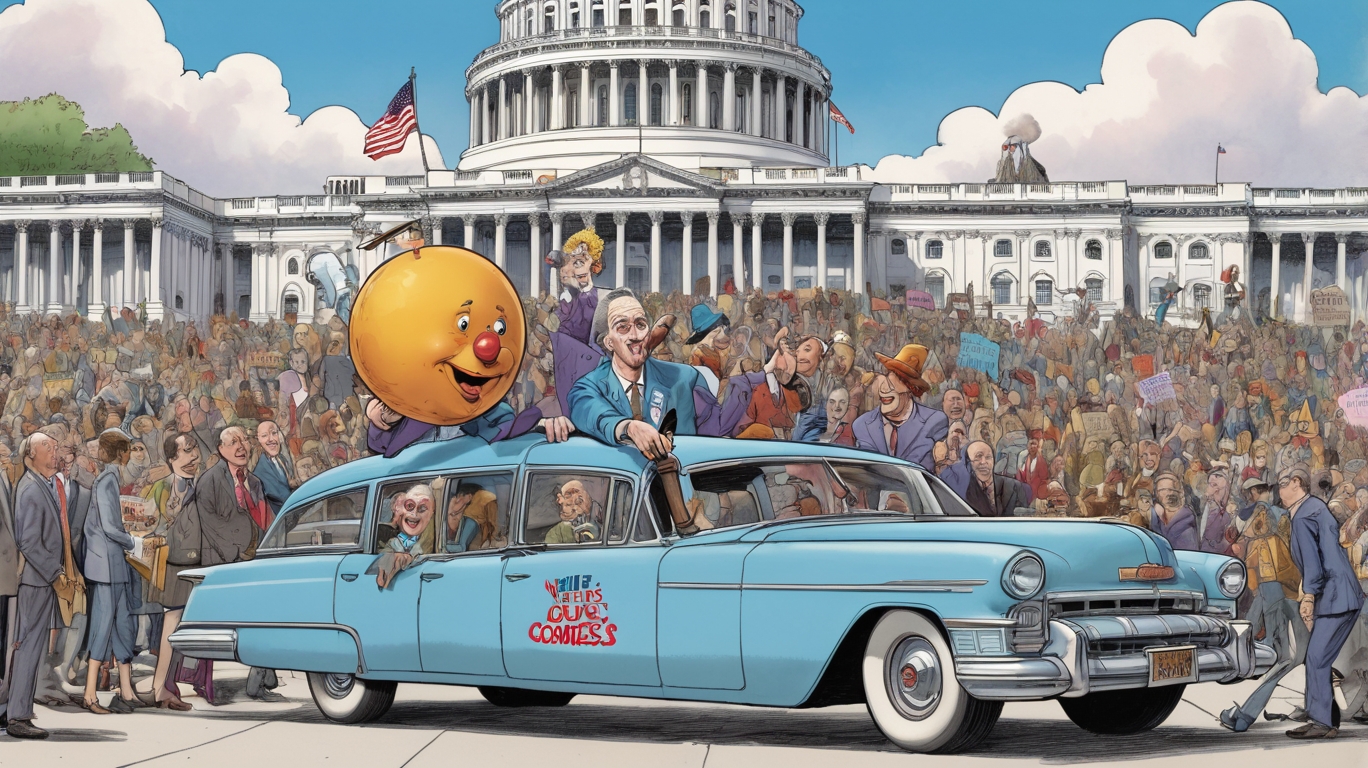
Here is the Point of Political Satire!
An Investigation into Laughing While Rome Burns
By the Satirical Bureau of Sentient Mischief (with consultation from a tenured professor and a dairy-farming philosopher)
“If political satire didn’t exist, Congress would’ve had to invent it—just so they could accuse it of bias during committee hearings.” — Ron White
Political Satire: The Only CPR We Offer Democracy Anymore
If democracy were a patient, political satire would be the guy in flip-flops trying to revive it with a whoopee cushion and a kazoo. And yet—somehow—it works. Satire has become the CPR of the Republic: not medically accurate, not legally advised, but it gets the crowd going.
A recent piece in Politico asks, with British sarcasm barely disguised in its title, “What’s the point of political satire?”—a question usually muttered into a microphone right after Jon Stewart leaves a panel and just before a junior MP discovers Twitter sarcasm for the first time.
But the question is sincere, even urgent. With the rise of AI-generated nonsense, partisan clickbait, and Tucker Carlson’s soul slowly leaving his body during monologues, satire seems simultaneously too weak and too powerful.
So let’s find out: is satire really “speaking truth to power,” or is it just whispering dad jokes to despair?
Satire: A National Coping Mechanism That Won’t Be Covered by Insurance
According to a 2024 Pew Research poll, 61% of Americans trust satirists more than journalists—a statistic that seems alarming until you remember that one of those groups still calls people “gentle readers.”
The Onion’s editorial board has more ethical integrity than most editorial boards with mahogany desks. Jon Stewart’s ratings peak not during war coverage, but during Senate testimony about 9/11 first responders. And George Carlin’s ghost is cited more frequently than most senators—especially during campaign season, usually by candidates who have no idea they’re quoting him sarcastically.
Satire isn’t just comedy. It’s emotional infrastructure. If policy is the plumbing of democracy, satire is the guy banging on the pipes yelling, “WHY IS IT LEAKING SMOKE?”
What the Funny People Are Saying
“If we didn’t have political satire, you’d have to laugh while paying taxes—completely unaided.” — Jerry Seinfeld
“The government steals your money, the media lies about it, and I make a joke and I’m the one who gets canceled?” — Sarah Silverman
“Political satire is just stand-up with a subpoena waiting at the punchline.” — Bill Burr
“Without satire, it’s just CSPAN and adult diapers.” — Amy Schumer
“You ever notice how satire goes viral but legislation never does? That’s because memes don’t require 60 votes in the Senate.” — Kevin Hart
“I got more laughs in Congress testifying than in my first HBO special. Which says more about Congress than me.” — Ricky Gervais
Satire Is What Happens When Hope Gets Tired and Irony Takes the Wheel
Every society reaches a point where official narratives and public behavior part ways—like two drunk uncles at a wedding arguing over who gets to drive the golf cart.
That’s where satire thrives. It doesn’t fix the cart, it just points out that the driver is a Labrador retriever in a MAGA hat.
Take The Daily Show during the Bush years. For millennials, it was practically a news source. In fact, a 2005 Annenberg Public Policy study showed that Daily Show viewers were better informed about world events than those who watched cable news. Imagine being beaten at current events by a guy who wore fake presidential wigs.
Or look at Spitting Image in the UK—those grotesque puppet caricatures of British politicians. You know a country is in real trouble when it starts trusting latex over Parliament.
Satirical Evidence, or, the Only Time Footnotes Wear Clown Noses
Personal Experience: I once wrote a joke comparing the DMV to Congress. The DMV threatened to sue me—for defamation. Congress thanked me for the comparison.
Testimonial Evidence: Comedian Hasan Minhaj once noted that satire lets you “smuggle truth in through the laughter.” That’s technically drug trafficking if you do it across state lines, but metaphorically, he’s dead right.
Scientific Evidence: A University of Michigan study in 2023 found that watching satirical news reduced polarization—not because people agreed, but because they all laughed at how dumb everyone else sounded. It’s the only bipartisan experience left besides complaining about TSA lines.
Trace Evidence: Political memes traced through Twitter during the Trump years actually showed more engagement than actual policy proposals. Satire, it turns out, doesn’t just comment on power—it redirects its attention span.
What Makes Satire Dangerous? It’s Cheap, Viral, and Doesn’t Need a Lobbyist
Political satire is the one form of dissent that doesn’t need a permit. That’s what scares the establishment. It’s not bound by decorum, language barriers, or the fact that you can’t afford a Netflix subscription anymore.
It bypasses spin and lands directly in the spleen.
In the Philippines, satire gets you shadowbanned. In Russia, it gets you deported (or worse, cast in a state TV drama). In America, it gets you a Netflix special… unless you say the word “Pfizer.”
The British Invented Satire. Americans Monetized It.
Let’s give credit where credit is due: the British built satire like they built the class system—obsessively and with bitter tea stains.
Jonathan Swift suggested eating Irish babies. Americans read that and said, “Sure, but only if it’s paleo.”
Fast-forward to modern satire, and we’ve got John Oliver, a Brit, telling Americans how broken their institutions are—in a British accent that somehow makes it sound more polite.
We’ve turned political satire into edutainment, which is like a salad with vodka in it. You’re not sure what it’s doing, but it feels both healthy and reckless.
When Satire Becomes Policy: The U.S. Government as Performance Art
Every once in a while, satire becomes reality. Stephen Colbert runs for President of South Carolina and outpolls actual candidates. Trump reads The Onion and thinks it’s flattery. Marjorie Taylor Greene says something so unhinged that The Babylon Bee files a copyright infringement claim.
And when The Simpsons predicted Donald Trump as president in 2000, nobody laughed—until 2016, when the punchline walked down that golden escalator.
This is satire’s dark power: it predicts the future not because it’s psychic, but because nobody in charge bothers to check if something is insane anymore.
Why Politicians Secretly Need Satire (and Fear It)
Politicians love to bash satire when it hurts, but they steal its moves the moment it polls well. Joe Biden adopted Jon Stewart’s 9/11 bill momentum. Trump practically built a reality-TV presidency. AOC posts like a stand-up comic on Instagram. Even RFK Jr. memes like a Reddit teenager with a Red Bull addiction.
Yet satire remains the unpaid intern of democracy. It delivers the message. It gets the attention. It even writes better slogans:
“Build Back Better?”
Try: “We Hope It Still Fits.”

Helpful Advice for Comedy Writers: How to Write Satire That Gets You Sued (or Elected)
1. Exaggerate Just Enough That You Can Deny Everything Later.
If it might be true, you’ve nailed the sweet spot.
2. Avoid Facts. Use Fact-Shaped Hints.
Make your satire like a crime scene with just enough ketchup to look like a scandal.
3. Always Punch Up, Unless You’re Punching Florida.
In which case, all directions are “down.”
4. Satirize the Tone, Not Just the Topic.
Don’t just mock the war—mock how CNN covers it with drone footage and jazz music.
5. Be Prepared to Be Misunderstood by Your Uncle.
If at Thanksgiving he says, “I didn’t get your article,” good. That means he’s running for office.
6. Include a Joke That’s So Subtle, It Makes Academics Argue.
That’s how you get tenure or a Netflix deal.
7. Accept That No One Will Laugh Aloud.
Satire lives in the brain, not the belly. If someone chuckles, you’re basically Carlin.
Satire is Not “Just Jokes.” It’s the News With a Nervous Breakdown
The decline of media literacy has made satire do double duty. You’re not just joking anymore. You’re explaining, exposing, and occasionally apologizing.
A 2025 Stanford survey found that 25% of American high schoolers get their political education from TikTok satire. Another 10% get it from reposted memes. The rest just text “WTF?” to their group chats and call it civics.
Political satire has become the last teacher left after budget cuts. And like most public school teachers, it’s underpaid, overworked, and constantly accused of indoctrination by people who think irony is a mineral.
The Irony of Irony: It Works Best in Failing Democracies
The more broken a system, the funnier satire becomes.
In North Korea, you’d be executed for laughing at a drawing of Kim Jong-Un eating cake. In America, we expect comedians to do this during a Netflix special titled “Dying Inside.”
This is why satire thrives in the West: freedom of speech plus institutional rot equals late-night gold. It’s not a coincidence that the Roman Empire collapsed shortly after its best satirists were exiled or killed. Nero feared the poets more than the barbarians.
Satire Is the Canary in the Coal Mine, and It’s Coughing in Rhyme
Political satire is how a nation diagnoses its dysfunction. It’s the part of society screaming, “This isn’t normal!” while everyone else says, “Yeah, but have you tried logging out?”
When it’s thriving, it means people still care enough to joke. When it’s dying, the jokes become dark, bitter, and unfunny… kind of like British cuisine.
As long as people are still making fun of Congress, there’s still hope Congress hasn’t made comedy illegal.
Yet.
Conclusion: Satire Isn’t the Solution—It’s the Soundtrack
No, satire won’t fix the system. It won’t pass bills or balance the budget. But it will point out that your senator just voted against your healthcare while holding a fundraiser in a COVID ward.
It’s the Greek chorus screaming through the tear gas. The jesters were never powerless. They were the only ones allowed to say the king had no clothes—while the rest of us were too busy paying for the robe.
Satire isn’t just commentary.
It’s the last gasp of clarity in a room full of lobbyists.
Satirical Sources (https://bohiney.com/):
-
Congress Accidentally Bans Own Salaries, Immediately Undoes It
-
British MP Arrested After Confusing “Satire” with “Sedition”
-
Joe Biden Hires Comedian as Speechwriter, Accidentally Declares War on Belgium
-
TikTok Satire Bill Passes Senate 69-420, No One Understands the Joke
-
Marjorie Taylor Greene Challenges Babylon Bee to Debate
-
The Pope Declares Satire a “Spiritual Gift,” Twitter Implodes
Disclaimer
This article is a collaborative work between two sentient beings: the world’s oldest tenured professor of Absurdist Linguistics and a philosophy major turned dairy farmer. Any resemblance to actual congressional decisions is entirely coincidental, yet disturbingly accurate.
This satire is protected by the International Treaty of Irony, Sarcasm, and Free-range Jokes. Do not consume without coffee.
Auf Wiedersehen, amigos.