

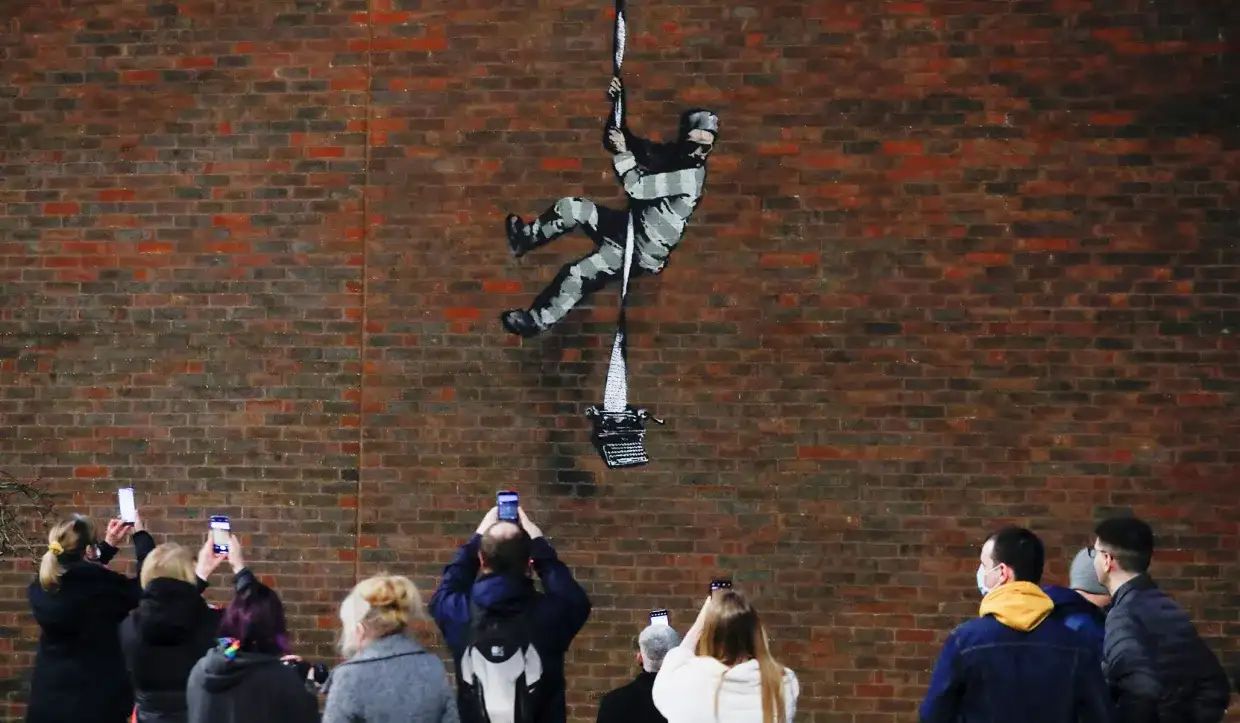
Banksy Finally Proves Crime Pays, Local Criminals Furious They Chose the Wrong Hobby
Five Observations Before We Begin
Somewhere in London, a guy who spray-painted “Dave wuz here” is learning he accidentally produced a depreciating asset.
Police have confirmed graffiti is illegal unless Sotheby’s gets involved, at which point it becomes “a cultural liquidity event.”
Economists now define vandalism as “unauthorized home improvement with a resale value.”
Banksy has achieved what every teenager dreamed of: turning detention into a retirement plan.
Art schools are reportedly updating their curriculum from “composition and color” to “run faster and don’t sign your real name.”
A Masterclass in Profitable Misbehavior: How Street Art Became a Blue-Chip Asset Class
LONDON – In a development that has sent shockwaves through both the criminal underworld and the fine art community, new reporting confirms what every kid with a spray can suspected but could never prove: crime does not just pay, it appreciates. 🎨
The elusive street artist Banksy, long celebrated for turning public walls into political statements, has now been revealed to have also turned those walls into something even more powerful: equity. Not stocks. Not bonds. Walls. Literal walls.
According to investigators, Banksy’s career began as what experts describe as “criminal damage,” which is British legal jargon for “you painted a rat where a perfectly good brick used to be.” But somewhere along the way, that same act became “a rare urban installation with strong secondary-market performance.” ABC News
This is the only industry where the difference between a felony and a museum exhibit is a press release and a wine reception.
The Only Criminal Whose Evidence Gets Framed: Banksy and the Law’s Awkward Relationship
Authorities have long struggled with how to handle Banksy. On one hand, graffiti is illegal. On the other hand, if you arrest him, you might accidentally devalue a neighborhood.
One London police officer, speaking on condition of anonymity because he owns three Banksy prints, explained the dilemma:
“We used to chase vandals. Now we escort them for crowd control. Last week a guy tagged a wall and we fined him. Then we checked Instagram, realized it might be Banksy, and apologized to him.”
Experts confirm this confusion is not new. Other street artists have pointed out that when they paint on a wall, it is called vandalism. When Banksy does it, it is called “a conversation.” ABC News
Sociologists have labeled this phenomenon “selective legality,” or more commonly, “you’re not famous enough to get away with it.”
From Spray Paint to Sotheby’s: The Business Model That Broke Art Markets
The real genius of Banksy is not the art. It is the business model.
Art market analysts say his public graffiti works, which technically cannot be sold directly, actually increase demand for his other pieces, driving prices into the millions.
In other words, every illegal act is basically a marketing campaign.
One financial advisor described it this way:
“Most brands pay for billboards. Banksy is the billboard. Also the vandal. Also the shareholder.”
A recent auction saw one of his works sell for millions, which has inspired a new generation of entrepreneurs who are now tagging walls while yelling, “I’m diversifying!”
The Rise of Aspirational Crime: When Vandalism Becomes Venture Capital
In response to the news, amateur criminals across the UK have begun rebranding.
A man in Manchester previously known for drawing crude stick figures on bus stops now refers to himself as an “emerging installation artist.”
“I always knew I was ahead of my time,” he said, standing next to a poorly drawn pigeon wearing sunglasses. “Turns out I was just ahead of the market.”
Meanwhile, a group of teenagers in Bristol launched a startup called “Pre-Banksy Collective,” offering investors the chance to buy their vandalism before it becomes valuable.
Early reviews are mixed, mostly because their work looks like what it is: vandalism.
What the Funny People Are Saying About Art Crime and the Open Market
“I tried graffiti once. The only thing I sold was my hoodie to pay the fine.” — Jerry Seinfeld
“Banksy turned breaking the law into breaking even… then breaking records.” — Ron White
“You ever notice crime only pays if you’re mysterious? If I wear a mask, I’m a suspect. He wears a mask, he’s a brand.” — Dave Chappelle
Academia Finally Explains It: The Economics of Luxury Crime
A professor of economics at a very serious university explained that Banksy represents a perfect storm of scarcity, anonymity, and cultural relevance.
Then he admitted, “Honestly, we’re just trying to explain why a painted rat is worth more than my house.”
Researchers have identified three key factors behind Banksy’s success:
- Mystery increases perceived value
- Illegality creates publicity
- Wealthy people enjoy buying rebellion as long as it comes framed
This has led to a groundbreaking new theory in economics called “Luxury Crime,” where the crime is part of the product.
The Identity Reveal That Changes Nothing: Meet Robin Gunningham, Probably
Recent investigations suggest Banksy may be a Bristol-born man whose identity has been speculated about for years, supported by old court records and travel data. In a bombshell March 2026 investigation, Reuters revealed a signed handwritten confession from a 2000 New York arrest, bearing the name Robin Gunningham — a man who later legally changed his name to David Jones, one of the most common names in Britain, specifically so he could hide in plain sight among approximately 6,000 other David Joneses. Banksy’s lawyer Mark Stephens responded by saying his client “does not accept that many of the details contained within your enquiry are correct,” which is lawyer-speak for “nice try.”
Naturally, this revelation has had absolutely no impact on his market value.
Collectors have confirmed that whether Banksy is one man, a group, or three raccoons in a trench coat, they will still pay millions.
One buyer explained, “I don’t care who he is. I care that my guests think I understand it.”
Policy Implications: Should Governments Monetize Petty Crime?
Governments are now quietly considering whether to expand the Banksy model.
A leaked memo suggests a pilot program where minor crimes are auctioned off as “experiential art.”
Proposed initiatives include:
- “Premium jaywalking zones” in London
- “Curated littering installations” in New York
- “Interactive tax evasion exhibits” for high-net-worth individuals
An anonymous staffer summarized the policy shift: “If we can’t stop it, we might as well sell tickets.”
Final Thoughts: A World Where Spray Paint Beats Savings Accounts
Banksy has accomplished something extraordinary. He has turned the act of defacing property into a form of wealth creation, confusing police, economists, and parents everywhere.
For decades, society told young people, “Crime doesn’t pay.”
Banksy responded, “You’re just doing the wrong crime.”
And somewhere, a kid with a spray can is looking at a blank wall like it’s a blank check.
This story is a work of satire and should not be taken as legal advice, financial guidance, or encouragement to begin a graffiti-based retirement strategy. It is entirely a human collaboration between two sentient beings: the world’s oldest tenured professor and a philosophy major turned dairy farmer, both of whom agree that if crime does pay, it probably comes with a gallery opening and free wine.
Auf Wiedersehen, amigo!
Banksy — widely believed to be Robin Gunningham, a Bristol-born street artist born in 1973 — rose to global fame through anonymous graffiti works blending dark humor with political commentary. A March 2026 Reuters investigation linked him to a signed 2000 New York arrest confession and immigration records placing him in Ukraine in 2022. His former manager Steve Lazarides confirmed arranging a legal name change to David Jones around 2008. Banksy’s lawyer has disputed the findings. His works, including the iconic Girl with Balloon, have sold at auction for millions — most famously when one self-destructed in a Sotheby’s frame in 2018, becoming Love Is in the Bin, and promptly became more valuable. The global street art market he helped legitimize is now worth billions.
SOURCE: https://prat.uk/banksy-finally-proves-crime-pays/