

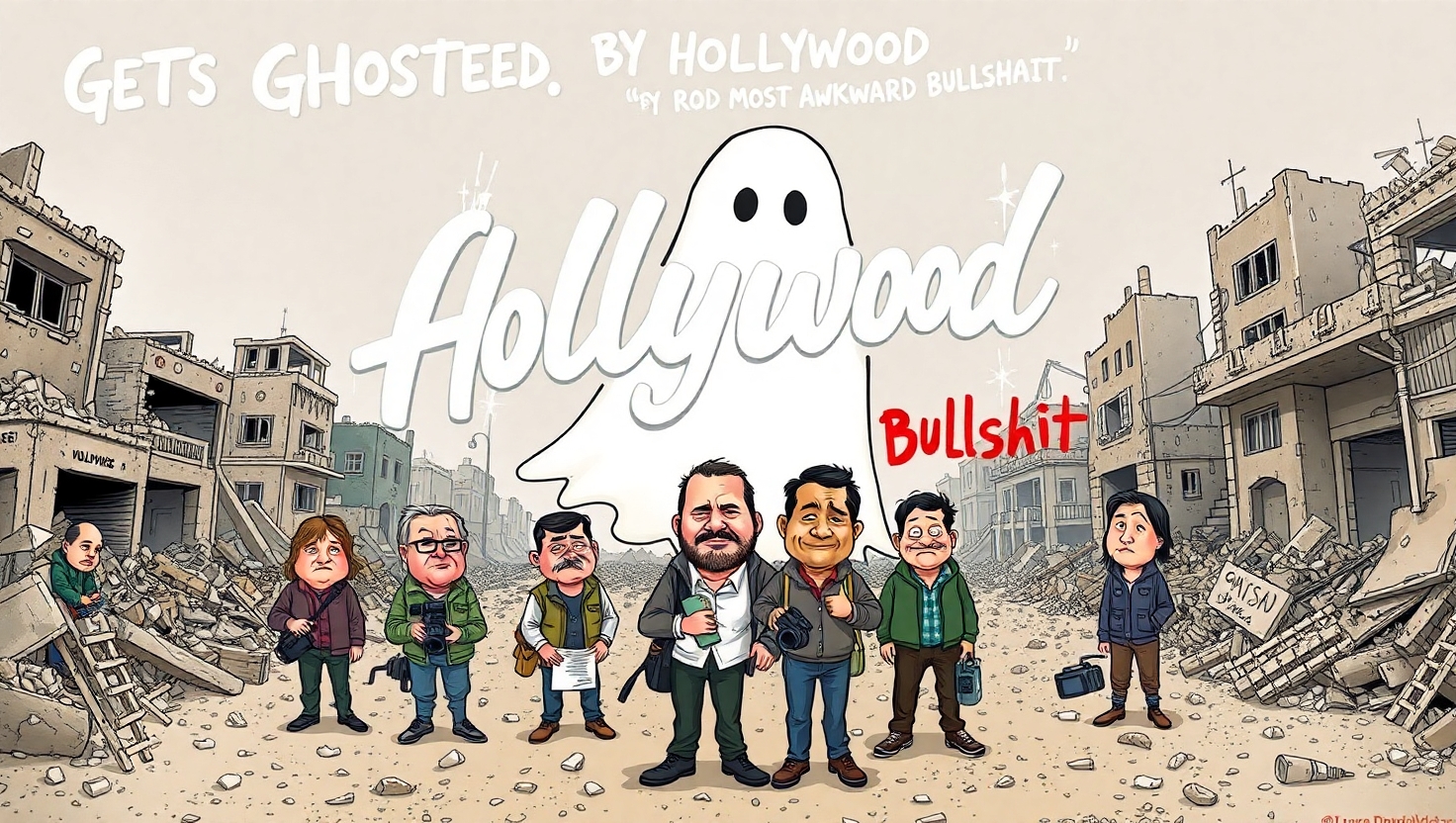
Gaza Gets Ghosted: Hollywood’s Most Awkward Breakup
When Permit Applications Become Treasure Maps to Nowhere
Trying to film in Gaza requires more paperwork than Jerry Seinfeld’s dry cleaning. “You know what I can’t figure out?” Seinfeld once said about bureaucracy, “They want you to fill out a form to get a form to fill out a form.” Replace “form” with “permit to film a kid playing soccer” and you’ve got Gaza filmmaking.
Palestinian filmmakers Ahmed and Mohammed Abu Naser discovered this when their film got censored in Gaza because a girl appeared without a headscarf. Not politics. Not violence. Wardrobe choices threatened society more than actual bombs.
Security Concerns: The Swiss Army Knife of Excuses
“Security concerns” has become the duct tape of film industry rejections. Gaza has zero functioning cinemas. The three that existed before 2005 were torched during internal conflicts, making it the only place where filmmakers premiere movies in parking lots.
Ron White nailed it: “You can’t fix stupid, but you can sure document it extensively before rejecting it for security reasons.”
The Great Funding Vanishing Act
Amy Schumer observed, “I’m not afraid of commitment. I’m afraid of committing to something stupid.” Hollywood producers listen to Gaza film pitches, nod, take notes, promise to “circle back,” then vanish faster than free food at film festivals.
The documentary No Other Land won multiple awards but has zero U.S. distribution because distributors treat Palestinian stories like plutonium – impressive from a distance, terrifying up close.
Self-Censorship: Editing Before Anyone Gets Triggered
Filmmakers now practice preemptive self-censorship with Swiss watchmaker precision. As Chris Rock put it, “You know the world is going crazy when the best rapper is a white guy, the best golfer is a black guy… and filmmakers censor themselves before anyone asks them to.”
The Abu Naser twins removed scenes not because of violence, but because wardrobe police deemed uncovered heads more dangerous than uncovered truths.
Footage Rights: Owning Digital Unicorns
Getting Hamas footage clearance requires more red tape than government computer upgrades. Toronto International Film Festival pulled The Road Between Us because filmmakers couldn’t secure rights to conflict footage.
Bill Burr captured it: “Everything is illegal until you pay someone to make it legal.” Except with conflict footage, paying someone lands you on watch lists.
Awards Season: International Applause, Local Silence
Gaza films win standing ovations at Venice and Cannes, then disappear into distribution limbo. The Voice of Hind Rajab, about a young girl killed in Gaza, earned festival praise but remains invisible to local audiences.
Trevor Noah understood this: “You can be right about everything and still lose the argument if you’re arguing with someone who doesn’t care about being right.”
Streaming Services: The Digital Disappearing Act
Netflix’s “Palestine Stories” collection featured 19 films until licenses expired and the entire collection vanished like Jimmy Hoffa. Critics called it censorship; Netflix called it “licensing logistics.”
When films disappear from platforms, they enter digital purgatory – existing in festival memories but accessible to nobody.
Legal Threats: When Courts Become Critics
The Al-Saraya Theater in Jaffa is fighting in court after police banned Palestinian films for “disrupting public order.” Apparently, showing Palestinian stories threatens social stability more than actual inequality.
Dave Chappelle noted, “Every comedian needs to remember that you have the right to free speech, but you don’t have the right to an audience.” Palestinian filmmakers discovered they don’t even have the right to screens.
The Catch-22 of Representation
Palestinians can’t be in movies and can’t watch movies – a paradox more twisted than IKEA assembly instructions. The people most affected remain most silenced in storytelling.
Jim Gaffigan’s observation rings true: “I told my wife the truth. I told her I was seeing a psychiatrist. Then she told me the truth: that she was seeing a psychiatrist, an attorney, and a bartender.” Gaza filmmakers see obstacles, more obstacles, and lawyers explaining why everything is impossible.
International Co-Productions: The Last Hope
Some filmmakers navigate obstacles through international co-productions that split legal risks like nervous dinner checks. Put Your Soul On Your Hand and Walk used video calls as filming technique, proving technology can overcome barriers when courage fails.
French, Palestinian, and Iranian producers collaborated because apparently it takes three countries to tell one story that one country doesn’t want told.
The Future: Waiting for Godot with Cameras
Gaza will get more movies when pigs fly, politicians tell truth, and airline food becomes edible. The industry that claims to champion underrepresented voices treats Palestinian narratives like nuclear waste – dangerous to handle, impossible to dispose of properly.
Sarah Silverman summed it up: “I was going to have cosmetic surgery until I noticed that the doctor’s office was full of portraits of women who looked exactly like each other.” Gaza filmmaking suffers the opposite problem – too many unique stories, not enough courage to tell them.
Real change requires infrastructure investment, legal protections, brave distributors, and audiences demanding authentic stories. Some voices, like independent filmmakers and screenwriters, continue pushing boundaries despite industry resistance. Until then, Gaza cinema remains Hollywood’s most awkward subject – acknowledged in acceptance speeches, ignored in distribution meetings.
The industry that champions underrepresented voices continues representing Palestinians like England represents good weather – occasionally, reluctantly, and with constant apologies.
As Nate Bargatze deadpanned, “I don’t understand people who are afraid of change. Have you seen what staying the same gets you?” Gaza filmmaking stays trapped: great stories, impossible obstacles, international awards, local silence.
The pattern breaks when Palestinian stories matter more than Palestinian politics make people uncomfortable. Until then, Gaza cinema remains the film industry’s best-kept secret – everyone knows about it, nobody wants to deal with it.
This piece represents collaborative journalism between human insight and digital research. No AI was consulted for opinions, only occasionally for spell-checking.

https://claude.ai/public/artifacts/957a2848-2eed-49e6-b1df-df172e670be9