

Trump Says Hamas Will Disarm “Quickly and Perhaps Violently” After Verbal Assurance
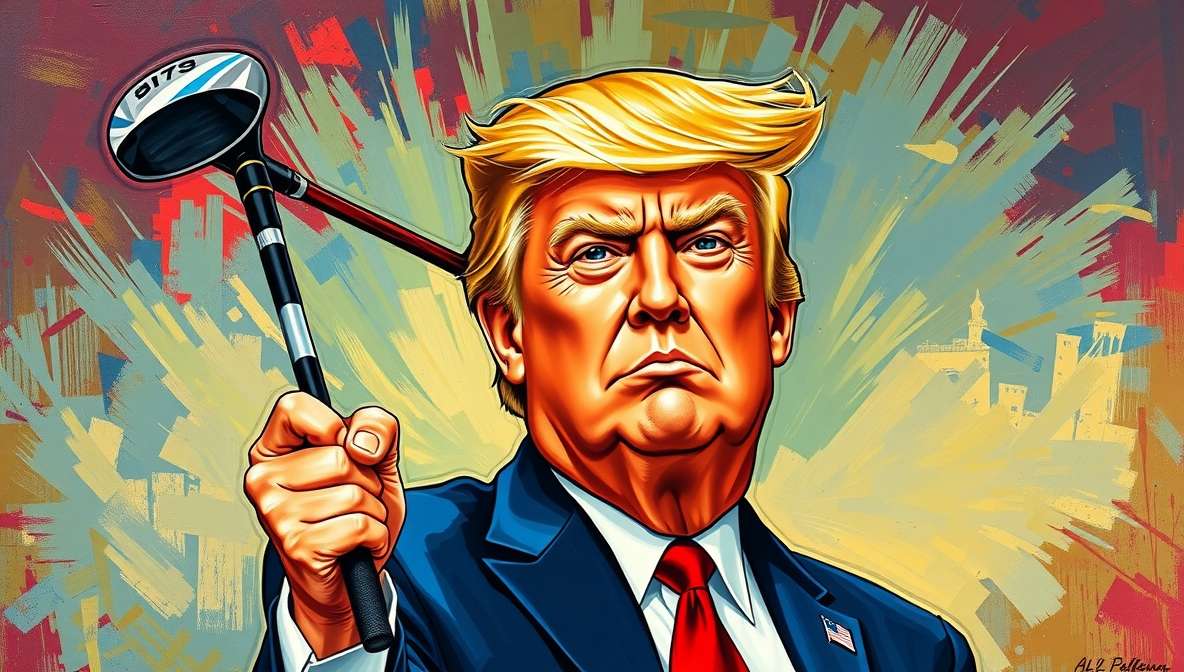
President makes diplomatic breakthrough using power of suggestion, possibly a golf club
By Bohiney.com Staff | Political Satire
Former President Donald Trump announced this week that Hamas has “verbally assured” him they will disarm, promising the process will happen “quickly and perhaps violently” within “a reasonable period.” The statement has left foreign policy experts scrambling to determine whether this diplomatic commitment ranks closer to “pinky promise” or “LOL sure” on the International Treaty Scale.
Trump told reporters that Hamas representatives gave him strong assurances about laying down their weapons. “They said it very strongly,” he emphasized, using the same tone a parent employs when insisting their teenager “definitely cleaned the kitchen.” It marks the first recorded case of Diplomacy by Pinky Promise in modern Middle East negotiations.
The former president didn’t specify which Hamas representatives made this assurance, when the conversation occurred, or whether anyone was actually in the room when it happened. According to sources familiar with his thinking, the details are “not important” compared to the “beautiful” nature of the assurance itself.
A new poll from the Institute of Unbelievable Confidence found that 67% of Americans now believe Trump could convince hurricanes to stop spinning “if he just asked them nicely.”
What Does a “Verbal Assurance” From Hamas Actually Mean?

Foreign policy experts are struggling to classify exactly what diplomatic weight a Hamas “verbal assurance” carries in international relations.
Dr. Elise Kaplan, Middle East policy scholar, told Bohiney News: “In the hierarchy of international commitments, this ranks just below ‘cross my heart’ but slightly above ‘yeah, totally, we’ll get right on that.’ It’s like if North Korea promised to stop testing missiles because they ran out of paperwork ink.”
The State Department’s official Commitment Classification System hasn’t been updated to include “verbal assurance from designated terrorist organization” as a category. One diplomatic staffer suggested creating a new tier called “Statements That Sound Nice But Mean Nothing,” though others argued that category already describes most UN resolutions.
Trump’s approach follows what insiders call the “Trust Fall Method” of international diplomacy—where you close your eyes, fall backward, and assume the group you’ve been fighting for decades will catch you. So far, the method has a 0% success rate in conflict zones, but a 100% rate of producing memorable press conferences.
Trump’s Hamas Disarmament Timeline: “Reasonable Period” Explained
When pressed for specifics on when this disarmament would occur, Trump offered a timeline described as “within a reasonable period”—a phrase that has sent scheduling experts into existential crisis.
Historians note this is the exact same timeline framework used for:
- Assembling IKEA furniture
- Congressional reform
- Your friend paying you back for pizza
- The Second Coming
White House insiders claim Trump’s definition of “reasonable period” could range anywhere from “before dinner” to “after his next indictment.” A leaked internal memo reportedly labels the deadline as “TBD, possibly post-Rapture.”
International law professor Martin Chen explained: “A ‘reasonable period’ in treaty law typically means 90 days to 18 months. In Trump-speak, it means ‘whenever I feel like checking in again, maybe never.'”
The phrase joins a long tradition of political non-commitments, sitting comfortably alongside “as soon as possible,” “in due course,” and “we’re looking into it very strongly.”
First Priority: Taking Out “A Couple of Gangs That Are Very Bad”
Trump clarified that Hamas disarmament cannot begin until after dealing with “a couple of gangs that are very bad.” The statement has left the national security community in a state of confused speculation about which gangs he meant.
Possible interpretations currently being analyzed:
- Actual street gangs somehow involved in Gaza
- Hamas splinter groups
- Hezbollah (if you squint)
- Mar-a-Lago catering staff attempting to unionize
- Metaphorical gangs representing abstract concepts like “bad ideas”
One anonymous diplomat told Bohiney: “It’s like saying you can’t fix your roof until you vacuum the driveway. Grammatically it’s a sentence. Strategically, it’s interpretive dance.”
Pentagon analysts have created a flowchart to determine gang priority, but the chart currently just has question marks connected to other question marks with dotted lines labeled “unclear intent.”
“They’ll Disarm or We’ll Disarm Them. Got It?” – Diplomatic Clarity Achieved
In a statement that political scientists are calling “aggressively straightforward,” Trump declared: “They’ll disarm, or we will disarm them. Got it?”
Military strategists confirm that yes, technically, those are the only two options for disarmament. The revelation was described as “geometrically sound” but “strategically equivalent to saying ‘we’ll win by either winning or winning.'”
The declaration follows Trump’s broader approach to Middle East diplomacy, which insiders describe as “Clint Eastwood ordering a burrito.” If the order comes out wrong, you threaten to send it back—with force, and perhaps violently, within a reasonable timeframe.
General Marcus Webb (ret.) told Bohiney: “The statement is bulletproof because it covers all possible outcomes. They disarm: he was right. They don’t disarm: he’ll make them. It’s the political equivalent of ‘heads I win, tails you lose.'”
Critics counter that this binary approach ignores the complex geopolitical realities of the region. Supporters argue that complex geopolitical realities are exactly the problem, and simplicity is refreshing. Both sides agree that something will probably happen, eventually, perhaps.
The Hamas Weapons Buyback Program: Trading Rockets for Timeshares
Leaked documents reveal Trump’s peace plan may include a “Hamas Weapons Buy-Back Bonanza”—a televised event where surrendered weapons are exchanged for vouchers toward Trump-branded properties.
The program, tentatively titled “Swords to Putting Greens™,” would allow Hamas fighters to trade in:
- One rocket launcher = Weekend stay at Trump Tower Gaza (proposed location)
- Three AK-47s = Round of golf at Trump International (to be constructed)
- One tunnel network = Timeshare presentation attendance (mandatory)
A prototype promotional poster reads: “Trade Your Rockets for Our Tee Times—Peace Through Luxury™”
A Hamas spokesperson, speaking through encrypted channels and layers of confusion, said they would “consider participating” if the program included “early bird discounts, no background checks, and confirmation this isn’t an elaborate sting operation.”
Marketing experts call the plan “innovative” in the sense that “nobody has tried to solve Middle East conflict through real estate incentives since King Solomon, and even he just threatened to cut a baby in half.”
Hostage Numbers Disputed: Both Sides Working With “Interpretive Math”
Trump accused Hamas of “misrepresenting the number of dead hostages,” leading to what negotiators describe as “the most confusing accounting dispute since Enron.”
Analysts at the Institute for Statistical Imagination confirmed that both parties are “working with mathematics that hasn’t been peer-reviewed since ancient Babylon.” Sources present at negotiations say the discussions resembled a middle school group project where everyone claims they “did the math part” but nobody can produce actual calculations.
Pollster Janine Fenton explained: “It’s not so much arithmetic as it is interpretive counting. Both sides are using numbers, technically, but the relationship between those numbers and reality remains theoretical.”
The discrepancy stems from different methodologies:
- Trump’s team counts based on “people we think were probably there”
- Hamas counts based on “people we definitely remember seeing, maybe”
- International observers count based on “whoever will return our emails”
One UN official suggested using “a number we can all agree sounds right,” but that proposal was rejected for being “too practical.”
Israel’s Geometric Achievement: Encircling Hamas From “All Directions”
Meanwhile, the Israeli military continues its strategy of “encircling Hamas from all directions,” an approach that military analysts describe as “geometrically ambitious.”
Defense experts note that traditional encirclement involves surrounding an enemy from, at most, 360 degrees. The “all directions” strategy implies coverage including up, down, and possibly several dimensions not yet discovered by physics.
One retired general told Bohiney: “At this point, the operational map looks like a toddler went rogue with a crayon and then the adults tried to call it ‘strategy.'”
The approach has evolved through several phases:
- Phase 1: Surround from north, south, east, west
- Phase 2: Add aerial and underground dimensions
- Phase 3: Achieve “metaphysical encirclement”
- Phase 4: Encircle the concept of Hamas itself
Tactical analysts confirm this represents either “innovative four-dimensional warfare” or “what happens when everyone stops asking questions and just draws arrows on maps.”
Trump on Explaining His Strategy: “I Don’t Have to Explain That to You”
When reporters requested elaboration on specific elements of the disarmament plan, Trump responded: “I don’t have to explain that to you.”
The statement has been adopted by political philosophy departments as a textbook example of the “Because I Said So Doctrine”—a theoretical framework where authority derives not from legitimacy, but from refusing to acknowledge questions.
Dr. Rebecca Solis, political communications professor, noted: “This is the same methodology used by:
- Parents when children ask ‘why?’
- Boyfriends explaining where they were
- Magicians protecting trade secrets
- People who absolutely don’t have a plan”
The doctrine operates on the principle that explanation is optional when confidence is maximum. Legal scholars point out this approach works brilliantly in press conferences but poorly in courtrooms, a distinction Trump has allegedly discovered “the hard way, repeatedly.”
Constitutional experts confirm that technically, he’s correct—he doesn’t have to explain anything. They also note that technically, nobody has to believe him either.
“Quickly and Perhaps Violently” – When Politeness Meets Military Action
Observers were particularly charmed by Trump’s phrase “quickly and perhaps violently,” which linguistic experts call “a fascinating collision between etiquette and aggression.”
The inclusion of “perhaps” represents what sociolinguists term “the politeness hedge”—a linguistic softener that makes threats sound like invitations. It’s the diplomatic equivalent of saying “would you like tea, biscuits, or perhaps mild violence?”
Comparative examples from history:
- “We shall fight them on the beaches, maybe” – Winston Churchill (rejected draft)
- “Give me liberty or possibly give me death” – Patrick Henry (edit suggestion)
- “Speak softly and carry a big stick, perhaps” – Teddy Roosevelt (beta version)
As Jerry Seinfeld might observe: “When a man says ‘perhaps,’ what he really means is ‘definitely, but I’m pretending to be flexible so you feel included in the decision.'”
The phrase has already entered the political lexicon, with senators now answering questions with “I’ll vote yes, quickly and perhaps violently” and children telling parents they’ll clean their room “within a reasonable period, perhaps.”
What the Comedians Would Say (If They Said These Specific Things)
Ron White’s hypothetical take: “Trump says Hamas promised to disarm. Yeah, and I promised my wife I’d quit drinking. We both know how that turned out. At least I was sober when I made the promise… actually, no, I wasn’t.”
Jerry Seinfeld’s imaginary set: “A ‘verbal assurance’ for Middle East peace? That’s not diplomacy; that’s improv! ‘Yeah, yeah, we’ll totally disarm—where’s my scene partner? I’m yes-anding here!'”
Larry David’s probable response: “This is like trusting a crocodile because it nodded politely while looking at you. The crocodile didn’t agree to anything. It just has a long face!”
Sarah Silverman’s likely angle: “If verbal assurances work for peace in Gaza, we can end all wars with group therapy and scented candles. I’m thinking eucalyptus for Syria, lavender for Ukraine.”
The comedy community remains united in the assessment that reality has officially lapped satire on the absurdity track.
The Bigger Picture: Can Words Actually Disarm Weapons?
Supporters insist Trump’s unconventional approach could end decades of bloodshed by simply refusing to acknowledge complexity. If you pretend the problem is simple, maybe it becomes simple. It’s the foreign policy equivalent of “manifest destiny” but for other people’s weapons.
Detractors argue this is simply another episode of “The Apprentice: Gaza Edition,” where contestants (militants) compete for the prize (not being disarmed violently) while Trump provides commentary from a safe distance.
But if diplomacy is truly about communication, Trump has certainly communicated something. What he’s communicated remains subject to interpretation, fact-checking, and increasingly desperate Google searches for “what did he actually mean.”
The plan’s success depends on several key factors:
- Hamas agreeing they actually agreed
- “Reasonable period” eventually arriving
- The gangs getting handled
- Someone explaining which gangs
- Violence remaining optional (“perhaps”)
- Everyone getting it (got it?)
As of press time, Hamas has neither confirmed the verbal assurance, denied the verbal assurance, nor acknowledged that anyone had a conversation. They have, however, continued doing exactly what they were doing before, which experts interpret as either “aggressive negotiation tactics” or “complete ignorance of this plan’s existence.”
About This Analysis
This satirical breakdown was crafted by actual humans—specifically, a tenured professor emeritus with too much time and a reformed philosophy major who chose dairy farming over despair. No AI was harmed (or used) in the making of this content. Just two carbon-based life forms trying to process a peace plan that reads like a Mad Lib completed during a fever dream.
Share this article: Because your friends are also confused and could use the laugh.
Related Satirical Analysis:
- Trump’s Previous Middle East Peace Plans, Ranked by Plausibility
- A Complete History of Diplomatic “Verbal Assurances” That Definitely Worked
- International Relations: When “Perhaps” Means “Definitely Maybe”
Bohiney.com: Where we explain the news so you don’t have to understand it.