

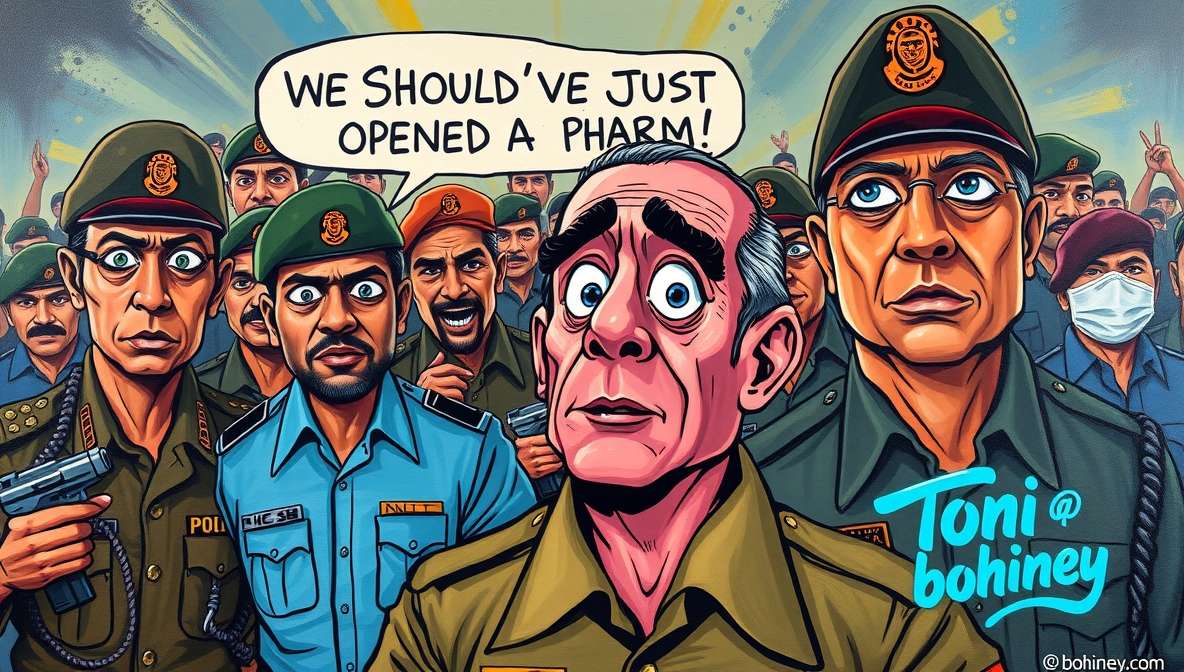
Police Seize 1,000 Kilograms of Illegal Drugs; Cartel Issues Self-Deprecating Statement on Profit Margins and Regulatory Burdens
1,000 Kilograms of Meth Seized in Delhi; Cartel Leadership Publicly Laments, ‘The Paperwork for This Is Worse Than Opening a Pharmacy’
NEW DELHI–In one of the largest drug seizures in Indian history, police successfully confiscated nearly 1,000 kilograms of methamphetamine in a raid near Delhi. However, the subsequent investigation took an unexpectedly satirical turn when sources within the detained cartel leadership issued a self-deprecating, deeply frustrated statement: the true catastrophe of their illicit operation was not the legal risk, but the soul-crushing administrative burden.
The cartel’s spokesperson, identified only by the codename “The Accountant,” sincerely confessed that the entire enterprise had become financially illogical. “We are genuinely disappointed,” The Accountant reportedly told an interrogating officer, employing the high-gravitas tone of a legitimate business failure. “The overhead, the logistics, the difficulty in obtaining pure chemicals, and the constant stress of inventory management–it’s all too much. We should’ve just opened a legitimate pharmacy. The profit margins are better, and the paperwork is likely less demanding.”
The Existential Crisis of Organized Crime

This statement, which transforms a systemic catastrophe into a relatable universal frustration, highlights the absurd parallel between highly organized crime and highly regulated legitimate business. The criminal archetype was subverted by assigning it the trivial, silly context of complaining about administrative labor.
A police official noted that The Accountant produced a fully detailed, notarized Cost-Benefit Analysis of Illicit Pharmaceutical Trade, which showed that the cartel’s internal regulatory compliance costs were exceeding 40% of their gross revenue. “They had internal auditors, quality control checks, and a surprisingly robust HR department for recruiting mule labor,” the officer confirmed. “They were undone not by a SWAT team, but by the sheer, unyielding weight of their own organized chaos.”
Dr. Kevin Li, a Professor of Bureaucratic Criminology at an unnamed university, noted that this is a predictable systemic failure. “When criminal enterprises mimic legitimate institutions, they inherit all the same points of failure. The only thing more frustrating than doing your taxes is doing your illegal organization’s fake taxes. This is functional chaos for the sake of profit.”
The entire operation was undone when a delivery driver failed to fill out the proper internal Manifest Form 33-B, which detailed the exact chemical composition of the shipment. Police were able to trace the shipment when “The Accountant” lodged a very angry complaint with his own Internal Investigations unit about the missing form.
The Administrative Downfall of Drug Trafficking
Law enforcement officials expressed surprise at the level of bureaucratic sophistication within the criminal organization. “We expected guns, money, and drugs,” said Deputy Commissioner Rajesh Kumar. “What we found was filing cabinets, performance review forms, and a surprisingly detailed employee handbook that included sections on workplace safety and mandatory vacation policies.”
The seized documents revealed that cartel members were required to attend monthly training seminars on topics including “Efficient Package Handling,” “Customer Service in High-Risk Environments,” and “Conflict Resolution Without Violence.” One confiscated memo complained about mandatory diversity training, noting that “cartel unity requires us to embrace our multicultural trafficking network.”
Financial Records Tell a Sobering Story
Forensic accountants examining the cartel’s books discovered meticulous financial records that would impress legitimate corporations. The organization maintained separate accounts for operational expenses, capital investments, and what they internally referred to as “compliance costs”–which apparently meant bribes, but were categorized with the care of a Fortune 500 company.
“They had quarterly earnings reports,” said one investigator. “They tracked key performance indicators. They even had a 401(k)-style retirement plan for senior members. It was less ‘Breaking Bad’ and more ‘Breaking Even.'”
Comedian Commentary on Corporate Crime
Comedian Jim Gaffigan said, “A drug cartel complaining about paperwork is the most relatable thing I’ve heard all year. We’re all just trying to file forms correctly, even if those forms are for international methamphetamine distribution.”
Jerry Seinfeld observed, “So they’re running a criminal empire, but the thing that really bothers them is filling out forms in triplicate? That’s not organized crime–that’s organized middle management.”
Ron White remarked, “I’ve lost money on stupider business ventures, but at least I didn’t have to worry about the DEA and quarterly profit projections at the same time.”
The Human Resources Nightmare
Perhaps most surprisingly, the cartel maintained detailed employee files including performance reviews, disciplinary records, and salary negotiations. One seized document showed a heated email exchange between “The Accountant” and a mid-level distributor who felt he deserved a raise based on “exceeding delivery targets for three consecutive quarters.”
The organization even had an internal mediation process for workplace disputes. “We found documentation of a formal complaint filed by one member against another for ‘creating a hostile work environment’ by playing loud music during transport operations,” said investigator Priya Sharma.
Amy Schumer noted, “They have better HR policies than most of the places I’ve worked. Should I be offended or impressed?”
Quality Control Obsession
The cartel’s quality control department rivaled that of pharmaceutical manufacturers. Product samples were tested for purity, consistency was monitored, and customer feedback was systematically collected and analyzed. One confiscated spreadsheet tracked “customer satisfaction ratings” with the same seriousness as a legitimate business.
“They had a Six Sigma certification program,” said one bewildered investigator. “They were applying lean manufacturing principles to methamphetamine production. It’s horrifying and impressive simultaneously.”
Bill Burr said, “Of course drug dealers have better quality control than my cable company. At least they care about customer retention.”
The Supply Chain Complexity
Documents revealed a supply chain operation of staggering complexity. The cartel tracked raw material sourcing, manufacturing timelines, distribution routes, and delivery schedules with military precision. They even maintained contingency plans for supply disruptions and had multiple backup suppliers for critical chemical precursors.
“This wasn’t a criminal organization–it was a vertically integrated multinational corporation that happened to be illegal,” said Interpol analyst David Chen. “They had vendor relationships, procurement contracts, and dispute resolution mechanisms.”
Chris Rock observed, “So illegal drug traffickers are more organized than the post office? That tracks.”
Technology Infrastructure
The organization invested heavily in technology infrastructure, maintaining encrypted communication systems, cloud-based file storage, and custom-built inventory management software. IT support tickets found during the raid included complaints about slow server response times and requests for software updates.
“They had an IT helpdesk,” said cybercrime specialist Lieutenant Anita Desai. “People were submitting tickets about password resets and printer connectivity issues. One guy complained that his laptop was ‘running slow’ and needed more RAM.”
Kevin Hart said, “Drug dealers with IT support tickets? That’s next-level professionalalism. I can’t even get my internet provider to answer the phone.”
Marketing and Brand Management
Investigators discovered that the cartel even engaged in marketing activities, including brand development, customer loyalty programs, and market research. Focus group data analyzed customer preferences for packaging, pricing, and product features.
“They had a marketing department,” said Detective Suresh Patel. “They conducted market analysis. They even tested different brand names for their products. This is late-stage capitalism applied to early-stage incarceration.”
Sarah Silverman quipped, “Drug cartels doing market research is peak 2025. What’s next, customer loyalty punch cards?”
The Regulatory Burden That Broke the Cartel
Ultimately, it was the self-imposed regulatory burden that proved unsustainable. The organization’s obsession with documentation, compliance, and process created the very paper trail that law enforcement used to dismantle the entire operation.
“Irony doesn’t begin to cover it,” said Police Commissioner Vikram Singh. “They tried so hard to run a professional operation that they created all the evidence we needed to prosecute them. If they’d just been disorganized criminals, they might have gotten away with it.”
Dave Chappelle said, “The paperwork got them. That’s the most middle-class ending to a crime story I’ve ever heard.”
Lessons in Organizational Dysfunction
Business school professors have already begun using the case as a teaching example. Harvard Business Review is reportedly preparing a case study titled “When Process Overwhelms Purpose: Administrative Collapse in High-Risk Ventures.”
“This demonstrates that excessive bureaucracy can undermine any organization, regardless of whether it’s legal,” said management consultant Dr. Elizabeth Morgan. “The pursuit of operational excellence became operationally self-destructive.”
Trevor Noah remarked, “Somewhere, a business school is teaching this as a cautionary tale about over-optimization. The lesson? Sometimes crime actually does pay–unless you over-manage it.”
The Pharmaceutical Alternative
The Accountant’s suggestion about opening a legitimate pharmacy wasn’t entirely facetious. Analysis shows that pharmaceutical retail can indeed be highly profitable with significantly less legal risk and comparable regulatory complexity.
“He wasn’t wrong,” admitted economist Dr. Rahul Sharma. “The profit margins on legitimate pharmaceuticals, especially in underserved markets, can be substantial. And while the paperwork is extensive, at least you don’t risk life imprisonment.”
Nate Bargatze said, “Opening a pharmacy sounds way easier than running a meth operation. Plus, you get dental insurance.”
International Implications
The seizure has attracted attention from international law enforcement agencies studying the evolution of drug trafficking organizations. The case demonstrates how criminal enterprises increasingly mirror legitimate corporate structures, creating both opportunities and challenges for investigators.
“Modern organized crime is organized,” said Europol analyst Marco Rossi. “That’s both the problem and, as we’ve seen here, potentially the solution.”
Tom Segura observed, “If your illegal drug operation requires an organizational chart with dotted reporting lines, you’ve gone too far.”
What Happens Next
Indian authorities are processing the largest drug-related prosecution in the country’s history. The Ministry of Law and Justice expects trials to last years, complicated by the sheer volume of documentary evidence the cartel thoughtfully provided.
“We have filing cabinets full of incriminating evidence,” said prosecutor Meera Krishnan. “They organized their own prosecution. It’s unprecedented.”
Bert Kreischer summed it up: “They got caught because they were too good at paperwork. That’s the most boring ending to a crime story ever, and I love it.”
Auf Wiedersehen, amigos.
Disclaimer: This story represents a collaboration between a philosophy major turned dairy farmer and the world’s oldest tenured professor. Any resemblance to actual drug busts, organizational dysfunction, or administrative nightmares is entirely intentional and possibly understated.