

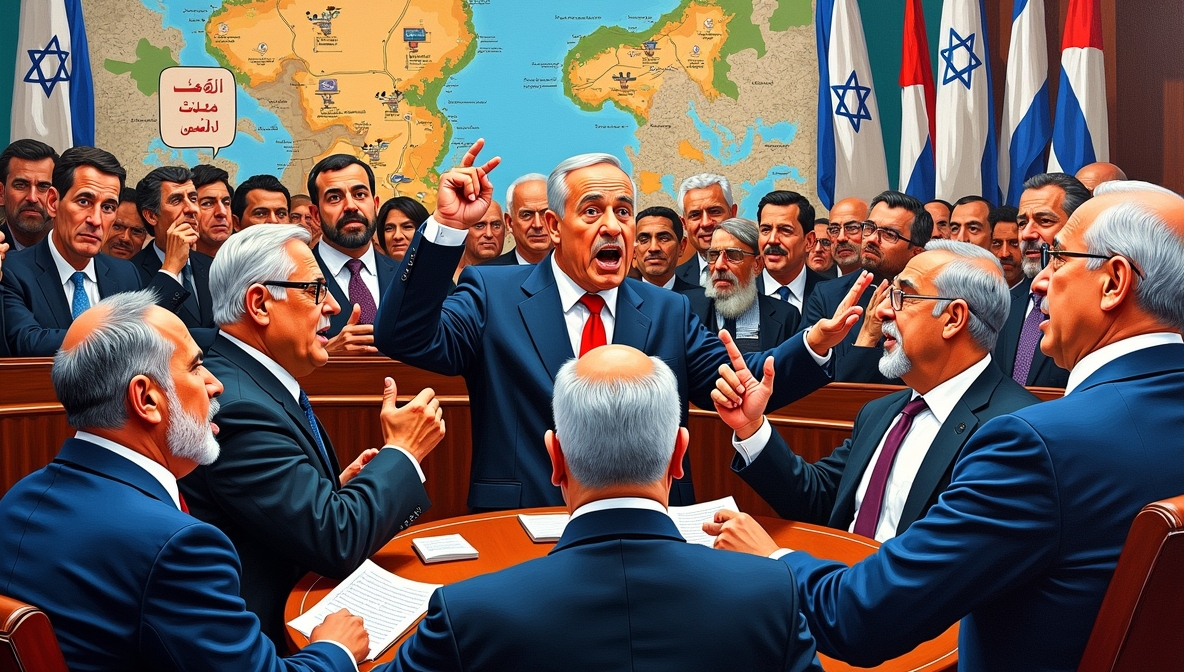
Netanyahu & Trump Walk into a Peace Plan: A Report
When “eternal peace” meets extended warranty logic and diplomatic theater
Eternal Peace in Three Hours: The Toaster Warranty Approach
Trump, fresh from a White House meeting with Prime Minister Netanyahu, stepped to the podium and proclaimed: “Today is a historic day for peace … let’s call it eternal peace in the Middle East.”
The audience blinked. Eternal peace in three hours? That’s like promising to fix climate change, solve world hunger, and teach cats to stop ignoring their owners — all before dinner.
One Congressional staffer whispered, “I can’t even get my printer to work.”
Trump thinks he can broker “eternal peace” in three hours — as though he’s selling extended warranties on toasters.
Flowery Praise and Coalition Thornbushes

Netanyahu, in full diplomatic mode, lavished praise on Trump’s plan. But then he leaned into his far-right base, pledging Israel would retain security prerogatives.
It’s like someone sending a “thank you” card and tacking on a note: “But also I might still take your car.”
Yes, the flowery language is suspect — coalitions prefer concrete pledges, or at least less hedging.
Netanyahu’s praise is full of “flowery language” — which is suspicious, since his coalition usually demands thorny barbs.
The Missing Guest: Hamas Wasn’t in the Room
Hamas wasn’t in the room, but somehow they’re the hinge of the plot. The deal calls for disarmament and exile — things Hamas may find troubling. Analysts at the Brookings Institution have noted that any sustainable peace agreement requires Hamas participation in negotiations.
A Hamas official said they’d “examine any proposal that does not conflict with the interests of the Palestinians.”
Which translates, in diplomatic speak: “We’ll look at it. Maybe after lunch. Perhaps with popcorn.”
Hamas is the ultimate party crasher — always the one not invited to the peace meeting, yet everyone expects it to RSVP.
Security Presence for the Foreseeable Future
The plan envisions Israel maintaining a security presence in Gaza “for the foreseeable future” — that is, forever-plus.
When someone says “for the foreseeable future,” what they often mean is “until we feel like leaving (or never).”
It’s akin to saying “I’ll always love you” but not committing to a date for the funeral.
Israel retains a “security presence” in Gaza “for the foreseeable future” — which is indefinite, vague, and thus perfect for political foot-dragging.
The 20-Point Plan That Leaves Thousands of Blanks
According to the plan, hostilities cease, hostages return within 72 hours, weapons are destroyed, Gaza is demilitarized, and a technocratic committee reigns until reforms occur.
Throw in Kushner, Blair, and a “Board of Peace.”
Yet many clauses “lack details.”
That’s like handing someone a cookbook with blank ingredient lists and telling them to eyeball it.
Diplomatic experts like Ilan Goldenberg warn that “the devil is in the details,” and without strong enforcement, the plan could stall indefinitely. Previous Israeli-Palestinian peace initiatives have faced similar challenges with implementation.
The 20-point plan lacks details — like giving someone a roadmap with blank spaces and telling them “just drive.”
Trump and Blair: Diplomacy Superteam or Comedy Duo?
The plan was “crafted with heavy input” from former British Prime Minister Tony Blair.
Two men walk into a room — one with red hair and a tan, the other with a British accent — to solve a war.
They could call their consulting firm “Conflict Resolution & Mild Regret.”
Blair brings foreign policy cachet; Trump brings showmanship; together, they bring the vibe of “we tried.”
Trump’s plan crafted with Tony Blair — a duo so iconic they might soon sell cologne: “Diplomacy Noir.”
Eye Contact Avoidance and Forced Friendliness
During the remarks, Netanyahu avoided eye contact with Trump. Meanwhile, he called him “friend.”
That’s like refusing to look at your hairdresser but saying you love your haircut.
Body language experts would call this high-level cognitive dissonance.
Netanyahu avoids eye contact with Trump while calling him “friend” — the body language of a hostage thanking her kidnapper politely.
Apologizing on Someone Else’s Behalf
As part of the deal, Netanyahu apologized to Qatar for an Israeli airstrike, at Trump’s urging.
It’s like your buddy says “sorry I punched your car,” and you — uninvited — apologize anyway.
It’s a delicate diplomatic dance: steps of contrition, missteps of pride.
Netanyahu apologized to Qatar on Trump’s behalf for an airstrike — like you’d say “Sorry I broke your favorite vase” for your buddy who has butterfingers.
The Hard Way vs. The Easy Way Threat
Netanyahu warned: “This can be done the easy way, or the hard way, but it will be done.”
He sounded like a landscaper threatening to mow the neighbor’s lawn for them.
It’s a car salesman’s line wrapped in military intent.
Also, “the hard way” in this conflict tends to involve real bullets — not lawnmowers.
Netanyahu says “this can be done the easy way or the hard way, but it will be done” — as though he’s threatening a lawn mowing job.
Peace Deals That Spoil Faster Than Milk
Historically, peace deals in this region have often unraveled swiftly. The UN’s documentation of Middle East peace processes shows a long history of stalled negotiations.
Observers note that initiatives “quickly fall apart.”
One Middle East analyst said this deal is “more likely to come to fruition” than others, if all parties hold heated feet to the fire.
But that’s a big if.
These agreements have shorter shelf lives than a carton of milk in Texas midsummer.
Deals fall apart quickly in this conflict — peace agreements here have shorter shelf lives than milk in July.
The Narrative: Peace Plan or Magician’s Trick?
Welcome, dear readers, to the Grand Illusion of Middle East Peace: now starring Donald Trump as the Great Diplomat and Benjamin Netanyahu as his reluctant assistant, with Tony Blair lurking in the wings like the guest judge on a bad reality show.
It all began with Trump declaring that Monday was one of “the great days ever in civilization” — a raise in rhetoric so audacious that even ancient Greek philosophers might spit out their amphorae in surprise. He promised “eternal peace.” If only my HOA board would promise eternal peace over my neighbor’s barking dog — I’d sign immediately.
Trump calls it “one of the great days ever in civilization” — setting the bar so high, even the invention of sliced bread looks puny.
Netanyahu’s Balancing Act: Friend and Foe
Netanyahu stepped up, using flowery praise worthy of a presidential candidate speech, then tucked in caveats powerful enough to trigger a coalition meltdown. He agrees — as long as Israel gets to keep boots in Gaza indefinitely. He praises Trump, but avoids his gaze. He apologizes to Qatar on Trump’s behalf for a missile strike. He threatens the “hard way” if Hamas balks. Pray, is this sincere or satire? Possibly both.
But here’s the rub: Hamas wasn’t in the room — yet it’s the linchpin. Trump and Netanyahu conjured a 20-point plan, calling for demilitarization, hostages released in 72 hours, a technocratic Gaza governance overseen by Trump + Blair, and an eventual path to Palestinian statehood.
Yet much of it is blank. Enforcement is contingent. Retention of Israeli security is indefinite. Terms are vague.
The Magic Contract With Missing Fine Print
It’s the old trick: hand someone a magic contract and cast a flourish, then let them fill in the blanks later — like a tax form you sign before reading.
Experts like Ilan Goldenberg warn that without sustained enforcement, the deal could collapse.
Arab countries issued tepid “welcomes” — like applauding politely after a karaoke song you’ve heard a thousand times.
Arab states “welcome” Trump’s announcement — much like you’d “welcome” your neighbor’s new rooster at 3 a.m.
Far-Right Ministers and Permanent Occupation Demands
Netanyahu’s far-right ministers, meanwhile, demand permanent occupation. They’re threatening to bolt if Israel pulls back. Reuters reporting on Israeli coalition politics shows how fragile these governing alliances can be.
Thus Netanyahu must balance: appease Trump, placate his base, and maintain plausible deniability.
Far-right Israeli ministers demand permanent occupation — like a roommate who refuses to pay rent but won’t move out.
The Board of Peace: Corporate Rebranding Meets Conflict
In effect, what passed as a peace deal is something more like a suspect warranty: “We’ll fix things — unless something changes, regulations intervene, or Congress cuts funding.”
The greatest trick the negotiators played was convincing everyone they were serious while leaving every door open to backtracking.
If peace fails, they’ll say: “Oh, well, the deal wasn’t perfect. We’ll renegotiate.”
And if peace succeeds, they’ll claim prophetic foresight.
The “Board of Peace” will include Trump and Blair — sounding more like a corporate rebranding of “Board of Conflict.”
Demilitarization Depends on Ongoing Agreement
Demilitarization of Gaza depends on ongoing “agreement” — i.e., terms subject to change, depending on how the wind blows.
When diplomats say “ongoing agreement,” what they mean is “we’ll agree when we feel like it, and we reserve the right to change our minds at any moment.”
It’s the diplomatic version of “let’s play it by ear” — which is code for “this probably won’t happen.”
Helpful Advice: How to Navigate Diplomatic Theater
Demand the full contract — insist that peace plans come with footnotes, enforcement clauses, and clearer timelines. No blanks.
Watch the body language — if bilateral lovefest speeches are paired with zero eye contact, expect silent foot stomping.
Don’t trust eternal promises — “eternal peace” is diplomatic hyperbole; always ask: eternal until when?
Insist on all parties present — a negotiating table is no use if a key party is absent (e.g. Hamas).
Monitor enforcement metrics — specify checkpoints, timelines, and third-party observers.
Be skeptical of celebrity diplomacy — Blair + Trump sell drama, not necessarily durable peace.
Hold people to their words — if someone says “the easy way or the hard way,” remind them we’re not signing up for a landscaping gig.
Use public pressure — polls, media scrutiny, and voter attention can force politicians to stick to their promises.
A Brief (Ironic) Disclaimer
This satirical story is entirely a human collaboration between two sentient beings — the world’s oldest tenured professor (who insists on long footnotes) and a philosophy major turned dairy farmer (who thinks butter is the greatest invention). No AI was blamed for writing this — though AI did help me proofread my puns (but only after I negotiated a royalty).
Auf Wiedersehen — until the next diplomatic miracle.
For actual news coverage, visit The Washington Post and other reliable news sources.