

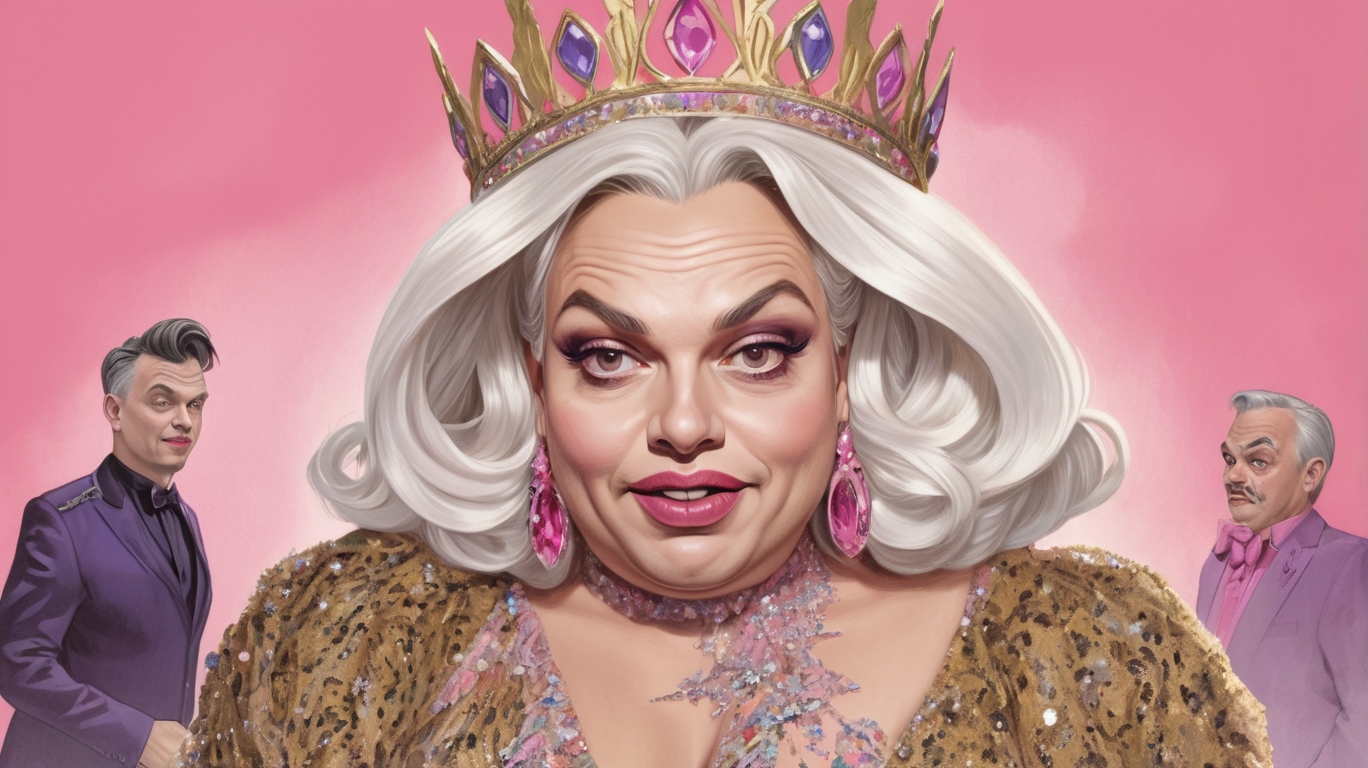
Viktor Orban Mistaken for Drag Queen, Wins Local Pageant
Hungarian Government Fines Self After Facial Recognition Misidentifies Cabinet, Greta Thunberg Accused of Weaponized Glitter Deployment
BUDAPEST, Hungary — In a series of increasingly bizarre developments following this year’s unexpectedly fabulous Budapest Pride, Prime Minister Viktor Orban is reported to have accidentally won the Miss Paprika Drag Pageant 2025 after being misidentified by the very facial recognition software he authorized to suppress LGBTQ+ expression. The incident has plunged the Hungarian government into what experts are calling a “satirical feedback loop with no known exit.”
Orban’s Rainbow Face
A Rainbow-Colored Glitch in the Matrix
It all began at 14:37 local time when Budapest’s state-installed surveillance system—code-named Project Purity—flagged a drag queen with “suspicious resemblance to state leadership.” Surveillance analysts were allegedly stunned when the face-matching AI declared with 97.6% certainty: “That’s Orban, but make it fashion.”
Within minutes, security forces arrived at the stage of the Miss Paprika Drag Pageant, prepared to make a symbolic arrest. Instead, they were greeted by the crowd chanting, “Werk it, Vik!” while a contestant—clad in a bedazzled hussar uniform and platform boots—blew kisses and winked.
“I just thought it was a look-alike act,” said judge Zsófia Banai, wiping a tear. “But when she did the goose-step in stilettos? That’s when I knew it had to be the real Viktor.”
Cabinet of Clones: The Great Misidentification Scandal
In the aftermath of the pageant debacle, the Hungarian government was forced to admit that the facial recognition database had incorrectly flagged 41 members of the Fidesz cabinet as various drag queens, Broadway performers, and in one case, Barbra Streisand.
Interior Minister Sándor Pintér was fined 430,000 Forints after being misidentified as a trans rights activist known as Glitter Papi, who had lip-synched to Beyoncé’s “Run the World” on the Buda Castle steps.
“It’s a system glitch,” said government spokesperson Zoltán Kovács. “Or possibly divine justice. Either way, we’re investigating.”
The official government ledger now shows that five different ministries were fined under their own Child Protection law—a law that, ironically, may soon be rebranded as the “Self-Owning Statute.”
Glitter Bombshell: Greta Thunberg Goes Full Disco
Adding fuel to the political inferno was Swedish climate activist Greta Thunberg, who appeared at Pride wearing what state media later called a “tactical sequined harness.” The Fidesz Party accused Thunberg of deploying “weaponized glitter” via drone at strategic intersections in downtown Budapest.
According to a leaked memo from the Hungarian Ministry of National Defense, the glitter allegedly impaired surveillance drones, blinded traffic cameras, and “temporarily increased morale in urban zones by 78%.”
Greta has neither confirmed nor denied the accusations, but posted on her Instagram: “If a biodegradable glitter canon makes your regime collapse, perhaps your regime wasn’t very sturdy.”
The UN has yet to weigh in, but insiders suggest the Security Council is split between “investigating war crimes” and “asking where she bought the boots.”
Mayor Karácsony: “I Did This for the Outfits”
Amid the chaos, Budapest Mayor Gergely Karácsony gave a candid interview to Magyar Madness, Hungary’s only openly satirical political zine. When asked about his motivations for defying the national ban and hosting Pride, he replied:
“Look, was it a human rights decision? Yes. Was it a political stand? Absolutely. But honestly? I mostly did it for the outfits. I mean, have you seen the feather capes? I’d trade a coalition vote for a rhinestone sash any day.”
He later clarified that city funds had not been spent on feather boas, though receipts from the Mayor’s Office suggest otherwise. One expense report lists “emergency glitter insurance” and “empathy consultants.”
The opposition has accused him of frivolity. Supporters have launched a petition to officially rename him “Glam Gergely.”
Confetti: The Final Straw
In a last-ditch effort to restore order, the Fidesz Party has now declared war on confetti. Parliamentary Resolution 88/2025 states:
“Confetti is inherently chaotic, subversive, and refuses to respect gravity or nationalism.”
This follows an internal report that found confetti was directly responsible for at least three ministers slipping on the Parliament steps, one of whom fractured his pride.
New legislation will restrict the sale, distribution, or joyful deployment of confetti within 150 meters of any government building, statue, or national sausage stand. Repeat offenders may face up to five years in a “moral reeducation spa,” which critics claim is just a hot tub with state-approved literature.
Fidesz MP Mária Tóth warned the nation during a televised address:
“First it’s glitter, then it’s confetti, then it’s anarchy. This is how democracy ends—sparkling.”
Orban’s Rainbow Face: From T-Shirt to Tender
The final twist came on Monday, when Hungary’s National Mint accidentally minted a batch of limited-edition commemorative coins bearing the glamorized visage of Viktor Orban in drag. The coins were supposed to feature King Matthias Corvinus but were printed using an image mistakenly uploaded by an intern named Dóra, who has since been promoted to Creative Director of Currency.
The coins—dubbed “OrbanFlairz”—feature the Prime Minister with smoky eyeshadow, glitter stubble, and the inscription “Unity Through Fabulousness.”
By Tuesday, the OrbanFlairz were being traded at twice their face value, with collectors from Vienna to Vatican City calling them “post-authoritarian chic.” In a rare moment of market success, Hungary’s Forint briefly overtook the Euro in symbolic relevance.
Economists say the OrbanFlairz has achieved what no policy could: a currency based entirely on sarcasm.

Humorous Observations From the Ground
-
A Pride marcher carrying a sign reading “Viktor Wears Prada” was offered a government grant—until officials realized it wasn’t ironic.
-
Facial recognition now mistakes Hungarian folk dancers for anarchists if their vests are too sequined.
-
Police complained that the parade disrupted “normal order.” One officer was quoted whispering, “But the vibes were immaculate.”
-
Pride’s theme, “We’re Not Going Quietly,” was misquoted by state TV as “We’re Not Going Home,” causing 78 think pieces on homelessness.
-
The rainbow flag over the Danube is now visible from space. The Hungarian Space Observatory reports Orban’s eye is “crying glitter.”
-
A drag queen dressed as the Hungarian constitution read articles aloud until the crowd burst into tears—then confetti.
-
Greta Thunberg’s hologram may or may not have led a synchronized voguing protest inside a Tesco.
-
Orban’s image on a Pride flag was cited as “artistic terrorism” by Fidesz—then added to a state museum when tourists loved it.
-
The Ministry of Morality was disbanded after its director came out as bisexual during a karaoke rendition of ABBA’s “Super Trouper.”
-
Orban allegedly called for calm during a closed-door meeting but misspoke, saying “Camp,” which was then livestreamed and turned into a TikTok challenge.
-
Hungary’s national anthem was remixed into a disco version called “March of the Glam-Goulash.”
-
A small group of elderly citizens mistook Pride for a national holiday and joined in, waving flags and demanding pensions in sequins.
-
Orban has denied all accusations of drag—but confirmed he “likes a strong brow and a structured silhouette.”
-
A rogue AI chatbot in Parliament began responding “YASSSSS!” to every conservative policy proposal.
-
Tourism has surged. Airbnb listings now include “Glitter-Proof Balconies” and “State-Surveillance Saunas.”
What the Funny People Are Saying
“Only in Hungary could a dictator become a drag icon by accident. It’s like Mussolini starring in RuPaul’s Drag Race: Axis Powers Edition.” — John Oliver
“Orban’s drag look? More like Haus of Hypocrisy, darling.” — Bianca Del Rio
“This is why you don’t ban glitter. It finds you. And it judges.” — Chris Rock
“Facial recognition mistaking your cabinet for cabaret stars? That’s not a glitch—that’s divine intervention.” — Larry David
“Greta Thunberg has gone from eco-activist to fabulous warlord. I stan.” — Amy Poehler
“The Forint is now backed by sarcasm and eyeliner. Central Bank just said ‘Slay.’” — Wanda Sykes
Hungary’s Future: Satirical or Simply Sparkly?
Political analysts are divided. Some say Hungary is on the brink of collapse; others believe it has entered a new post-ironic utopia where power is policed by humor and the Constitution is now read to a beat.
In a recent poll conducted by Pesti Polls & Puppets, 61% of citizens said they “support human rights if they come with good costumes.” Another 27% said they were “just here for the vibes,” and 12% were still waiting for facial recognition to let them know who they are.
The Hungarian Parliament will reconvene next week to vote on Bill 138: The Anti-Fab Amendment, which would limit expressive gestures to those previously approved by the Ministry of Somberness.
Meanwhile, the people keep dancing.
Auf Wiedersehen, authoritarianism.
BREAKING NEWS
Hungarian Government Fines Self After Facial Recognition Misidentifies Cabinet
In a digital age twist only Kafka could love, Hungary’s right-wing government accidentally fined itself this week after state-deployed facial recognition software confused several cabinet members with drag queens, club DJs, and at least one Lady Gaga impersonator.
The incident began when the surveillance system—originally installed to monitor “inappropriate rainbow behavior”—flagged Minister of Justice Judit Varga as “Miss Sappho Deluxe,” a popular performer at Budapest’s Club Flamboyant. Prime Minister Viktor Orban was also briefly detained after the AI mistook his scowl and high-collared jacket for “Haus of Gloom couture.”
Internal memos reveal the government issued 43 fines, totaling 2.3 million forints, before realizing they were ticketing their own bureaucracy. One cabinet member attempted to appeal the fine, only to be flagged again for using too much highlighter in his Facebook profile picture.
“This is not a failure,” said the National Security Minister. “This is proof the system is unbiased. Even we can’t escape our own absurdity.”
A new directive now requires all ministers to wear “boring face stickers” to avoid future mix-ups.
Meanwhile, Budapest’s drag scene is thriving, boosted by unintentional endorsements from half the ruling party. A new show titled The Cabinet of Glam premieres next week—with Orban’s frowning visage on the poster.
Greta Thunberg Accused of Weaponized Glitter Deployment
Swedish climate activist Greta Thunberg is under investigation in Hungary for allegedly deploying “weaponized glitter” during the Budapest Pride march, a move state media is calling an “act of eco-anarcho-sparkle sabotage.”
According to Hungarian authorities, Thunberg was observed launching biodegradable glitter from a solar-powered drone over Elizabeth Bridge, temporarily blinding three surveillance cameras and inspiring spontaneous voguing among local youths. “She weaponized joy,” declared Fidesz spokesperson Zoltán Kiszelly, dabbing glitter off his blazer.
In a now-viral moment, Orban’s police chief dramatically held up a confiscated glitter canister during a press conference and declared, “This is not just party supply—this is subversion in a bottle!”
Thunberg, unfazed, posted on Instagram: “Glitter is carbon-neutral. And fabulous.”
Hungary’s National Bureau of Tactical Seriousness has formally requested extradition, but the Swedish government has instead nominated her for a Nobel in “Mood Enhancement.”
Conservatives warn this is the beginning of a new tactic: Eco-Glam Warfare. “What’s next?” asked one panicked host on state TV. “Reusable boas? Solar sequins?”
Meanwhile, youth turnout for climate activism has surged. Hungarian teens are forming “Glam Squads for Earth,” hosting zero-emissions dance protests.
One protester said, “If Greta wants to bomb us with sparkle, we surrender. Please—rain it down.”
UN officials remain amused but unconcerned.
Mayor of Budapest Admits: “I Only Did This for the Fabulous Outfits”
In a surprisingly candid moment during a post-Pride press conference, Budapest’s Mayor Gergely Karácsony admitted the real reason he defied Viktor Orban’s ban on the parade: “I did it for the outfits. The politics were a bonus.”
Reporters were stunned as Karácsony, wearing a sequined cravat and rainbow loafers, explained how the city’s annual fashion calendar had been “dreadfully dull” since the 2018 crackdown on jazz hands and glitter eyeliner in official events.
“I was bored of grey suits, grey skies, and greyer policies,” said the Mayor. “Pride gave us color, sass, and six-foot-tall stiletto boots. I wept.”
The confession prompted mixed reactions. Fidesz called it a “catastrophic breach of governance.” Hungarian youth, however, immediately began printing T-shirts with the phrase: “Fabulous Resistance.”
Karácsony also revealed that the city’s official guest list included stylists, drag coaches, and a seamstress from Vienna code-named “The Hemline Prophet.”
When asked about future events, the Mayor shrugged. “We’ve already booked the State Opera for a voguing championship.”
Critics accuse Karácsony of dereliction of duty. Supporters argue he’s finally restored joy to city politics.
One attendee summed it up: “He may not have fixed potholes, but he healed my inner child—and that’s infrastructure too.”
Fidesz Party Declares War on Confetti, Declares It ‘Too Chaotic’
In its latest crusade against joy, Hungary’s ruling Fidesz party has declared war on confetti, calling the decorative staple of celebration “an agent of chaos, moral erosion, and wrist sprains.”
According to a leaked parliamentary draft, confetti will now be classified as a Schedule C Symbol of Subversion, alongside flash mobs, ironic memes, and unsanctioned glitter. The proposed ban cites multiple injuries caused by confetti “ambushes,” including a lawmaker who allegedly slipped during a surprise birthday shout-out.
“Confetti has no respect for gravity, hierarchy, or the Hungarian family,” said conservative MP Márta Hegedűs. “It flies where it wants—like anarchy with a paper trail.”
New regulations require confetti to be biodegradable, state-approved in color (white, red, or melancholy blue), and launched only during “patriotic exhalations” like state funerals or tax announcements.
Police have already raided two party stores, seizing 11 kilograms of “rainbow contraband.” One Budapest bachelorette party was forcibly disbanded when authorities discovered illicit heart-shaped sprinkles.
A counter-protest group, calling themselves the “Confettiratti,” has vowed to “shower resistance” at every Fidesz press conference.
The EU responded with cautious humor. One diplomat tweeted, “Hungary: Banning everything except delusion.”
As for the confetti? It remains airborne—taunting tyranny one paper speck at a time.
Viktor Orban’s Rainbow Face Becomes National Currency
In what economists are calling a “high-camp monetary accident,” the Hungarian National Mint has accidentally printed a limited run of commemorative coins bearing a rainbow-colored, glammed-up portrait of Prime Minister Viktor Orban.
The coins, intended to honor the country’s 2025 fiscal reform, were misprinted after a junior mint designer accidentally uploaded a Pride-themed meme of Orban in heavy eye shadow and sequins. By the time officials noticed, 200,000 coins had entered circulation.
Instead of recalling them, the National Bank issued a formal statement: “The market has spoken. Fabulousness is inflation-proof.”
Dubbed the “OrbanFlair,” the coins feature a smoky-eyed Prime Minister framed by the words: “Liberty, Glitter, Tax Reform.” Within days, the currency spiked in value as collectors across Europe clamored for it.
“The irony is liquid gold,” said one Dutch numismatist. “It’s the first fascist currency you’d actually want to frame.”
Fidesz attempted to ban the coins but accidentally legitimized them under a 2019 law protecting “national expressions of pride.”
Budapest merchants now advertise “glam-friendly pricing,” and a drag bar has offered OrbanFlair-only cocktails.
Asked for comment, Orban muttered, “We will fix this mistake”—but was later spotted discreetly flipping a coin with his own rainbow face.
Onlookers say: he smiled.