

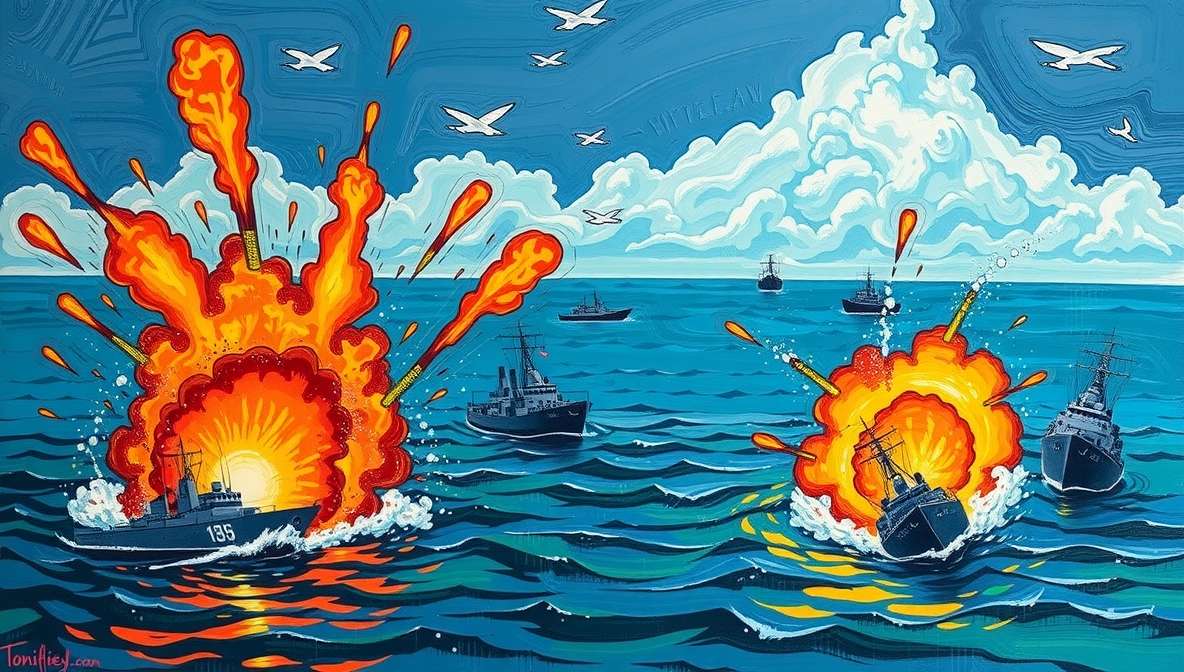
China’s “Narrow Options” Plan: A Comedy of Waterways

Every empire dreams of glory. Some dream of soybeans. Others dream of silicon. But the empire du jour—let’s call it Big Party China—seems to have traded in its dream-scroll for a really annoying game of Battleship. According to a recent dispatch titled “China’s Taiwan options narrow as U.S., allies fortify key waterways,” much of Beijing’s plan has gone from “sneak-in-by-sea” to “Whoa, why is everyone staring at the map?”
Basically, the United States and a handful of its allies have decided to play various versions of “Don’t you dare sail through here.” They’re fortifying chokepoints. They’re turning maritime routes into high-stakes game shows. That leaves China with fewer credible waterway routes—which, in grand imperial terms, is like wanting to throw a surprise party but discovering every door is locked, and the windows are watched by panicked neighbors with binoculars.
Naturally, that’s given Beijing a serious case of strategic indigestion.
When Naval Strategy Meets Reality TV
The new waterways blockade has turned Beijing’s navy from sleek war-minded tsars into something more like an apologetic Uber trying to find an open lane. Taiwan’s defenders—plus allies—now act like overly protective bouncers at a club, patting down every ship before letting it pass. As Jerry Seinfeld said, “You know what I hate? When you’re trying to get somewhere and there’s a guy standing in front of every door going, ‘Not today, buddy.'”
China’s planners probably feel like a teen left out of the group chat—”why’s nobody letting me in?” This is less “art of war” and more “art of being permanently stuck in traffic.” The water lanes have become so monitored it’s like shipping routes are auditioning for a spy thriller.
The Maritime Diet Plan Nobody Asked For
China’s options narrowing is a bit like a dieting plan gone wrong—you cut carbs, then get angry when you’re still hungry. Every allied fortification added is like putting another padlock on China’s maritime diary. Amy Schumer noted, “I love when people tell me I have ‘options.’ Yeah, I have options—they’re just all terrible.”
China might soon start fantasizing about teleportation—or at least teleporting their ships. The landscape resembles a cosmic board game where China discovered too late that the box says “Do Not Pass Go.” It’s roast night for fleets—and China’s navy is the only one on the spit.
The Chokepoint Chronicles
China’s strategic planners now have more “no-go zones” than adulting rulebooks do. The new waterways blockade is effectively turning the Pacific Ocean into a “Do Not Disturb” sign. China’s dual-use ferries (yes, civilian ferries they hoped to sneak past) are now being stared down like suspicious uncles at a PTA meeting.
Any ship approaching these waterways now needs more permission slips than a high-school field trip. If this were a rom-com, it’d be “Forbidden Waters: When China Couldn’t Get a Date.” Dave Chappelle said, “You ever try to sneak into somewhere and realize everybody already knows you’re coming? That’s not sneaking—that’s just showing up embarrassed.”
Tales from the Deep: Behind the Satire
See, when you hear “options narrowing,” it typically means someone sold their car, lost their job, and now drinks instant coffee instead of lattes. In geopolitical terms, it’s far less depressing—but only by a hair. In this case, the narrowing refers to sea lanes, naval access, and that important maritime wiggle-room that big powers rely on when they think they can just “swipe right” on an island and ghost it.
Because here’s the thing: a chunk of global trade moves through maritime chokepoints. Block them, and you don’t just inconvenience a country—you mess with global supply chains, real-time shipments, and occasionally, the entire concept of “just-in-time delivery.”
So when allies start reinforcing those chokepoints—escorting ships, boosting aerial surveillance, tightening naval patrols—they don’t just build walls in water. They erect something more elaborate: a bureaucratic aquatic theme-park of suspicion, where every vessel gets frisked, every anchor gets eyed, and every ferry gets mentally fingerprinted.
When Your Night Vision Goggles Turn Out to Be 3-D Glasses
For Beijing, this isn’t just inconvenient. It’s the equivalent of realizing that your night vision goggles turned out to be 3-D glasses—and someone switched off the lights. Bill Burr said, “Nothing’s worse than thinking you’re sneaky and then finding out everyone’s been watching you the whole time like you’re on a reality show.”
What’s even richer is that some of China’s previous “clever” ideas—like converting civilian-use ferries into amphibious invasion craft—now get sidelined by logistics plus collective eyebrow-raising. Patterns observed by Western intelligence suggested such dual-use vessels were being modified precisely for that reason. But when the adversary installs cameras, radar, drones, and probably a supervisor named Karen asking “are you sure you belong here,” the surprise attack becomes more like a surprise party—where everyone shows up and glare-photos are taken.
So what do you do when your surprise-navy gets turned into a tourist fleet under surveillance? You either reinvent tactics or spend a lot of time boiling soybeans in existential frustration.
Satirical “Helpful Advice” (Because Satire Needs a Purpose)
If you were advising Beijing (and I’m totally not, but humor me), you might say: Maybe don’t put all your eggs in amphibious ferries. Maybe treat diplomacy and trade like—I don’t know—something other than firewall-bait for allied military coordination. Maybe invest less in “surprise beach landings,” and more in, say, “not giving the entire Pacific powers the excuse to align against you.”
Chris Rock said, “You know what’s crazy? When you spend all your time planning something sneaky and then act surprised when people don’t trust you anymore.” Alternatively: become extremely good at boat-hopping illusions. Hire magicians. Learn how to teleport. Or maybe just start building lots of underground sea tunnels. (Because nothing says “dominant regional power” like subterranean logistics.)
If you’re in the position of the allies: good job. Keep watching the water, keep tightening chokepoints, keep playing “guess who’s messing around in the strait.” But also—maybe find better hobbies than staring at dark waters all day. Try mindfulness. Or knitting. Anything that doesn’t involve drones.
The Ferryman’s Dilemma
The Department of Defense has been particularly vocal about monitoring dual-use vessels, which sounds fancy until you realize it just means “boats that could maybe be sneaky.” Taiwan’s defense ministry has echoed similar concerns, noting increased activity near sensitive waterways. Meanwhile, Japan’s Self-Defense Forces have quietly ramped up patrols, because nothing says “neighborhood watch” like a destroyer flotilla.
Ricky Gervais said, “I love when governments say they’re ‘monitoring the situation.’ That’s code for ‘we’re watching you mess up in real time.'” The Philippine Navy has also joined the vigilance party, turning the South China Sea into something resembling a heavily supervised pool party where nobody’s allowed to splash.
Moral of the Comedy: When Strategic Options Narrow, So Do Nightmares
At the end of the day, the lesson here is that naval power is not just about big ships and bravado. Sometimes it’s about geography, supply lines, and whether your enemies have enough binoculars to track your every move. For those plotting in Beijing, the oceans just got a lot more crowded—with surveillance, suspicion, and the creeping dread that your amphibious fantasies might have just been boarded by reality.
Kevin Hart said, “You know you’re in trouble when your plan A, plan B, and plan C all require nobody noticing what you’re doing—and everybody’s already noticed.” So you’ve got your strategic bluff called. You’ve got your waterways locked down. You’ve got global shipping lanes living their best life under protective escort. And China’s left scratching its head, trying to figure out if maybe it should have invested in something else—like soybeans, or maybe a brand of surprisingly sturdy umbrellas.
The Pentagon, NATO, and various Indo-Pacific partners continue to coordinate what they’re calling “freedom of navigation operations,” which is diplomatic speak for “we’re watching every boat you’ve got.” Even Australia’s defense forces have gotten involved, proving that when it comes to maritime security, the neighborhood watch extends well beyond the neighborhood.
From the smoky musings of an old professor, and the cow-talks of a former philosophy major turned dairy farmer: sometimes the sea isn’t where you find power. Sometimes, the sea is where power finds you.
Related Coverage:
- The New York Times – Asia Pacific
- BBC News – China
- CNN International
- Reuters World News
- NPR International
- Voice of America News
Auf Wiedersehen, amigos.