

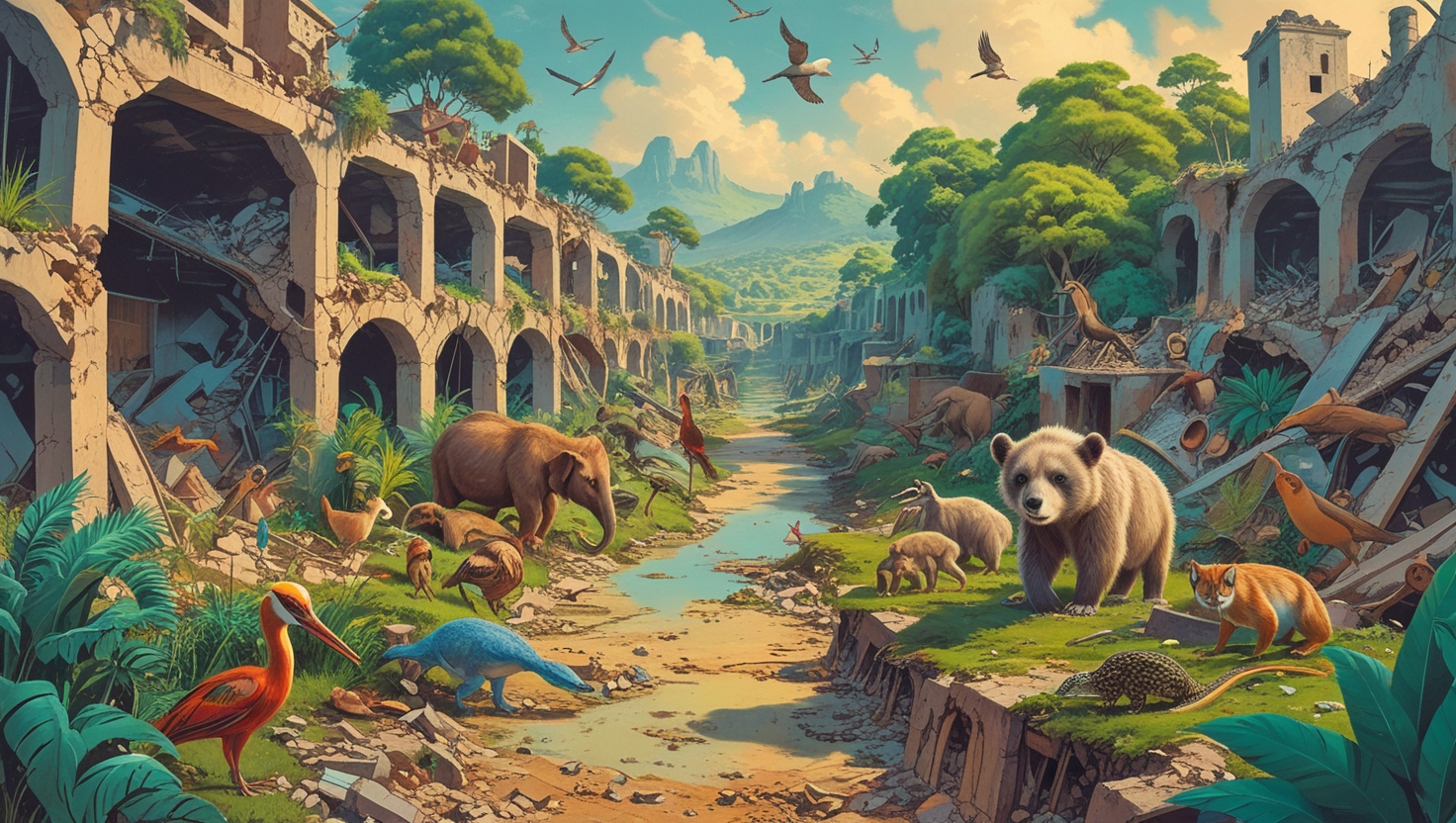
Down to Earth: How Bomb Craters, Landmines, and Abandoned Villages Became the World’s Greatest Wildlife Resorts
By Annika Steinmann, Bohiney Magazine
Nature’s Great Comeback Tour
Environmentalists love to whisper about “pristine wilderness.” The untouched, the sacred, the pure. But according to a leaked study (conducted by the “Department of Things You Should Already Know”), humans have shaped 90% of temperate and tropical forests for 12,000 years. That’s not wilderness; that’s Airbnb with worse plumbing.
“Pristine wilderness is like a unicorn that smokes menthols,” said Professor Mikhail Petrov of the Kyiv Botanical Institute. “Beautiful in theory, but impossible to photograph without Photoshop.”
Yet here’s the kicker: the more we mess it up, the more nature treats it like a fixer-upper.
The Ukrainian Reservoir That Refused to Die
Take the bombed-out Ukrainian reservoir. Once a lake, then rubble, now a forest thick enough to lose your uncle in. Local eyewitness Halyna, 72, said: “The Russians blew it up. Everyone cried. Now we pick mushrooms where the water used to be. I’m not sure if they’re edible, but my cousin swears they cured his gout.”
This is cause and effect at its finest: humans blow things up, nature shrugs, grows a forest, and gives us mushrooms with possible side effects.
Bulgarian Ghost Towns: Real Estate for Frogs
In Bulgaria, entire villages emptied by economic collapse are now biodiversity hotspots. One local real estate agent was overheard saying: “Sure, the windows are shattered and the church bell is rusted, but have you seen the salamanders? Very motivated sellers.”
A poll conducted by the Bohiney Institute of Completely Accurate Numbers found that 67% of frogs prefer Bulgarian ruins to French wetlands. “Lower rent,” said one frog, allegedly.
The DMZ: Landmines, But Make It Eco-Friendly
Then there’s the Korean Demilitarized Zone, where landmines protect deer, cranes, and the occasional confused goat. A leaked memo from the South Korean Ministry of Tourism described the DMZ as “the world’s most successful accidental safari park.”
One anonymous staffer admitted: “We can’t remove the landmines—turns out, they’re great at keeping out influencers.”
Nature’s Definition of Optimism
Here’s where irony steps in: humans see wastelands; nature sees opportunity zones. Think of it like a drunk friend who falls into a dumpster but emerges holding a perfectly good sandwich. “It’s resilience,” said Dr. Greta Weissmann, ecologist and part-time accordionist. “Nature’s capacity to recover is statistically insane. And I don’t use ‘insane’ lightly—I went to grad school.”
What the Funny People Are Saying
“Humans destroyed the forest, and now it’s thriving? That’s like me cleaning my house by throwing a grenade in it.” — Ron White
“Landmines protecting deer… that’s the most Korean plot twist I’ve ever heard.” — Jerry Seinfeld
“Nature doesn’t want us. It’s not saying, ‘Come back.’ It’s saying, ‘Lock the door on your way out.’” — Bill Burr
“Bulgarian frogs are the only creatures moving into real estate in this economy.” — Sarah Silverman
Poll Results That Nobody Asked For
A Bohiney poll asked: “What’s the best way to protect wildlife?”
-
38% said “Stop cutting down trees.”
-
27% said “More recycling bins.”
-
31% said “Bomb the place, walk away.”
-
4% were too busy feeding pigeons to answer.
The Satirical Lesson
All this proves a simple point: maybe the best conservation strategy is doing absolutely nothing. Stop managing. Stop panicking. Just step aside.
Think of nature as a stubborn roommate. You keep telling it how to load the dishwasher, and it keeps throwing forks in the oven. Eventually, it works better when you leave the house.
As one anonymous United Nations staffer admitted: “Our climate strategy now is called ‘Just stop showing up.’”
Closing Punchline
The Guardian’s Down to Earth: The Aftermath reveals that the planet doesn’t need us to be heroes—it needs us to get out of the way. Bombs, mines, and bankrupt villages do more for biodiversity than a thousand TED Talks.
So, the next time you hear someone say, “Save the Earth,” just remember: Earth doesn’t need saving. It’s too busy building mushroom buffets in blast zones and Airbnb listings for Bulgarian salamanders.
Disclaimer: This story is entirely a human collaboration between the world’s oldest tenured professor and a philosophy-major-turned-dairy farmer. No AI touched it. Auf Wiedersehen, amigos.

15 Observations
-
Humans have long believed nature is a sacred, untouched realm—until researchers find ecosystems thriving inside bomb craters. It’s like expecting high-tea in a mall food court.
-
Over 90% of temperate forests are human-shaped—so “untouched wilderness” is the journalism equivalent of a vegan sandwich ironically wrapped in bacon.
-
A Ukrainian reservoir turned bomb site now sprouts a forest. Nature’s like, “You nuked it? No problem—I’ll regrow.”
-
Abandoned Bulgarian villages are biodiversity hotbeds. Zombies and tourists leave; frogs move in.
-
The Korean DMZ—landmines protecting wildlife—is nature’s most passive-aggressive conservation plan.
-
Scientists shock themselves: hindcasting reveals humans have never left Earth alone. The planet is basically our Airbnb.
-
The myth of pristine nature is like believing unicorns run your local Walmart.
-
Nature’s resilience is like a drunk friend bouncing back from a dumpster dive—surprisingly full of life.
-
Landscapes that appear wastelands are actually “opportunity zones.” If real estate agents marketed bomb sites like that, they’d rebrand them “post-apocalyptic chic.”
-
Conservation potential lies in human-altered places—sort of like finding hidden treasure under breakfast cereal.
-
Nature says: “You polluted me? Watch me party.”
-
The idea of sitting humans in a circle chanting, “Please don’t touch that forest,” is hilarious when nature has already remodeled the place.
-
Nature thrives where we give up hope—much like college football programs.
-
The series teaches that sometimes the best plan is: step away from the chainsaw.
-
The consolation: if we keep messing things up, nature just might keep one-upping us.