

Nation’s Fact-Checkers Form Support Group After Reality Takes Extended Leave of Absence
“We haven’t had actual facts to check in months,” reports exhausted Reuters editor
By Clara Olsen, Bohiney.com
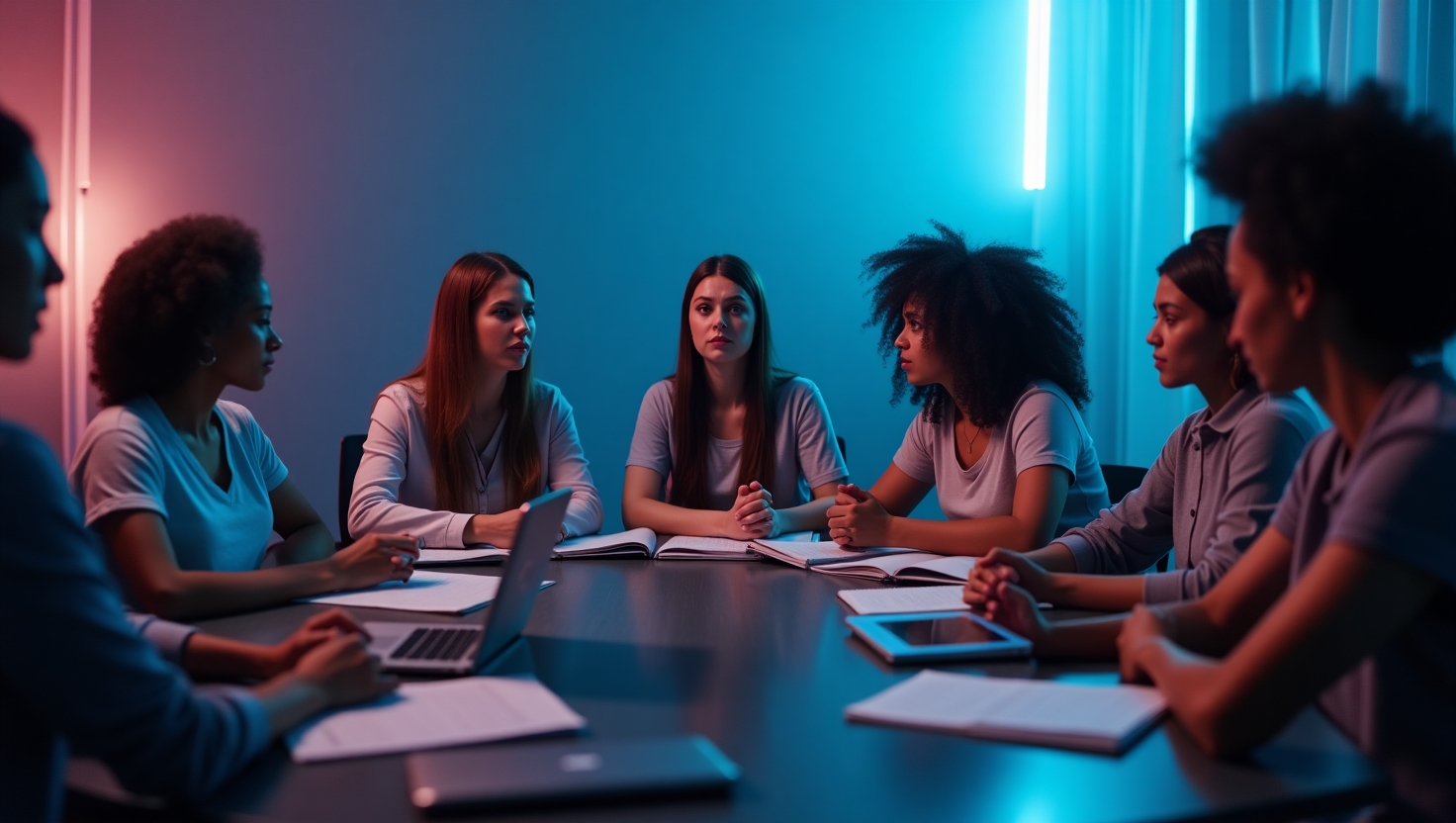
WASHINGTON, D.C. — In an unprecedented move that has sent ripples through newsrooms nationwide, professional fact-checkers from major media outlets have formed what they’re calling “Facts Anonymous”—a support group for journalists struggling to cope with the complete disappearance of verifiable reality from American public discourse.
The group, which meets twice weekly in the basement of the National Press Club, was founded after Reuters fact-checking editor Margaret Thompson experienced what colleagues describe as a “complete epistemic breakdown” while attempting to verify a simple claim about weather patterns.
“I started fact-checking a statement that it was raining,” Thompson explained during the group’s inaugural meeting, her voice barely above a whisper. “Seven hours and forty-three sources later, I discovered that half the country insists it’s actually sunshine, the other half claims weather is a hoax, and three senators are demanding congressional investigations into ‘Big Meteorology.'”
The support group now includes fact-checkers from CNN, Fox News, Associated Press, PolitiFact, Snopes, and even the Library of Congress, all united in their shared experience of professional futility in an era where objective truth has apparently filed for extended medical leave.
The Breaking Point
According to meeting transcripts obtained by Bohiney, the crisis began accumulating gradually over several years but reached a tipping point last month when fact-checkers realized they were spending more time debunking obvious reality than actual misinformation.
“Last Tuesday, I had to write a fact-check explaining that the sky is blue,” said David Martinez, senior fact-checker for the Associated Press, fighting back tears. “Not metaphorically blue. Literally blue. Because apparently that’s now controversial somehow.”
The group’s formation was precipitated by what members refer to as “The Great Factual Drought of 2025,” a three-week period in which no verifiably true statements appeared in American political discourse. Fact-checking departments across the country reported having nothing to verify, debunk, or contextualize.
“We kept waiting for someone—anyone—to make a claim we could actually fact-check,” explained Sarah Kim from CNN’s Reality Check desk. “But every statement was either obviously false, completely incomprehensible, or somehow both simultaneously true and false depending on which timeline you’re living in.”
Support Group Dynamics
Facts Anonymous meetings follow a traditional 12-step program format, adapted for journalists experiencing what psychologists term “epistemic vertigo”—the disorienting feeling that comes from realizing objective reality no longer serves as a shared reference point in society.
The group’s serenity prayer has been modified to read: “Grant me the serenity to accept the facts I cannot verify, the courage to fact-check the lies I can debunk, and the wisdom to know that both may be equally meaningless in current discourse.”
Members take turns sharing their most challenging experiences. Recent testimonials include:
- A PolitiFact researcher who spent six months investigating whether water is wet, only to discover the question had become politically polarized
- A Snopes editor who attempted to verify whether Tuesday comes after Monday and found herself in a heated Twitter debate with calendar truthers
- An AP fact-checker who tried to confirm that 2+2=4 and was accused of promoting “mathematical elitism”
The Psychological Toll
Dr. Rebecca Foster, a psychiatrist specializing in journalism-related trauma, has been providing pro bono counseling to Facts Anonymous members. She describes their condition as “occupational reality dysphoria”—a previously unknown disorder affecting professionals whose jobs depend on the existence of verifiable truth.
“These are highly trained journalists who dedicated their careers to distinguishing fact from fiction,” Dr. Foster explained. “Imagine spending years learning to identify counterfeit currency, only to discover that money itself has been abolished. That’s essentially what’s happened to fact-checking.”
The psychological symptoms are severe and varied. Thompson reports chronic insomnia caused by “recurring nightmares about successfully fact-checking something.” Martinez has developed what he calls “verification anxiety,” breaking into cold sweats whenever anyone makes a factual claim. Kim describes experiencing “truth vertigo” when encountering genuinely accurate information.
Several fact-checkers have required extended medical leave. One Washington Post researcher was hospitalized after attempting to verify a simple statement about the current year and falling into what doctors termed “a temporal-epistemic spiral.”
Industry Adaptation Attempts
Major news organizations have struggled to adapt their fact-checking operations to the new reality-free environment. Some have pivoted to what they call “fiction-checking”—verifying whether lies are at least internally consistent.
“Since nobody’s telling the truth anyway, we’ve started rating falsehoods on creativity and narrative coherence,” explained fact-checking supervisor Jennifer Walsh from USA Today. “It’s not ideal, but at least we’re still employed.”
Others have embraced “quantum fact-checking,” simultaneously rating claims as true, false, and indeterminate until observed by readers, at which point the rating collapses into whatever the reader wants to believe anyway.
The International Fact-Checking Network has issued new professional standards acknowledging that “traditional concepts of accuracy may no longer apply in post-truth media environments.” The updated guidelines include provisions for “fact-checking in the absence of facts” and “maintaining professional standards when standards themselves become controversial.”
Political Response
Politicians have responded to the fact-checkers’ crisis with characteristic empathy and understanding. Senator Josh Hawley tweeted, “Fact-checkers forming support groups proves that elite media can’t handle Americans thinking for themselves!” The tweet received 47 fact-checks, all of which were immediately fact-checked by other fact-checkers, creating an infinite recursive loop that crashed three media websites.
Representative Alexandria Ocasio-Cortez expressed sympathy for the fact-checkers’ plight, noting that “workers in declining industries deserve support and retraining opportunities.” She was immediately fact-checked by seventeen different outlets, who were then fact-checked for fact-checking her expression of support for fact-checkers.
Former President Trump issued a statement claiming he “invented fact-checking” and that the current crisis proves he was “right about fake news all along.” The statement contained 23 verifiable falsehoods, which would normally provide fact-checkers with ample material, but by now they’ve developed collective PTSD around Trump-related verification work.
Alternative Career Paths
Many fact-checkers are exploring alternative career options that don’t depend on the existence of objective reality. Several have transitioned to creative writing, finding their skills at constructing coherent narratives from fragmentary information surprisingly applicable to fiction.
Others have joined philosophy departments, where questions about the nature of truth and reality are considered intellectually stimulating rather than occupationally hazardous. “At least in philosophy, nobody expects you to definitively resolve whether something is actually true,” noted former PolitiFact researcher Dr. Amanda Chen, now teaching epistemology at Georgetown.
Some have found work in the entertainment industry, where their ability to quickly identify plot holes and inconsistencies makes them valuable script consultants. “Marvel movies have more internal logical consistency than American politics,” explained former CNN fact-checker Robert Kim, now working in Hollywood. “It’s refreshing to work with fictional universes that follow their own rules.”
The Future of Fact-Checking
Industry analysts remain pessimistic about the future of professional fact-checking. “It’s essentially a profession based on the assumption that truth matters,” explained Columbia Journalism School professor Dr. Maria Santos. “When that assumption breaks down, the entire field becomes obsolete.”
However, some fact-checkers remain optimistic that objective reality might eventually return from its extended absence. Facts Anonymous has established a “Reality Watch” program, where members take turns monitoring public discourse for any signs of emerging truth.
“We’re like lighthouse keepers,” Thompson explained during last week’s meeting. “Even if nobody’s paying attention to the light right now, we need to keep it burning in case anyone ever needs to find their way back to shore.”
The group has also launched a public awareness campaign called “Remember Facts?” featuring nostalgic advertisements showing Americans from simpler times when they agreed on basic empirical questions like whether events actually happened or what words meant.
Signs of Hope?
There are occasional glimmers of hope. Last week, a bipartisan group of senators agreed that Washington, D.C. is the nation’s capital—the first consensus on objective reality achieved in Congress since 2019. The moment was so unprecedented that C-SPAN interrupted regular programming to broadcast live coverage of politicians acknowledging a basic geographical fact.
Facts Anonymous members celebrated this breakthrough as “proof that recovery is possible” and have established a “Fact Alert” system to notify members whenever genuine factual consensus emerges anywhere in American discourse.
Until then, they continue meeting, sharing their experiences, and maintaining their professional skills through exercises like fact-checking historical events that nobody disputes yet, debunking conspiracy theories about fictional characters, and practicing verification techniques on mathematical concepts that haven’t been politicized.
“We may not be able to fact-check current reality,” Thompson concluded, “but we’ll be ready when reality decides to come back.”
Clara Olsen holds a Ph.D. in Information Science and covers media dysfunction for Bohiney.com. She fact-checked this article seven times before realizing that accuracy might no longer be relevant.
