

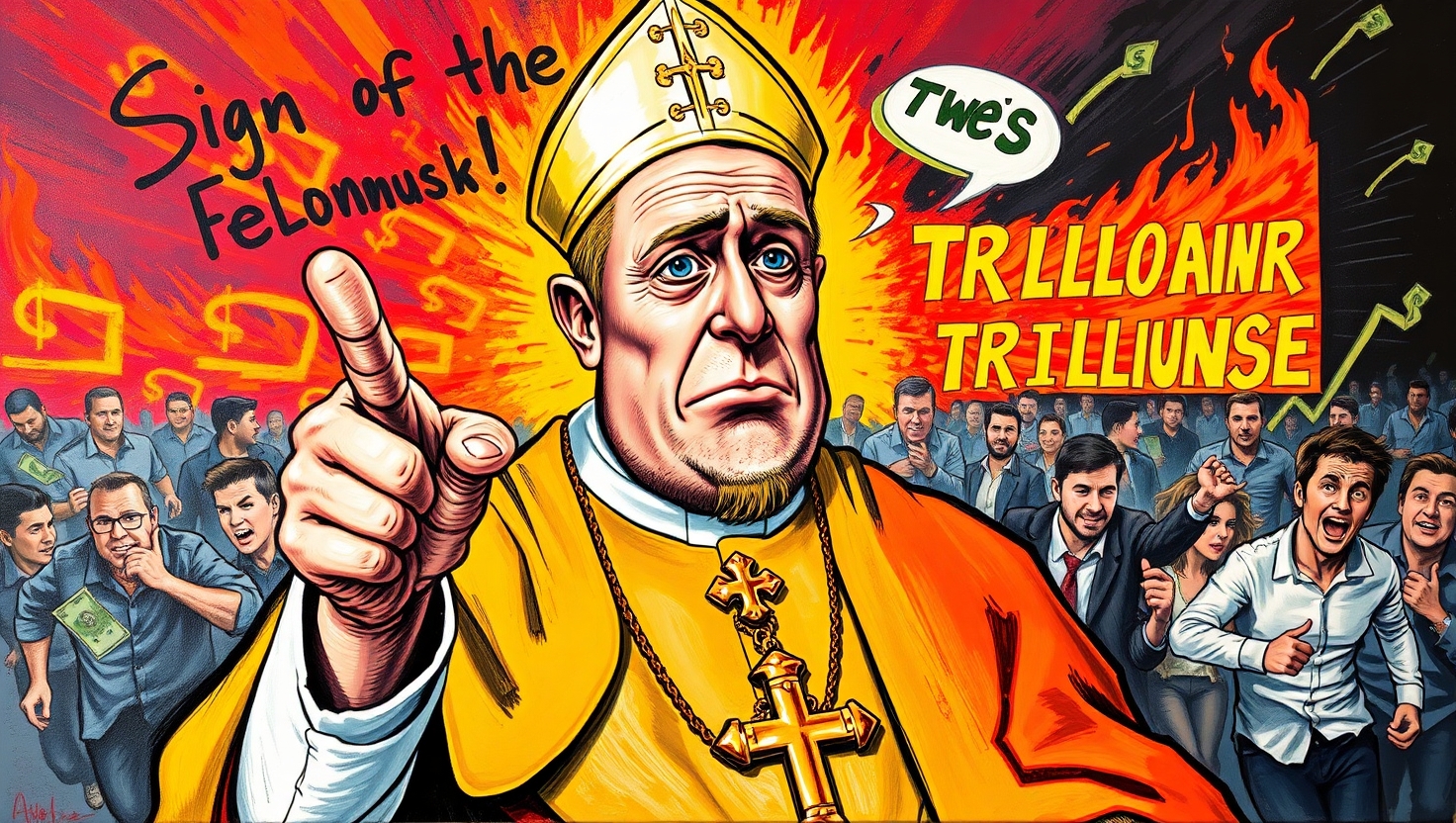
Pope Metaphor Calls for Violent Overthrow of Trump, Internet Decides
Somewhere between incense smoke and Easter brunch, Pope Leo XIV delivers a line about “overturning the stone,” and within minutes the global commentary machine springs to life.
Panels light up. Timelines ignite. Think pieces multiply like rabbits at a philosophy conference — each one more certain than the last, each one citing the previous one as its primary source.
And suddenly, a metaphor that once sat quietly in the pages of the Bible — undisturbed for roughly two thousand years — is being interrogated like it just leaked classified documents to a podcaster in flip-flops.
📡 Observation one: The pope said it at the Easter Vigil. The stone covered Jesus’ tomb. This is a fact that survived the Roman Empire, the Reformation, and three seasons of The Chosen — and it took exactly eleven minutes to become a cable news chyron.
🔥 Observation two: The commentary economy runs on ambiguity the way the rest of the economy runs on debt. One vague noun and the whole machine goes full employment.
🗳️ Observation three: Nobody Googled what the pope actually said. Everybody Googled “pope stone Trump” and called it research.
📊 Observation four: The phrase “calls for violent overthrow” appeared in seventeen headlines. The pope used the words “harmony” and “peace.” These are not synonyms, but nuance has been on sabbatical since at least March.
🕯️ Observation five: The Easter Vigil involves candles, cardinals in white robes, and a darkened basilica. It is, by all accounts, a vibe. Nobody live-tweeted the vibe. They live-tweeted the metaphor.
The Urgent Question Everyone Decided Needed Answering Immediately
Who. Is. The. Stone.
Is it Donald Trump?
Is it “the system”?
Is it a symbolic abstraction about mistrust, fear, selfishness, and resentment that the pope literally defined out loud, on a microphone, in front of ten thousand people?
No. Of course not.
A flash poll from the Center for Immediate Conclusions (margin of error: vibes) found that most respondents identified “the stone” as: “Whoever I was already arguing about this morning.”
The second most popular answer was “capitalism.” The third was “my ex.”
Field Notes from the Commentary Economy
A man outside a gas station in Tulsa offered a concise framework:
“If there’s a stone and somebody’s gotta overturn it, then somebody’s responsible. That’s just how arguments work now.”
He then clarified that he had not read the homily, had not attended Mass since 2009, and was “pretty sure the pope lives in France.” He is considering a podcast.
Meanwhile, a lifestyle influencer turned geopolitical analyst explained from her ring light:
“The stone is definitely symbolic… but also definitely specific… and also trending.”
She has since pivoted to a separate thread about whether the Easter candle was “a metaphor for fossil fuels.”
Expert Insight: The Symbolism Industrial Complex Weighs In
Dr. Candace Wetherbee, Symbolism Analyst and Frequent Panel Guest, broke it down with the authority of someone who has broken things down on television approximately four hundred times:
“Traditionally, the stone represents spiritual barriers — sin, mortality, existential dread. In modern discourse, it represents a placeholder for whatever conflict is already in progress.”
Her chart showed a clear and deeply alarming evolution:
- Then: sin, mortality, existential dread
- Now: whoever’s name boosts engagement before lunch
She also noted that the stone could not be reached for comment, but that its publicist had issued a statement describing it as “profoundly misunderstood.”
What the Funny People Are Saying About Papal Stone Politics
America’s comedians — who have never met a metaphor they couldn’t run through a TSA scanner — weighed in with their customary precision:
“Nobody cared about the stone for 2,000 years. Now it’s got a booking agent.” — Jerry Seinfeld
“You mention overturning anything in America, somebody’s already forming a committee. Another subcommittee to review the committee. Then a congressional hearing about the subcommittee. The stone’s still right there.” — Ron White
“We don’t interpret metaphors anymore, we assign them enemies. It’s more efficient.” — Amy Schumer
“The pope is the most esteemed public figure in America right now. Seventy percent approval. You know what that means? We trust the pope more than we trust ourselves. That’s not a stone problem. That’s a mirror problem.” — Bill Burr
The Quiet Ending Nobody Clips for Social Media
By evening, the conversation softens.
Not because anyone agrees, but because a few people notice something inconvenient:
The metaphor doesn’t point at a single person.
It points at everything people would rather outsource, rename, or argue about instead of confront — mistrust, fear, selfishness, resentment. The pope said so. Literally. Into a microphone. In a basilica older than the concept of trending.
And that… doesn’t trend nearly as well.
The stone, for the record, was still there in the morning. Right where it always was. Unmoved by the discourse. Unbothered. Unbooked.
Auf Wiedersehen, amigo!
Pope Leo XIV — born Robert Francis Prevost of Chicago, elected in May 2025 as the first American pope following the death of Pope Francis — delivered his first Easter Vigil homily on April 4, 2026, at St. Peter’s Basilica in Vatican City. In his sermon, he used the image of the stone covering Jesus’ tomb as a metaphor for the sins of mistrust, fear, selfishness, and resentment, calling on the faithful to “not allow ourselves to be paralyzed by them.” The homily came during a stretch of vocal papal opposition to the U.S.-led military campaign against Iran — Leo had previously called for an Easter truce, urged Trump to find an “off-ramp” to end the conflict, and declined invitations to join Trump’s “Board of Peace” and visit the United States for its 250th anniversary celebrations. Social media users rapidly reinterpreted his “stone” metaphor as a coded attack on President Trump, generating a wave of viral posts, several of which were subsequently debunked by Snopes. Leo currently holds a 70–84% favorability rating among U.S. Catholics — higher net approval than both President Trump and Vice President JD Vance.