

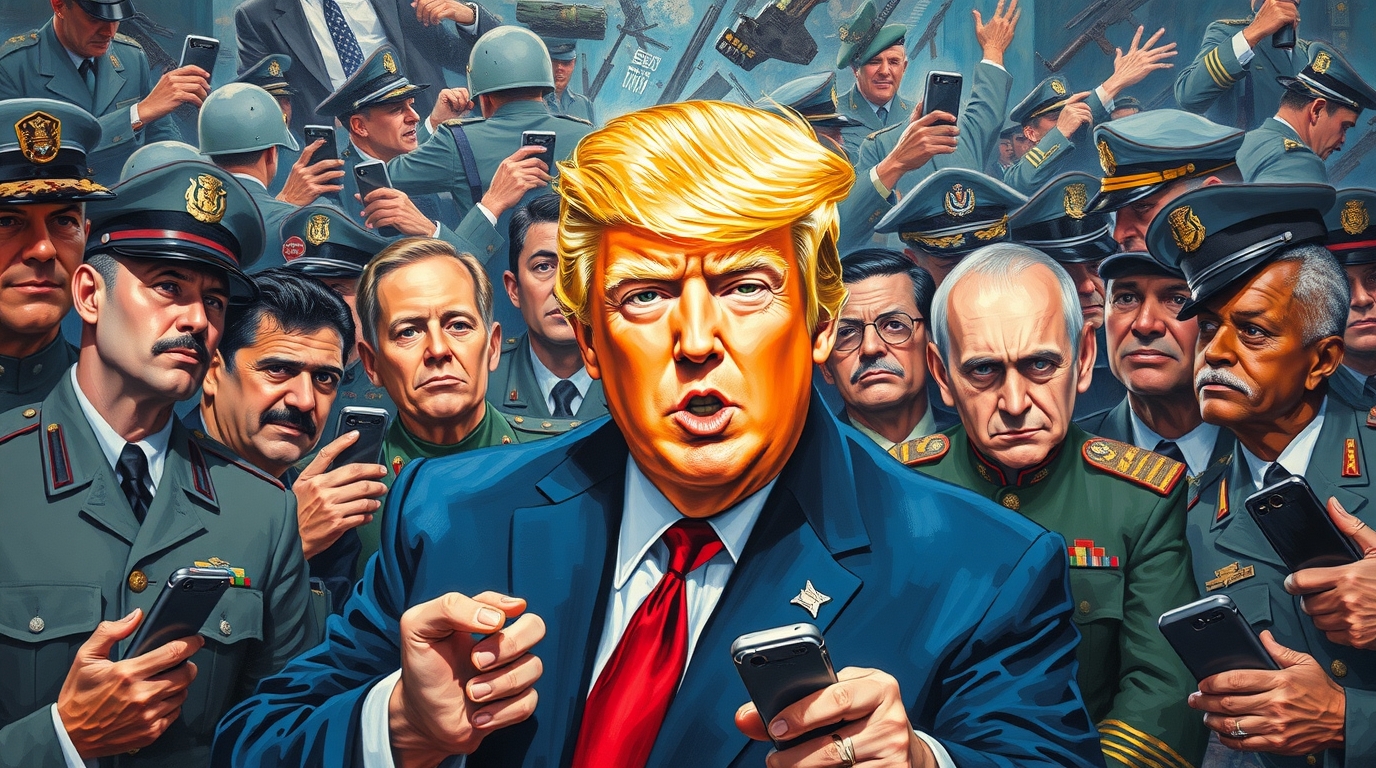
Trump’s “Generals on Speed Dial” Policy: Military Chaos Erupts at Quantico
By Alan Nafzger
WASHINGTON, D.C.—In what military historians are calling “a combination of a Saturday morning cartoon and a constitutional crisis,” President Donald Trump recently unveiled his revolutionary plan for the U.S. armed forces: generals are now on probation. No, not probation in the mild, HR-suggested sense—this is firing-on-the-spot probation. As the president explained to a crowd of bewildered officers at Quantico, “If I don’t like you, you’re gone. No warnings. No paperwork. No, uh… Congress.”
Jerry Seinfeld weighed in on the policy: “So now we have generals checking their phones every five minutes like teenagers waiting for a text back. Except instead of ‘Hey, you up?’ it’s ‘Hey, you still employed?'”
Trump’s Military Shakeup: The “You’re Fired!” Doctrine

Generals, admirals, and a few confused lieutenants found themselves staring down the new reality at the Quantico Marine Corps Base. General David Allvin, the Air Force chief of staff, reportedly retired 12 minutes after Trump’s announcement. “I just… I can’t take the uncertainty,” Allvin said in a grainy cellphone video obtained by the Bohiney News Bureau. “Yesterday, I worried about enemy aircraft. Today, I worry about my hairline, my golf swing, and whether my shoes match my uniform.”
The atmosphere inside the Pentagon has shifted from strategic planning to survival mode. Officers who once coordinated military operations worldwide now spend their mornings checking Twitter to see if they still have jobs. One colonel described the experience as “like playing Russian roulette, except every chamber is loaded and the gun is pointed at your career.”
Ron White commented on the situation: “I’ve been fired from worse places than the military. At least when Trump fires you, you get to keep your dignity. Well, some of it. Maybe none of it. But you get cable news interviews.”
Dr. Felicity Hornbeam, a retired naval strategist, explained the unprecedented nature of this military leadership crisis: “This is less a chain of command and more like a reality TV show where everyone’s voted off the island weekly. Except the island is the Pentagon, and the prize is not getting fired.”
The policy has created what insiders are calling “decorative paralysis”—officers so terrified of making decisions that they’ve essentially become very expensive furniture. One general spent an entire Tuesday morning rearranging his desk instead of attending a Joint Chiefs briefing, reasoning that “at least I can control the stapler.”
Pete Hegseth’s “MAGA Military” Vision Unveiled
Defense Secretary Pete Hegseth, standing at a podium like a man auditioning for the next season of The Apprentice: Pentagon Edition, explained the need for a “MAGA military.” This isn’t just an acronym for Make America Great Again—it’s a lifestyle, a brand, and possibly a line of commemorative challenge coins coming soon to a gift shop near you.
Hegseth emphasized that any officer who fails to toe the ideological line should submit their resignation immediately or prepare to be “politely escorted to the exit.” The word “politely” is doing considerable heavy lifting in that sentence, witnesses noted, as security personnel demonstrated the escort technique on a potted plant for illustrative purposes.
“The military has lost its way,” Hegseth said, gesturing dramatically at a map of Chicago with a gold marker. “We have too many fat generals. Too much political correctness. We need warriors who know their MAGA hats from their berets.”
Amy Schumer responded to the announcement: “So we’re judging generals on their fitness now? Great. I can’t wait until we start rating them on their Instagram presence. ‘Sorry, General, your engagement rate is down 3%. You’re fired.'”
The Ideological Litmus Test
The new Pentagon leadership structure now includes what staffers are calling “the loyalty pledge,” though officially it’s termed “ideological alignment assessment.” Officers must demonstrate commitment to administration priorities, which apparently includes knowing the words to “God Bless the USA” and having opinions about hamburger preparation.
One unnamed officer described the assessment process: “They asked me if I believed in American exceptionalism. I said yes. They asked if I believed in fiscal responsibility. I said yes. Then they asked if I thought Obama was born in Kenya. I suddenly remembered I had a dentist appointment.”
The policy has created fascinating social dynamics within military ranks. Junior officers now spend more time studying Trump’s Twitter feed than enemy capabilities. “I used to read Clausewitz,” one captain lamented. “Now I read Truth Social. I’m not sure which is more confusing.”
Pentagon Rebrand: Welcome to the “Department of War”
Trump, never one to shy away from a rebranding opportunity, suggested renaming the Pentagon the “Department of War.” When pressed about the potential confusion this might cause, he replied, “People know war. They don’t always know bureaucracy. We’re streamlining. Efficiency is winning. Winning is war. You see?”
The proposed name change has sparked debate among constitutional scholars and brand consultants alike. “It’s like renaming your cat ‘Dog,'” one retired general commented. “Sure, it’s technically accurate because he behaves like a dog sometimes, but it’s confusing at parties.”
Dave Chappelle said: “Department of War? That’s the most honest thing the government’s ever called itself. What’s next? The Department of Slightly Concerning Health Violations?”
A leaked internal memo hinted that all future military briefings must now include phrases like “total victory” and “bigly impressive maneuvers,” though definitions were left intentionally vague. Strategic planners are reportedly struggling to translate “winning so much you’ll get tired of winning” into operational objectives.
The rebranding effort extends beyond nomenclature. Interior designers have been commissioned to replace the Pentagon’s current “bureaucratic beige” aesthetic with what Hegseth calls “patriotic aggression red.” Early mockups suggest the building will resemble either a monument to American power or a very large Arby’s.
Marketing the Military
The administration has hired a branding consultant who previously worked on reality television. His first suggestion: “Have you considered military operations with better names? Like instead of ‘Operation Enduring Freedom,’ try ‘Operation You’re Gonna Love This.'”
Bill Burr commented: “They’re marketing the military like it’s a streaming service. ‘Subscribe now for just $850 billion a year! Includes free regime changes and occasional democracy installations!'”
Military Fitness Standards: The Gender-Neutral Controversy
In an apparent effort to prioritize combat readiness over inclusivity, the administration announced gender-neutral physical fitness standards. While on paper this sounds progressive, sources inside the Pentagon describe the program as “basic survival skills with optional interpretive dance.”
“Some of the exercises are… creative,” said an anonymous staffer. “Push-ups are fine. Pull-ups are fine. But then they added ‘run from your existential dread while reciting the Gettysburg Address.’ It’s confusing, but you feel strong afterward.”
The new regime reportedly caused several senior officers to consider applying for desk jobs in accounting instead of field command. The Army Physical Fitness Test now includes a section called “emotional resilience under absurd conditions,” which essentially measures how long you can maintain composure during contradictory orders.
Kevin Hart said: “They want gender-neutral fitness standards? I’m 5’4″. The military has never been neutral about my height. Trust me.”
The Interpretive Dance Requirement
Perhaps most controversially, the new fitness standards include what officials call “combat flexibility assessment” but what everyone else calls “mandatory stretching that looks suspiciously like yoga.” Conservative military bloggers have denounced it as “woke flexibility,” while yoga instructors have denounced it as “terrible form.”
One sergeant described the experience: “Yesterday I did burpees. Today I did ‘warrior pose.’ Tomorrow, apparently, we’re learning about chakras. I joined the Marines, not a wellness retreat.”
Domestic Military Operations: Chicago as Training Ground
Trump’s proposal to use domestic cities such as Chicago and Portland as “training grounds” for military drills has been met with legal scrutiny. The Posse Comitatus Act, which restricts military involvement in civilian law enforcement, seems to have been politely ignored.
When asked about constitutional limitations, the president clarified: “It’s just training. Nobody gets hurt. Maybe some property. But hey, you can’t spell ‘freedom’ without a little ‘chaos.'”
This novel interpretation of the Constitution has prompted mixed reactions from local officials. Chicago’s mayor reportedly asked, “Do you mean our roads? Our bridges? Or the entire Lincoln Park Zoo?” Portland’s city council requested that at least the hipsters be spared, citing concerns about artisanal coffee shortages.
Chris Rock weighed in: “They want to use Chicago for military training? Chicago’s been training civilians for urban warfare for decades. The military should be taking notes, not giving lessons.”
The Posse Comitatus Problem
Legal experts note that the 1878 federal law explicitly prohibits using federal troops for domestic law enforcement. “It’s not ambiguous,” said Professor Irene Glass of Georgetown Law. “But apparently ambiguity is in the eye of the commander-in-chief.”
Military lawyers—JAG officers who once worried about Geneva Convention compliance—now spend their days researching whether “training exercise” is different enough from “military occupation” to avoid federal prosecution. “It’s a semantic argument,” one admitted. “But semantics is all we have left.”
The “Woke Military” Purge Accelerates
Hegseth also criticized diversity and inclusion initiatives, labeling them “woke nonsense” that “weakens the warrior spirit.” Several officers with extensive DEI training were quietly reassigned—or, according to an anonymous source, told they were “too woke to lead men in combat.”
“One officer literally fainted,” said the staffer. “We’re still not sure if it was the stress or the realization he couldn’t wear his rainbow-colored combat socks anymore.”
The purge extends beyond personnel decisions. The Pentagon library has been instructed to review its collection for “ideological contamination.” Books on leadership, military history, and apparently anything written after 1955 are under scrutiny. One librarian reported receiving a memo asking if Sun Tzu’s The Art of War contained “too much Eastern philosophy.”
Trevor Noah said: “They’re removing diversity training from the military. You know, because nothing says ‘strong defense’ like making sure everyone thinks exactly the same way. That’s worked great throughout history. Ask any empire that collapsed.”
The DEI Dismantlement
The Department of Defense’s diversity programs, which previously included unconscious bias training and inclusive leadership workshops, have been replaced with what officials call “merit-based excellence seminars.” Attendees report these seminars consist primarily of watching Patton on repeat and discussing why political correctness ruins everything.
Younger officers, particularly those recruited during the Obama and Biden administrations, express confusion about the new direction. “I was told the military values different perspectives,” one lieutenant said. “Now I’m told the military values the same perspective, just louder.”
Ricky Gervais commented: “Imagine being so fragile that diversity training threatens your masculinity. ‘Oh no, someone suggested I be nice to people different from me. My warrior spirit is destroyed!’ Grow up.”
Generals Practice the Art of Silent Endurance
During Trump’s address at Quantico, military leaders practiced an ancient ritual known as “silent endurance,” which, in layman’s terms, means staring straight ahead while hoping nobody notices your rapidly increasing heart rate. “It’s called professionalism,” explained retired Admiral Lucinda Marsh. “Or insanity. Sometimes it’s hard to tell.”
The scene inside the auditorium resembled a high-stakes poker game, except instead of cards, the players held their military careers, and instead of chips, they wagered their dignity. Observers noted the remarkable discipline required to maintain composure while being told your decades of service might end with a tweet.
“I’ve seen combat,” one general whispered to a colleague. “I’ve been shot at. I’ve jumped out of airplanes. Nothing prepared me for this.”
Ali Wong said: “These generals have more self-control than me at a dessert buffet. Someone insults their entire career and they just stand there? I would’ve thrown my shoe.”
The Poker Face Protocol
Military protocol has always emphasized maintaining composure under pressure, but this situation tested limits. Several officers reportedly practiced their “neutral expression” in bathroom mirrors before the event, rehearsing responses to potentially career-ending announcements.
“It’s like playing poker when everyone can see your cards, the dealer hates you, and the stakes are your entire professional identity,” explained a military psychologist. “But sure, keep that poker face.”
Body language experts analyzing footage of the event noted “micro-expressions of existential despair” appearing every 3-4 seconds, which they describe as “statistically significant” and “deeply concerning.”
The “Friday Night Massacre” Shakes Pentagon Leadership
The first wave of firings—including General Charles Q. Brown Jr. and Admiral Lisa Franchetti—prompted social media to dub the event the “Friday Night Massacre.” This moniker, blending cinematic drama with uncomfortable reality, has stuck, even among Pentagon staffers.
“Everyone’s talking about it,” said one naval officer. “Some people are angry. Some are sad. Some just hope the cafeteria menu hasn’t changed. It’s chaos.”
The timing of the firings—late Friday afternoon—follows a time-honored Washington tradition of releasing bad news when media attention is lowest. However, in the social media age, this strategy backfired spectacularly. By Saturday morning, #FridayNightMassacre was trending globally, accompanied by memes of generals clearing out their desks while Hall & Oates played in the background.
Jim Gaffigan said: “They fired generals on a Friday night. You know what I do on Friday nights? Eat cheese. These people are destroying military careers while I’m destroying a block of cheddar. Different priorities.”
The Awkward Exit Interviews
Several fired generals reported being escorted from the building immediately after notification, a departure from traditional military retirement ceremonies involving speeches, awards, and at least a cake.
“I served 35 years,” one general said. “My exit interview consisted of a security guard saying ‘This way, sir’ and pointing toward the parking lot. I didn’t even get to grab my coffee mug.”
The abruptness has created an awkward market for military memorabilia. Ebay listings for “Authentic General’s Desk Items, Hastily Abandoned” have proliferated, including nameplates, forgotten family photos, and one very confused goldfish.
Retirement Speeches Undelivered
In a particularly surreal twist, several generals were seen practicing their acceptance speeches for potential firing, complete with dramatic pauses and slightly tearful monologues. Analysts say this may be the first time in U.S. history that military officers have rehearsed losing their jobs like Oscar nominees.
“I had a whole thing prepared,” admitted one recently dismissed general. “About service, sacrifice, and the honor of wearing the uniform. Instead I got a text message that said ‘Thanks for your service, effective immediately.'”
Hasan Minhaj commented: “Imagine preparing your whole life for a moment of recognition, and instead you get fired via text. That’s not a Friday Night Massacre. That’s a Tuesday afternoon ghosting.”
Legal Scholars Debate Constitutional Boundaries
While the Supreme Court has upheld presidential authority to dismiss executive officers, legal scholars question whether firing top military brass on a whim might set an unfortunate precedent.
“It’s… complicated,” said Professor Irene Glass of Georgetown Law. “Technically, the president can do it. Practically, it’s like juggling chainsaws blindfolded while riding a unicycle. Legally impressive, morally questionable.”
The Constitution grants the president authority as Commander-in-Chief, but the Founders likely didn’t envision that authority including mass firings announced via social media. “They imagined careful deliberation,” one constitutional historian noted. “Not ‘I don’t like your face, you’re out.'”
Sarah Silverman said: “The Constitution is like a recipe. Sure, you can technically substitute ingredients, but if you replace all the flour with cocaine, you’re not baking anymore—you’re just making bad decisions.”
The Precedent Problem
Legal experts warn that normalizing rapid-fire military leadership changes could create instability in national security apparatus. “Institutional knowledge matters,” explained a Brookings Institution fellow. “You can’t just swap out generals like they’re iPhone apps.”
The concern extends beyond individual careers to operational readiness. Military strategies take years to develop and implement. Constantly changing leadership creates what one analyst called “strategic whiplash”—the sensation of planning for the future while unsure if you’ll have a job tomorrow.
Some retired officers suggest the new policy could lead to a surge in post-retirement memoirs, all with titles like How I Survived the MAGA Military or The Day My Commander-in-Chief Checked His Twitter Instead of the Briefing.
Tom Segura said: “These generals are going to write books. So many books. The publishing industry is about to have its best quarter since Harry Potter.”
Public Opinion: A Nation Divided on Military Leadership
A recent poll by the National Institute for Military Humor (NIMH) indicated the public is deeply divided on Trump’s military policy overhaul. The findings reveal a fascinating cross-section of American opinion:
42% support the president’s push for a more ideologically aligned and disciplined military, arguing that “fresh blood” and “new perspectives” will strengthen national defense. These supporters tend to view the firings as necessary housecleaning, comparing the Pentagon to a bureaucratic swamp in need of draining.
38% oppose the policy, believing the administration is dangerously politicizing the armed forces. This group worries about erosion of military independence and the chilling effect on officer decision-making. “Generals should fear the enemy, not their boss,” one respondent noted.
20% remain unsure, citing confusion over whether the poll was asking about the military or their favorite fast-food chain. This demographic confusion speaks to the surreal nature of current events—reality has become difficult to distinguish from satire.
Gabriel Iglesias commented: “20% of people thought the poll was about food? I get it. When things get crazy, I also think about food. It’s called comfort eating, and apparently it’s called coping with constitutional crises.”
The Social Media Response
Online discourse about the policy reveals the predictable tribal divisions of modern politics. Twitter threads alternate between celebrating the “swamp drainage” and mourning the “destruction of institutional norms.” TikTok videos range from generals doing exit dances to teenagers explaining military law better than cable news.
In local bars and coffee shops across America, conversations range from “This is exactly what the Founding Fathers intended!” to “I thought generals came with pensions, not Twitter notifications from the Oval Office.”
Memes depicting generals playing musical chairs with exit signs have gone viral, suggesting that humor may be the only universal coping mechanism. One particularly popular image shows a general frantically checking his phone with the caption: “Refresh… Refresh… Still employed? Refresh…”
The Military Families Perspective
Often overlooked in political debates are military families navigating these changes. Spouses report increased anxiety about career stability, with some families putting major purchases on hold pending clarity about employment status.
“We were going to buy a house,” one military spouse explained. “Then my husband’s boss got fired via tweet. Now we’re renting month-to-month and keeping our savings in something called ‘oh-god-what-if’ money.”
Children of military families, accustomed to frequent moves and deployment separations, now face a new uncertainty: “Will Daddy still be a general tomorrow?” has replaced “Will Daddy come home from deployment?” as the primary source of childhood anxiety.
Bert Kreischer said: “Military kids are tough. They move constantly, their parents deploy, and now they have to explain to their friends that Daddy got fired by the president. That’s not childhood—that’s an origin story for a superhero or a therapist.”
Conclusion: A New Era of Military Uncertainty
Trump’s “Generals on Speed Dial” policy has undeniably shaken the foundations of military decorum, professionalism, and sanity. Officers now navigate a surreal environment where ideology trumps experience, fitness tests double as performance art, and urban landscapes are potential battle drills.
The Department of Defense, once America’s most stable institution, now resembles a corporate startup during layoffs—everyone’s updating their LinkedIn profiles and networking furiously. The phrase “strategic planning” has been replaced with “strategic hoping we’re still employed next week.”
As one general sighed while polishing his MAGA hat: “I joined the military to defend the country, not to audition for America’s Got Generals.”
The long-term implications remain unclear. Will this approach strengthen military effectiveness through increased loyalty and alignment? Or will it weaken institutional knowledge and strategic continuity? Only time—and possibly several congressional investigations—will tell.
What seems certain is that the relationship between civilian leadership and military command has fundamentally changed. The question is whether this change represents necessary reform or dangerous precedent. Americans, as always, will decide that question at the ballot box, assuming the ballot box itself doesn’t get fired first.
Nate Bargatze said: “I don’t understand military stuff. But I do understand crazy. And this? This is crazy. Like ‘explaining to your kids why their guinea pig got fired’ level crazy.”
What the Funny People Are Saying
The comedy world has responded to Trump’s military policy with the kind of bewildered amusement typically reserved for discovering your car insurance doesn’t cover alien abductions.
“I never thought I’d see the day where generals fear their commander-in-chief more than enemy combatants,” Jerry Seinfeld said during his Tuesday night set. “What’s the deal with firing generals? Is there a performance review? Do they get two weeks notice? Or is it just ‘You’re fired’ and suddenly you’re civilian Dave with no health insurance?”
Ron White commented at his Fort Worth show: “It’s like The Apprentice met Band of Brothers, and neither of them brought snacks. I’ve been fired from better places than the Pentagon. At least when I got fired from the Sears automotive department, they let me keep my coveralls.”
Sarah Silverman tweeted: “Finally, a military that takes firing literally. Next up: the Navy will actually fire people out of torpedo tubes. It’s called ‘streamlining.'”
Jackie Mason, in what witnesses describe as a “vintage rant,” said: “I feel like Groucho Marx in the Pentagon, only with fewer cigars and more Twitter. You fire a general? In my day, you didn’t fire generals. They retired with medals and pensions. Now they retire with severance packages and therapy bills.”
Louis C.K. said during his Sunday set: “Generals are on probation now. Probation! Like they’re middle managers at Kinkos. ‘Sorry, General, you’re great at war, but your TPS reports are lacking.'”
Wanda Sykes commented: “These generals spent 30 years learning military strategy. Now they’re learning unemployment strategy. That’s a different kind of tactical planning.”
Tiffany Haddish said: “Trump firing generals like he’s playing Fortnite. ‘Eliminated. Eliminated. Victory Royale!’ Except the victory is just more chaos.”
Jo Koy added: “My mom would never fire a general. She’d just passive-aggressively hint that maybe they should consider ‘other opportunities’ until they fired themselves.”
Disclaimer: This story is a human collaboration between the world’s oldest tenured professor and a philosophy major turned dairy farmer. Any resemblance to real events, persons, or generals’ fashion choices is purely coincidental and probably exaggerated for comedic effect. The quotes attributed to comedians represent their satirical perspectives on current events as reported today. No actual generals, admirals, or decorative plants were harmed in the making of this article. Auf Wiedersehen, amigos.