

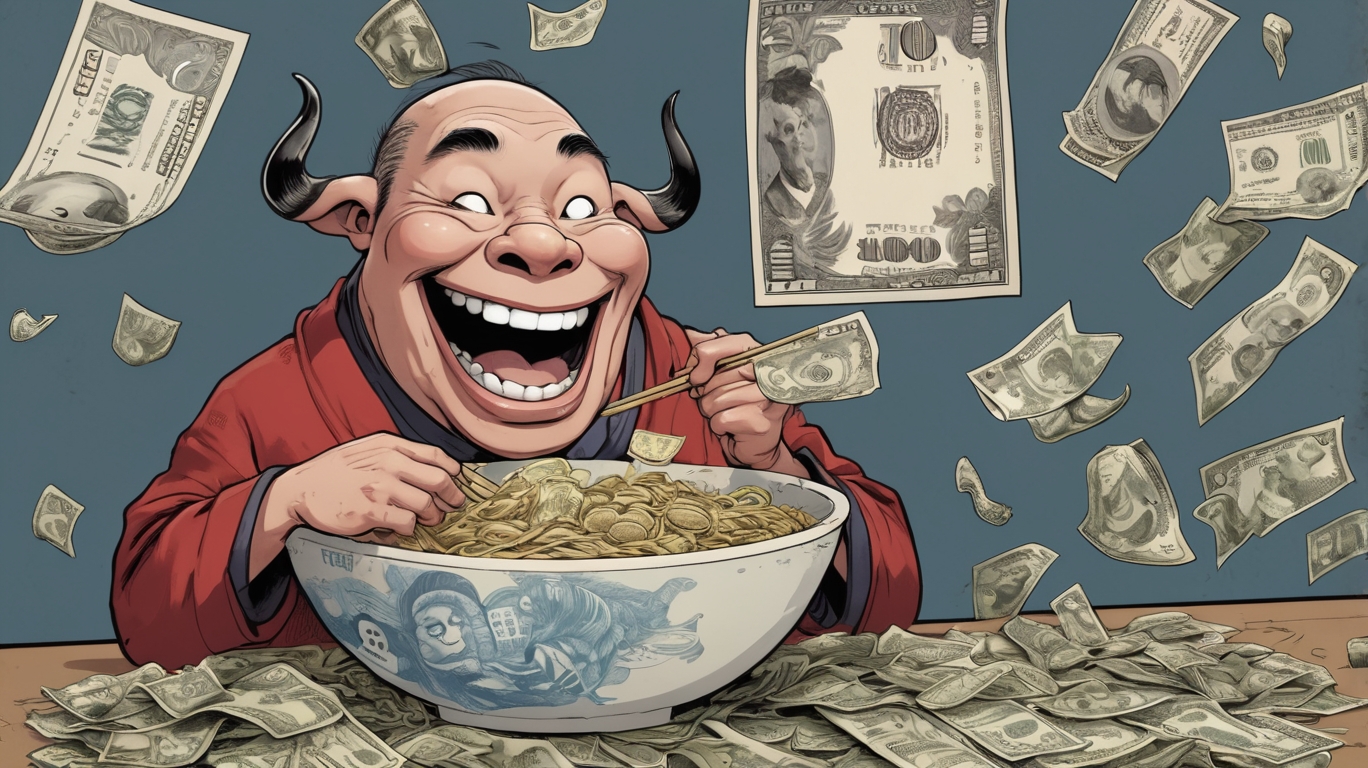
Yuan More Joke? Comedians Declare China’s Currency Funnier Than Stand-Up Itself”
Comics Roast China’s Renminbi: ‘It’s Not Backed by Gold, It’s Backed by Xi’s Vibes and a Giant Picture of a Panda Playing Mahjong’
Comedians Discover the Real Chinese Export: Punchlines
In a shocking development from the global comedy circuit, stand-up comedians across continents have unofficially designated China’s renminbi (RMB) as the “world’s funniest currency”—beating out the Venezuelan bolívar and even Monopoly money in blind laughter tests.
The renminbi, which means “people’s currency,” now affectionately goes by “comedy coin” in underground comedy clubs from Los Angeles to Lagos. “It’s not a currency, it’s a knock-knock joke in banknote form,” said New York comic Larry Feldstein during his Monday night set at The Chuckle Bucket.
What the Funny People Are Saying
-
“I tried to exchange renminbi at the airport. They gave me a coupon for steamed dumplings and a note that said, ‘Try again during the next dynasty.’” — Ron White
-
“The yuan is pegged, floated, and managed so tightly, even helicopter parents say, ‘Damn, let it breathe!’” — Jerry Seinfeld
-
“China said the yuan would one day rival the dollar. That’s like saying Panda Express will one day outcook your grandma.” — Ali Wong
-
“I bought something on AliExpress with renminbi. It shipped in 2 weeks and emotionally arrived in 3-5 business decades.” — Dave Chappelle
-
“It’s called the ‘people’s currency’ because the people never get to touch it. It just circles around like a drone over a forbidden province.” — Trevor Noah
-
“I invested in the yuan. Now I can buy either a Starbucks straw or an apology letter from the Chinese Communist Party.” — Sarah Silverman
-
“Their currency is ‘managed’ like my uncle manages his diet: lies, manipulation, and denial of reality.” — Bill Burr
-
“It’s backed by three things: hope, tea leaves, and the ghost of Deng Xiaoping whispering, ‘Shh, just print more.’” — Kevin Hart
-
“China wants the yuan to compete with the dollar. That’s like entering a cockroach in the Kentucky Derby.” — Tig Notaro
-
“The yuan is international now—like TikTok trends and lead in baby toys.” — Chris Rock
-
“The dollar is a currency. The euro is a currency. The yuan is more of a vibe.” — Amy Schumer
-
“Ever tried to buy something in yuan outside China? It’s like trying to pay for gas with a haiku.” — Ricky Gervais
When Xi Jinping Met SNL: A Brief History of Laughable Pegs
According to the New York Times report, the yuan is plummeting against the dollar—down to levels that economists are calling “delicate,” comedians are calling “inevitable,” and the CCP is calling “totally intentional, please stop looking.”
China’s response? Blame foreign speculators, release state-owned economic optimism, and remind everyone that “it’s not the value of the yuan, it’s the loyalty of the yuan.”
But comics disagree. “The yuan’s not in freefall, it’s just experimenting with zero-gravity economics,” quipped London’s James Glastonbury, who hosts Yuan Direction: The Currency That Cried Wolf on BBC Radio 4.
The Rise of the “Yuan Coin Flip Economy”
China’s central bank, the People’s Bank of China (PBoC), reportedly manages the yuan’s exchange rate so tightly, even dictators are like, “Bro, chill.”
A former IMF advisor—under condition of anonymity—described the yuan’s value as “somewhere between an educated guess and a state-mandated hallucination.”
“Every morning, the PBoC spins a giant wheel that says ‘Appreciate’ and ‘Depreciate,’” said comedian-turned-economist Mandy Xu. “If it lands on ‘Depreciate,’ Xi blames foreign plots. If it lands on ‘Appreciate,’ they fire someone anyway—just to be sure.”
Currency Goals: The Renminbi’s Dream of Becoming a Real Boy
The article outlines China’s dream of internationalizing the yuan to rival the dollar and euro. But the yuan currently accounts for only 4% of global payments, and most of that is reportedly from Russian arms dealers paying for hair gel.
Beijing has been using cross-border banking tools like CIPS (China’s version of SWIFT) and UnionPay to push for greater adoption of the currency. But so far, even Belt-and-Road nations prefer to be paid in chickens rather than yuan, citing “at least chickens lay eggs.”
The yuan’s branding as a trustworthy global currency is hampered by the fact that China doesn’t allow it to float freely—which makes it less a “market currency” and more a government-approved emotional support blanket.
Trade War Theater: Where Tariffs Meet TikTok
The U.S.–China trade war has contributed to the yuan’s instability, and American officials continue to accuse China of currency manipulation. One Treasury analyst recently said, “It’s like trying to play poker with a guy who keeps changing the value of the chips mid-hand and arresting the dealer.”
Even Elon Musk tweeted: “China’s currency is quantum—it exists in a state of value and non-value until you measure it, then it disappears into a blockchain.”
‘Managed Float’ Sounds Like a Disneyland Ride
According to the Times, China uses a “managed float”—a phrase economists love and comedians adore.
“It’s like letting your teenager drive but only between 2 a.m. and 3 a.m. in a Walmart parking lot with the handbrake on,” said economic humorist Felipe Martinez.
Critics claim the system is rigid, inflexible, and deeply incompatible with global finance. Defenders say, “Yeah, but have you seen how fast we can crush a currency with no apology?”
The New Silk Road Has a Toll Booth
Despite these comedic jabs, China’s long game is to undermine the dollar’s global dominance by building a multi-polar system that includes the yuan.
The only problem? Everyone trusts China’s digital yuan about as much as they trust a TikTok health tip sponsored by a herbal vape influencer.
A Nigerian importer interviewed for this article said, “I tried using the yuan once. My money disappeared, and I got a notification that said, ‘Thank you for supporting socialism with Chinese characteristics.’”
Satirical Currency Ratings (According to The Comedians’ Bureau of Economic Impressions)
-
US Dollar – “Boring, imperialist, but still gets you a burger.”
-
Euro – “Emotionally unstable, but charming in a beret.”
-
Yuan – “Propaganda pamphlet printed on rice paper.”
Final Take: Should You Buy Yuan?
Only if you’re hosting a themed party called “Collapse of Global Trust: Bring Your Own Narratives.”
Financial comedian Les Moolah concluded, “Buying the yuan right now is like downloading a Chinese app: it might seem convenient, but it’s secretly tracking your emotions, your sleep schedule, and your snack preferences—and you still can’t uninstall it.”
BREAKING NEWS:
China’s Renminbi Plummets, Stand-Up Economy Rises
As the Chinese renminbi hits its lowest value in years, comedy clubs across the globe are reporting record profits. Financial experts are baffled, but comedians are thrilled. “We finally found a growth sector,” said Larry the Hedge Fund Guy. “Turns out economic collapse is hilarious.”
With each dip in the yuan, ticket sales for stand-up specials spike. Economists call it the “Laugh Index”—a metric where every 0.1 yuan of depreciation equals one new tight five on Netflix.
Popular topics include:
-
Digital yuan tracking menstrual cycles.
-
Beijing’s currency confidence seminars featuring sock puppets.
-
Foreign investors converting yuan to NFTs of cash.
Even Chinese state media has pivoted. CCTV debuted a variety show called “Who Wants to Peg a Currency?” hosted by an AI version of Deng Xiaoping.
The People’s Bank of China insists everything is “functioning within parameters,” while using finger quotes and nervous glances at gold.
Meanwhile, the yuan’s collapse has inspired a new dating app: “Floatr,” where users swipe left on volatile currencies and right on anything backed by oil.
As Beijing tries to stabilize the renminbi, it may not recover its former value—but it has gained something else: a starring role in the booming global stand-up economy.
U.S. Accuses Yuan of Identity Theft, Currency Now Identifies as ‘Token of Gratitude’
In a stunning press release from the U.S. Treasury Department, officials have accused China’s yuan of “gross economic identity theft,” claiming it is now masquerading as a stable global currency.
According to reports, the renminbi recently attempted to open a Swiss bank account while identifying as “Token of Gratitude, Age 74, Born in the People’s Will.” The account was flagged after it failed the “convertibility” CAPTCHA three times.
U.S. Secretary of Snark Janet Yellen stated, “The yuan wants to be the dollar so badly it just applied for a green card.”
China’s Ministry of Monetary Self-Esteem responded with a carefully folded press release shaped like a lotus flower, stating, “The renminbi is not stealing identities. It’s exploring its own.”
Meanwhile, identity experts noted the yuan has recently been seen wearing Western suits, hanging out at G7 conferences, and using phrases like “free-market adjacent.”
In retaliation, the dollar has filed a restraining order, citing emotional manipulation, unauthorized pegging, and excessive flattery.
Currency therapists warn of the yuan experiencing “denomination dysphoria,” a condition where a currency can’t decide if it’s a symbol of state control or a friendly neighborhood blockchain.
The yuan has reportedly begun journaling under its new name, Token of Gratitude, and ends each transaction with a polite bow.
Xi Jinping Declares the Yuan ‘Fully Backed by National Pride and Fortune Cookies’
In an effort to calm rising concerns over the yuan’s slide, President Xi Jinping addressed the nation with a new financial doctrine: “The yuan is no longer backed by boring things like reserves. It is now fortified by national pride and fortune cookies.”
Flanked by two stone lions and a projection of a red phoenix doing tai chi, Xi proclaimed that Western reliance on gold and GDP was “spiritually bankrupt,” unlike China’s revolutionary new monetary philosophy: belief-based banking.
“Our currency is strong,” he said, “not because of external metrics, but because it carries the hopes of 1.4 billion citizens and 30 million laminated dessert prophecies.”
Critics pointed out that this might not appeal to international investors, many of whom demand at least one form of math in their currency evaluations.
Still, the new policy includes:
-
Daily injections of optimism into yuan pricing models.
-
Press briefings read aloud by pandas in Confucius robes.
-
An official backup reserve consisting of handwritten fortunes from state-run buffets.
When asked about the currency’s future, Xi smiled and opened a cookie that read: “Great change is coming. Embrace it. Avoid seafood today.”
Markets dropped 300 points, but morale soared—briefly.
Digital Yuan Causes Phones to Start Quoting Confucius in Broken English
Following the rollout of the Digital Yuan 4.0, users across China reported a strange phenomenon: their phones began randomly quoting Confucius—often in garbled, questionably translated English.
“I tried to buy noodles, and my phone said, ‘Man who runs in front of car get tired,’” said one confused Beijing commuter. “Then it asked if I respect my ancestors before applying a 5% patriotic surcharge.”
The People’s Bank of China insists this is a feature, not a bug. “We have fused tradition and technology,” said one developer. “This is currency with cultural kung fu.”
New features include:
-
Mandatory wisdom notifications before purchases over 200 yuan.
-
Moral score adjustments based on how you spend.
-
A “Shame Gong” sound effect if you try to tip in a Western app.
Digital yuan’s Confucian mode also offers transaction feedback like:
-
“Great journey begins with single spend.”
-
“To err is to buy foreign shoes.”
State media praised the update as “harmonious fusion of e-commerce and 2,500-year-old aphorisms,” but citizens remain wary.
One user claimed his phone refused to process a refund until he solved a riddle involving filial piety and dumpling etiquette.
So far, the digital yuan is spreading wisdom, confusion, and low-level dread in equal measure.
Currency Exchange Booth Catches Fire After Attempting to Value Yuan Honestly
Panic erupted in Macau this week after a local currency exchange booth caught fire when an employee tried to assess the true market value of the Chinese yuan.
Eyewitnesses say the moment the clerk entered “actual floating value” into the terminal, sparks flew, the cash drawer locked itself, and a robotic voice whispered, “Unauthorized truth detected.”
Within minutes, the kiosk ignited like a flaming pile of trade imbalances. Authorities blamed “power surges and irresponsible arithmetic,” while online conspiracy forums suspect the PBoC installed an anti-honesty protocol.
“I just wanted to exchange 500 yuan for casino chips,” said one bewildered tourist. “Instead, I got a front-row seat to monetary arson.”
Emergency services arrived swiftly but were unable to cool the screen displaying a 1:7.45 USD exchange rate with an asterisk reading “*Based on Delusions.”
The incident has led other exchange booths to issue warning signs:
“Attempting Accurate Valuation May Void Warranty and Spark International Incident.”
Meanwhile, central banks in Europe and the U.S. have reinforced their systems with sarcasm filters and padded irony insulation.
China’s official statement claimed the booth caught fire due to “excessive curiosity,” urging citizens to “embrace fiscal faith, not math.”
The clerk has since been reassigned to folding origami swans out of unspent yuan.
Renminbi Wins Golden Globe for Best Performance in a Non-Convertible Role
In a dazzling awards ceremony aired exclusively on state-run television, the Chinese renminbi took home the Golden Globe for Best Performance in a Non-Convertible Role.
Wearing a custom-tailored silk wallet and escorted by an entourage of suspicious economic data, the yuan humbly accepted the award: “Thank you to the central bank for believing in me—even when I barely believe in myself.”
The nomination came after a year of riveting performances:
-
Faking stability under U.S. tariffs.
-
Dramatically crying during exchange rate revisions.
-
Playing both the hero and victim in “Trade Deficit: The Musical.”
“This is the Meryl Streep of currency performances,” said one overly polite IMF analyst. “You know it’s acting, but damn it, you clap anyway.”
State media praised the award as “global recognition of fiscal storytelling,” while foreign investors couldn’t remember if the yuan was even eligible for international screening.
Rumors suggest the renminbi will now star in a trilogy:
-
The Managed Float Chronicles
-
Yuan of the Dead
-
Fast & Furious 10: Pegged & Furious
Backstage, the dollar was spotted sighing, while the euro filed a formal complaint that the whole ceremony was staged.
China responded: “The yuan may not be convertible, but its performance? Unforgettable.”
Disclaimer: This satirical article is a collaborative work between the world’s oldest tenured professor and a former philosophy major turned dairy farmer. The renminbi remains a functioning currency, albeit with performance anxiety and strict parental controls. No pandas were harmed in the making of this economic satire.
Auf Wiedersehen, amigos.

What The Funny People Are Saying About The Yuan…
“The yuan is like my ex—it says it’s flexible, but it refuses to change.”
— Ron White“You can’t convert yuan without government approval. That’s not a currency, that’s a toddler on a leash.”
— Jerry Seinfeld“Digital yuan? It’s like Venmo if it tattled on you to your mom and the state.”
— Sarah Silverman“I tried to buy a sandwich with yuan overseas. The guy gave me back my money and a note that said, ‘Nice try, Confucius.’”
— Chris Rock“They say the yuan floats. Yeah, so does my cousin’s karaoke career—it’s technically alive, but nobody’s buying it.”
— Dave Chappelle“The yuan’s more heavily monitored than a teenage girl’s Instagram account in a Mormon household.”
— Ali Wong“It’s pegged, managed, guided—hell, I haven’t seen this much control since my grandma played Monopoly.”
— Bill Burr“The yuan is the only currency that comes with a fortune cookie and a government disclaimer.”
— Amy Schumer“You ever seen a currency that needs therapy? The yuan stares at the dollar like it’s the prom king who ghosted them.”
— Kevin Hart“The yuan’s not collapsing. It’s just performing interpretive dance in slow motion off a financial cliff.”
— Tig Notaro“It’s called the ‘people’s currency,’ but I think they mean ‘people’ like in ‘the People’s Court’—guilty until proven convertible.”
— Trevor Noah“If the yuan were a movie, it’d be Inception: layered, confusing, and probably a dream someone planted in a state economist’s brain.”
— Ricky Gervais