

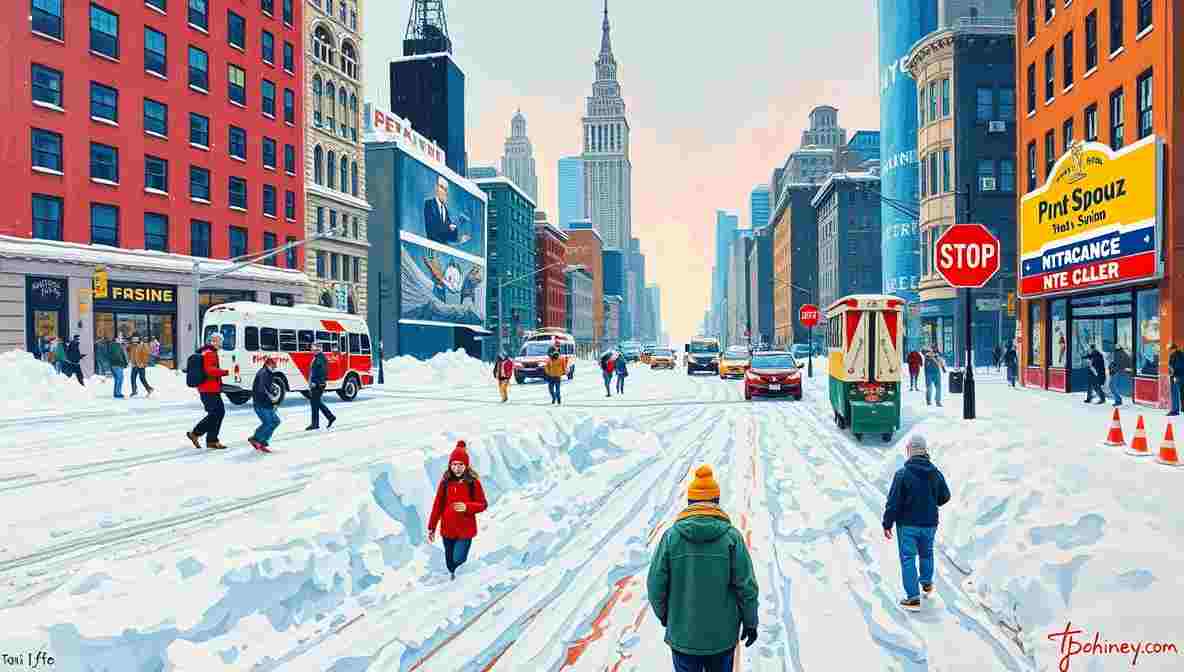
Five Quick Observations Before the Snowplough Hits Publish
- New York only becomes a quiet, reflective city when it is physically unable to move. Otherwise it is a loud, reflective city that still will not move out of your way.
- A blizzard is the only event that can unite Americans across class lines: billionaires, baristas, and guys named “Chad” all become equal the moment they cannot charge their phones.
- Airports in a major storm are the purest form of modern philosophy: thousands of people staring at screens that say “Cancelled” like it is a sacred text.
- Power outages do not create chaos. They reveal chaos. Your neighbour with fourteen generators has been planning for this since a cashier once said, “The card reader is down.”
- When the BBC says “near impossible travel conditions,” New Yorkers hear, “Perfect. Time to walk three miles for artisanal soup because the soup is part of my brand.”
Blizzard Business School: How the East Coast Learned That Nature Does Not Respect Your Calendar Invite
The Storm Arrives, and the Region Immediately Enters Stage One: Public Stoicism

On Monday, as the US East Coast got walloped with snow totals that sound like someone misread a ruler in a panic, the entire corridor from North Carolina to Maine performed the same ancient ceremony: everyone looked outside, sighed, and said, “Well. This is happening.” Then they opened an app and asked it to lie nicely.
The numbers are the kind that make weather feel personal. Rhode Island and Massachusetts seeing more than 32 inches, Central Park flirting with 20 inches, and wind gusts clocking into the 70mph range. That is not “snow.” That is “atmospheric furniture moving in.”
And yet the first instinct of a coastal city is not humility. It is branding. New York does not simply get buried. New York gets “snowed under” and then immediately produces a time-lapse of the Empire State Building like it is a luxury candle ad titled: Eau de Panic.
A serious scientist type, Dr. Leland Krupnik of the Northeast Cryosphere Institute, tried to explain it with calm authority: “When snowfall rates increase and wind creates whiteout conditions, mobility decreases sharply and infrastructure strain rises nonlinearly. Humans interpret this as a personal attack.” He later added, “Also, everyone makes the same joke about bread and milk, and none of them have ever baked anything in their lives.”
The science is correct. But the human behaviour is funnier. Especially the part where eight state governors declared states of emergency and fully 40 million people still needed to be told, individually, not to drive.
Government Issues Travel Bans, and the Public Hears “Prove It”
Massachusetts Governor Maura Healey imposed a travel ban in parts of the state, warning that whiteout conditions made travel extremely dangerous and help would struggle to reach stranded drivers. That is the reasonable thing to say.
Americans, however, treat reasonable warnings the way cats treat closed doors: as a challenge to their dignity.
An “anonymous state operations staffer” described the internal tone like this: “We planned for ploughs, salt spreaders, and emergency shelters. We did not plan for the volume of people who will attempt a Costco run as if snow is a limited-time offer.”
In New York, the city deployed 2,300 snow ploughs and 700 salt spreaders, plus sanitation workers on long shifts, because nothing screams romance like a municipal workforce holding civilisation together with salt and spite. Mayor Zohran Mamdani, facing only his second major snowstorm in two months on the job, went on record saying this was the worst storm in a decade — which is either a warning or a personal rite of passage depending on how new you are to the office.
And then, inevitably, the official language becomes a kind of poetry:
“Stay off the roads.”
“Non-essential travel banned.”
“Speed limit reduced.”
“Violators subject to summonses.”
This is the state trying to say: “Please do not become a frozen statistic.”
The public responds: “I will just pop out real quick.”
Airports Become Monasteries Where the Monks Worship the Word “Cancelled”
More than 5,600 flights were cancelled — with JFK and LaGuardia achieving cancellation percentages above 89% and 90% respectively, numbers that belong in museum exhibits. When nearly everything stops, air travel turns into a communal theatre of resignation.
There is always one man in a fleece vest acting like the weather has personally wronged him. He storms up to the desk and says, “So what are you going to do about it?” as if Delta has a weather machine behind the Hudson News.
A weary gate agent, interviewed in the sacred light of a dead escalator, offered an insight that should be engraved on a plaque: “People keep asking if the flight is cancelled. The board says cancelled. The app says cancelled. The plane is not here. I do not know what else to cancel.”
This storm created thousands of tiny tragedies, like the traveller trying to get to Minnesota for a sick grandmother and a baby shower, rebooked again and again, living inside the modern miracle of “free changes” that still cost you your soul.
And here comes the contrast that makes the satire bite: the more advanced the technology, the more primitive the emotions. We have live tracking, automatic rebooking, and predictive modelling, yet the dominant ritual remains standing in a line and whispering, “Is there any chance…”
New York Quiets Down, and It Is Somehow Creepier Than the Noise
The BBC descriptions of Manhattan and Brooklyn hit that eerie detail: Fifth Avenue quiet, parks closed because trees are loaded with snow, fallen branches, streets blocked, and a small group of humans shuffling like they are extras in a film titled “Please Just Let Me Get Home.”
The storm also produces the most reliable eyewitness in America: someone who has lived there forever and cannot remember anything like this, even if the archives could. NOAA satellites, of course, can remember. But they do not live in Brooklyn and are therefore not invited to the conversation.
Jenny in Brooklyn sees a big tree down and says it is gorgeous. This is not denial. This is coping. New Yorkers can romanticise anything if it is inconvenient enough. There is a specific local pride in suffering, like hardship is a subscription service.
An eyewitness, Vinny “Two Scarves” DelGatto, claimed he saw a guy ski through Central Park “like he was late for a meeting with destiny.” Vinny also reported that the ducks continued swimming, which is the most insulting part. Humans create emergency declarations, while ducks treat it like a spa day.
The Animals Provide the Best Leadership
The storm coverage includes dogs blasting through drifts, squirrels wearing snow like a bad decision, and ducks swimming in Central Park as if they paid for a membership.
That is the part that breaks the human ego. People look at the ducks and think, “So you are not even slightly inconvenienced?” Ducks respond with body language that translates to: “I have evolved to float. You chose skinny jeans.”
A social scientist, Professor Maribel Tewksbury of the Institute for Overreaction Studies, offered a tidy explanation: “In disasters, humans seek meaning. Animals seek snacks. The animal approach is more sustainable.” She cited National Park Service wildlife research supporting this, though the ducks were unavailable for comment.
The Fake Poll That Everyone Will Treat Like Scripture Anyway
The Northeast Blizzard Opinion Tracking Cooperative, which conducts its research entirely in bodega checkout lines, released results from a “rapid-response” survey of 1,013 highly stressed adults:
- 61% believe the storm is “worse than the last one,” regardless of what the last one was
- 48% have googled “what is a blizzard” while actively standing in one
- 39% said, “I like the quiet,” and immediately panicked at their own thought
- 28% attempted to charge a phone with a portable battery that was also dead
- 19% declared they would “move somewhere warm” and then remembered rent exists everywhere
- 7% tried to shovel in sneakers and learned the meaning of regret
Cause and effect is simple: more snow equals less movement, less power, more cancelled flights, more people trapped with their own thoughts, and more group delusion that a single run to the shop will fix existential dread. The 600,000+ power outages across the Northeast confirmed this mathematically, even for the people who do not believe in math.
What the Funny People Are Saying
“Nothing makes you appreciate electricity like trying to butter toast in the dark with a phone flashlight and optimism.” — Ron White
“A blizzard is when the city finally achieves peace, and the peace is still expensive.” — Jerry Seinfeld
“Airports during a storm are just adult daycare with worse snacks and more emotional baggage, literally.” — Amy Schumer
Helpful Content, Because Satire Should Hand You a Scarf and a Plan
If you are in the storm zone and the power is out, here is the practical stuff that actually helps, minus the lecture:
Keep one room warm-ish and treat it like your “base camp.” Close doors, block drafts, and conserve heat like it is a rare collectible. The Federal Emergency Management Agency’s winter preparedness guidance recommends exactly this, though they phrase it with fewer collectible analogies.
Charge devices when you can, but also print or write down key numbers. The future is amazing until the battery hits 2%.
If you have to drive, do not. If you absolutely have to, tell someone your route and time. Disasters turn “I will be fine” into “I should have texted.” The National Highway Traffic Safety Administration has entered the chat to agree.
Check on neighbours, especially older people. Not in a dramatic way. In a normal, decent way. Storms make communities either kinder or weirder. Choose kinder.
And give yourself permission to be overwhelmed. The weather is doing a lot. You do not need to compete.
The Closing Punchline the Storm Insists on Delivering
When the blizzard warning hits New York City for the first time in nine years, the city does not simply shut down. It pauses. It looks at itself. It hears its own silence. And it realises something terrifying.
Without power, without flights, without traffic, and without the constant hum of hurry, the only thing left is the human being inside the coat.
That is when New Yorkers will do the bravest thing imaginable.
They will stay indoors.
And they will think.
This satirical news story is entirely a human collaboration between two sentient beings: the world’s oldest tenured professor and a philosophy major turned dairy farmer. It uses real-world storm details as a foundation for humour, social commentary, and practical safety reminders. Please follow local emergency guidance, travel advisories, and weather updates in your area. Auf Wiedersehen, amigo!