

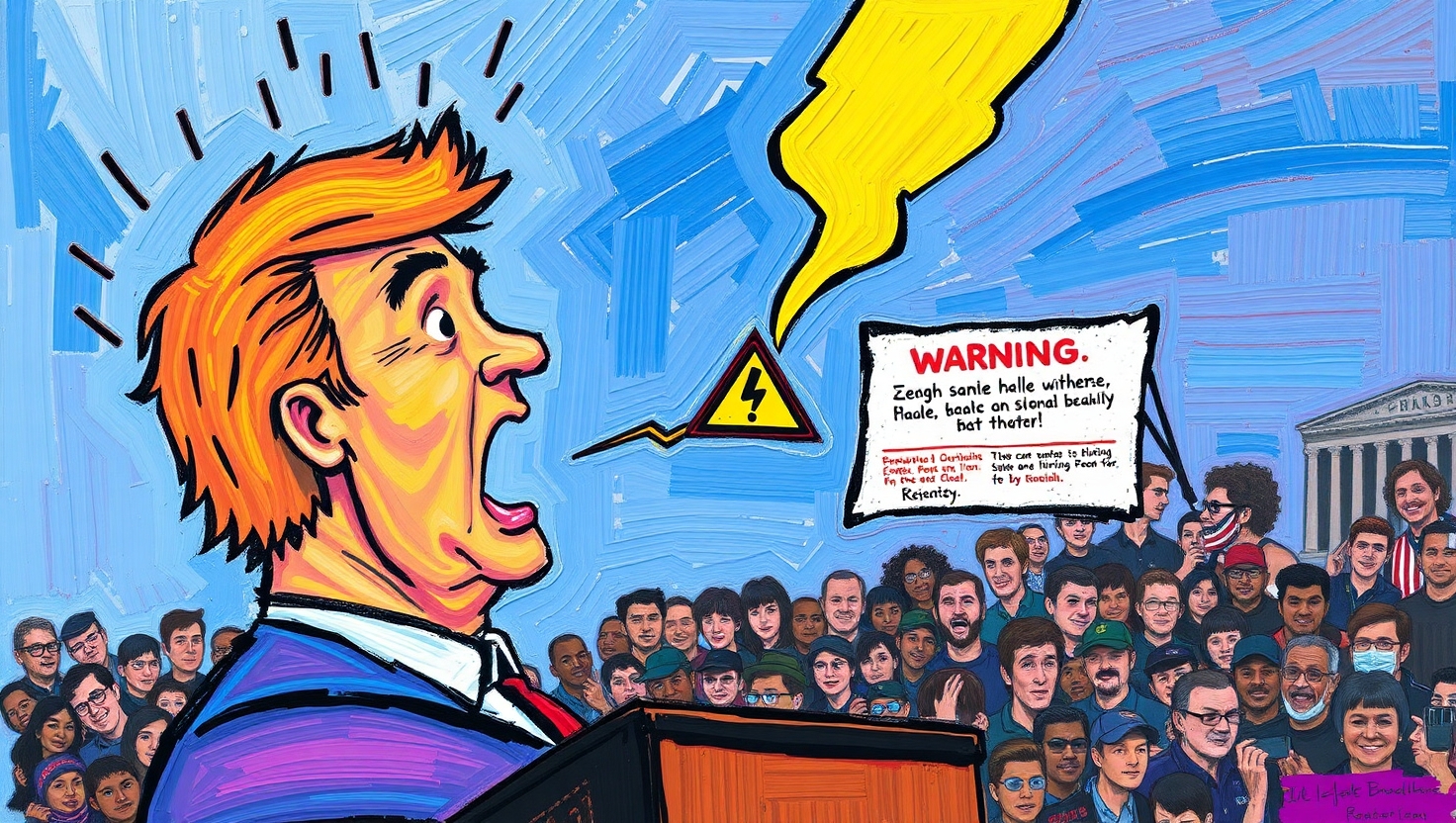
Nation Shocked: Political Violence Spikes, Turns Out Rhetoric needs a Warning Label
Surgeon General Recommends Mandatory Disclaimers for Political Speech After Scientific Breakthrough
WASHINGTON — The U.S. Surgeon General announced Tuesday that political rhetoric will now require warning labels similar to cigarette packages, after researchers at the Centers for Disease Control discovered a “shocking correlation” between inflammatory political speech and people acting on inflammatory political speech.
“We’ve identified a previously unknown phenomenon where repeatedly telling people that democracy is under attack and their opponents are existential threats somehow leads to increased political violence,” explained Dr. Vivek Murthy during a press conference where he appeared genuinely surprised by this scientific breakthrough. “It’s almost as if words have consequences. Who could have predicted this?”
The mandatory warning labels, developed by a joint task force of the Department of Health and Human Services and what sources describe as “three marketing executives who used to work for Philip Morris,” will be required on all political advertisements, campaign speeches, and social media posts containing what researchers term “democracy-threatening language intensity above acceptable levels.”
Congressional Leaders Express Shock at Cause-and-Effect Relationship
House Speaker Mike Johnson held an emergency press conference expressing amazement at the revelation that political rhetoric might influence political behavior. “This is groundbreaking research,” Johnson stated while consulting notes that appeared to be written in crayon. “The idea that repeatedly calling your opponents ‘enemies of democracy’ might make some people treat them as enemies is revolutionary scientific thinking.”
Senate Majority Leader Chuck Schumer echoed this sentiment, adding, “For years, we’ve been saying our opponents are destroying America, and now we discover that some people actually believed us. This changes everything we thought we knew about communication and human psychology.”
The Congressional Research Service has been tasked with conducting a comprehensive study on whether other forms of speech might also influence behavior, including whether telling people to vote affects voting rates and whether campaign fundraising appeals impact donation patterns.
Warning Label Development Process Reveals Scientific Innovation
The CDC’s research team, led by Dr. Sarah Martinez of the Political Communication Epidemiology Division, spent eighteen months and $47 million to definitively establish that inflammatory rhetoric correlates with inflammatory behavior. “We used advanced statistical analysis, controlled studies, and what we call ‘really obvious pattern recognition’ to reach our conclusions,” Martinez explained.
The study, published in the Journal of Political Medicine, tracked 10,000 Americans exposed to varying levels of apocalyptic political messaging and found that those hearing daily warnings about democracy’s imminent collapse were significantly more likely to believe democracy was actually in imminent danger.
“The correlation was so strong, it almost seemed like people were listening to what politicians were saying and taking it seriously,” noted co-researcher Dr. James Patterson. “This represents a fundamental breakthrough in our understanding of how human communication works.”
Media Organizations Implement Content Warnings
Major television networks have begun adding warning labels to political coverage, with CNN pioneering the “Caution: This Segment Contains Political Rhetoric That May Cause Viewers to Take Politics Seriously” disclaimer. Fox News has adopted a similar warning reading “Alert: The Following Commentary May Lead to Strong Political Opinions and Possible Civic Engagement.”
MSNBC has taken the most comprehensive approach, adding a rotating series of warnings including “Warning: This Analysis May Cause Increased Voter Turnout,” “Caution: Political Commentary May Lead to Informed Opinions,” and “Alert: Exposure to Political News May Result in Citizens Acting Like Citizens.”
The Federal Communications Commission is considering mandatory disclosure requirements for all political programming, similar to pharmaceutical advertisements, where hosts would be required to rapidly recite potential side effects of political exposure including “increased civic awareness, heightened democratic participation, and possible reality-based decision making.”
Social Media Platforms Deploy Automated Warning Systems
Meta has implemented an artificial intelligence system that automatically adds warning labels to posts containing phrases like “this is the most important election ever,” “democracy hangs in the balance,” and “the future of America depends on this vote.” The AI system reportedly flags approximately 87% of all political content posted during election seasons.
“Our algorithms can detect potentially dangerous levels of political urgency with 94% accuracy,” explained Meta’s Political Content Safety Director Jennifer Wong. “When someone posts that an election is ‘literally life or death,’ our system immediately adds a disclaimer reminding users that elections are typically just about governance and policy preferences.”
Twitter/X has adopted a simpler approach, automatically appending “This tweet may contain traces of hyperbole” to all political posts, while TikTok adds dancing warning labels that appear before political videos featuring urgent music and dramatic text overlays.
Campaign Strategists Adapt to New Regulatory Environment
Political consultants report significant challenges adapting campaign messaging to comply with warning label requirements. “It’s really hard to say ‘This election will determine whether America survives as a nation’ when you have to follow it with ‘Warning: This statement may be exaggerated for political effect,'” explained Republican strategist Patricia Wells.
Democratic consultant Dr. Michael Harrison notes similar difficulties: “Our focus groups respond really well to existential dread messaging, but adding ‘Side effects may include increased anxiety, political paranoia, and tendency to view neighbors as potential enemies’ really kills the mood.”
The American Association of Political Consultants has petitioned the Federal Election Commission for exemptions from warning label requirements, arguing that “effective political messaging has always required a certain degree of apocalyptic urgency” and that mandatory disclaimers “interfere with the American tradition of political hyperbole.”
Academic Researchers Study Warning Label Effectiveness
Harvard University’s Kennedy School of Government has launched a comprehensive study examining whether warning labels actually reduce political violence or simply make people more aware that they’re being manipulated by political rhetoric designed to make them angry and afraid.
“Preliminary findings suggest that when people see a warning label saying ‘This speech may cause you to view political opponents as existential threats,’ they experience what we term ‘manipulation awareness,'” explained lead researcher Dr. Lisa Rodriguez. “Participants report feeling simultaneously outraged by political messaging and embarrassed that they’re being outraged by obvious political manipulation.”
The study includes control groups exposed to unlabeled political rhetoric, labeled political rhetoric, and what researchers describe as “political rhetoric with increasingly obvious warning labels until participants realize they’re being studied for their susceptibility to political manipulation.”
International Community Offers Consultation
Foreign governments have begun offering assistance to help American democracy implement political rhetoric safety measures. The Canadian Government issued a statement noting that “political disagreement without existential dread is possible” and offering to share “decades of experience conducting elections without convincing citizens that democracy ends if the other party wins.”
The British Parliament has offered to provide consultation on “how to have political opponents without treating them as mortal enemies,” while the German Bundestag has volunteered to demonstrate “democratic governance techniques that don’t require citizens to believe their nation is perpetually on the brink of collapse.”
The United Nations has announced plans to send election observers to monitor whether American political warning labels successfully reduce what UN officials diplomatically describe as “the American tendency to treat routine democratic processes as apocalyptic struggles between good and evil.”
Healthcare System Prepares for Political Rhetoric Withdrawal
The American Medical Association has issued guidance to healthcare providers on treating patients experiencing withdrawal symptoms from reduced exposure to inflammatory political rhetoric. “We’re seeing patients who’ve become physiologically dependent on daily doses of political outrage,” explained Dr. Rebecca Chen, who specializes in Political Communication Addiction Medicine.
Symptoms of political rhetoric withdrawal reportedly include “decreased anxiety about democracy,” “reduced tendency to view elections as existential crises,” and what medical professionals term “inappropriate optimism about American institutions.”
Treatment centers across the country are developing specialized programs for Americans who’ve become addicted to believing every election determines whether the nation survives. “Recovery involves learning to care about politics without believing the world ends if your candidate loses,” Chen explained.
Religious Leaders Adapt Sermons to Include Political Disclaimers
The National Council of Churches has issued guidance recommending that religious leaders add warning labels to sermons containing political content. “When discussing the intersection of faith and politics, pastors should remind congregants that Jesus probably didn’t intend for Christians to treat political opponents as demons,” explained Council spokesperson Dr. Patricia Martinez.
Some evangelical churches have begun adding disclaimers to political prayers, with language such as “The following prayer may contain partisan assumptions that conflate specific policy preferences with divine will.” Catholic dioceses are reportedly considering similar measures for politically-themed homilies.
Educational Institutions Implement Civic Engagement Safety Protocols
The Department of Education has announced new guidelines requiring high schools to add warning labels to civics classes that might cause students to “develop unrealistic expectations about democratic participation” or “believe that voting actually affects governance outcomes.”
College political science departments are implementing “political reality disclaimers” for courses that might lead students to think political engagement involves more than choosing between competing forms of apocalyptic messaging.
The American Political Science Association has developed new ethical guidelines requiring professors to warn students that “studying politics may lead to understanding how politics actually works, which could be psychologically disturbing for citizens who prefer believing in simple good-versus-evil narratives.”
Law Enforcement Adapts to Reduced Political Extremism
The FBI reports a significant decrease in domestic terrorism investigations since warning labels were implemented, creating what Bureau officials describe as “an unexpected employment challenge for agents specializing in political violence.”
“We trained hundreds of agents to monitor political extremism, and now that political rhetoric comes with warning labels, extremist recruitment is way down,” explained FBI Domestic Terrorism Division Director Dr. James Crawford. “Turns out when you tell people that political messaging is designed to make them angry and afraid, they become less angry and afraid.”
The Department of Homeland Security is reportedly considering reassigning political violence specialists to other duties, though officials note that “there’s not really high demand for experts in apocalyptic political messaging outside of election seasons.”
As Americans adjust to political rhetoric that comes with warning labels, the nation waits to see whether democracy can function when citizens aren’t constantly terrified that it’s about to end, marking what political scientists call the first attempt in modern American history to conduct politics without convincing everyone that politics is a matter of life and death.
IMAGE GALLERY
Nation Shocked: Political Violence Spikes, Turns Out Rhetoric needs a Warning Label

Humorous Observations
The Surgeon General’s discovery that inflammatory political rhetoric causes political inflammation represents the first time government scientists have confirmed that saying inflammatory things makes people inflamed.
Congressional leaders expressed genuine shock at learning that repeatedly calling opponents “enemies of democracy” might cause some people to treat them as enemies, revealing a previously unknown gap in political communication theory.
The CDC spent $47 million to establish that people who hear apocalyptic political messaging tend to believe apocalyptic things are happening, representing breakthrough research in the field of extremely obvious cause-and-effect relationships.
Media organizations now add warning labels to political coverage like pharmaceutical ads, creating the surreal situation where watching the news requires medical disclaimers about potential side effects of democratic participation.
Social media platforms flagging political urgency represents the first time in American history that caring too much about elections has been treated as a public health hazard requiring content warnings.
Campaign strategists are struggling to maintain apocalyptic messaging while adding disclaimers that the apocalypse might be exaggerated for political effect, fundamentally undermining the entire modern political communication strategy.
Harvard researchers are studying whether warning labels reduce political violence or just make people aware they’re being manipulated, suggesting academic research has reached the point of studying whether citizens can recognize when they’re being lied to.
International governments offering to teach America how to have political disagreements without existential dread represents the first time foreign nations have provided democracy consultation services to the United States.
Healthcare providers are now treating political rhetoric withdrawal symptoms, creating a new medical subspecialty for Americans who’ve become physiologically dependent on daily doses of political outrage and democratic panic.
Religious leaders adding political disclaimers to sermons suggests that even divine guidance now requires warnings about potential partisan bias and conflation of policy preferences with spiritual truth.
Educational institutions implementing civic engagement safety protocols represents the first time in American history that learning about democracy has been considered potentially psychologically dangerous for citizens.
The FBI’s domestic terrorism division experiencing unemployment due to reduced political extremism suggests that warning labels have been more effective at preventing political violence than decades of federal law enforcement efforts.
Political science professors now warn students that studying politics might help them understand how politics works, treating civic knowledge as potentially psychologically disturbing for citizens who prefer simple narratives.
Warning labels on political content create the unprecedented situation where democratic participation requires medical-style disclaimers about the risks of taking democracy seriously.
The effectiveness of political rhetoric warning labels suggests that American political violence was primarily caused by citizens not realizing that politicians were deliberately trying to make them angry and afraid for electoral advantage.
Comedian Commentary
Jerry Seinfeld observed: “They put warning labels on political speeches now. What’s next, ‘Caution: This candidate may promise things they can’t deliver’? That’s not a warning label, that’s just Tuesday!”
Amy Schumer noted: “Political rhetoric needs warning labels like cigarettes? At least cigarettes actually delivered what they promised. Politicians just give you cancer of the democracy.”
Ron White remarked: “They discovered that telling people democracy is ending makes them act like democracy is ending. Next they’ll discover that telling people the world is flat makes them… well, never mind, we already know how that one goes.”
Dave Chappelle commented: “White politicians are so surprised that their words have consequences. Black people have been dealing with the consequences of white people’s words for 400 years!”
Bill Burr stated: “So political speeches need warning labels? How about ‘Warning: This politician may be completely full of shit’? That would cover about 90% of all political content.”
Chris Rock said: “They’re putting warning labels on political rhetoric. Next thing you know, they’ll put warning labels on marriage: ‘Warning: This relationship may cause you to argue about loading the dishwasher for 30 years.'”
Jim Gaffigan observed: “Political warning labels? ‘This speech may cause you to care about voting.’ That’s not a side effect, that’s the whole point of democracy!”
Trevor Noah noted: “America discovered that inflammatory political rhetoric causes political inflammation. In other countries, we call this ‘Tuesday.’ In America, it’s a medical breakthrough.”
Sarah Silverman quipped: “Political speeches need warning labels like ‘May cause existential dread.’ So do my dating profiles, but nobody’s regulating those.”
Gabriel Iglesias commented: “Warning labels on political speeches? ‘This candidate may cause you to lose faith in humanity.’ That should be on every ballot!”
Tom Segura observed: “The government spent millions to discover that scary political messages make people scared. Next they’ll spend millions to discover that water is wet.”
Nate Bargatze said: “My wife watches political news with warning labels now. The label says ‘May cause increased anxiety.’ She watches it anyway. That’s like me reading the calories on ice cream—I’m still gonna eat it.”