

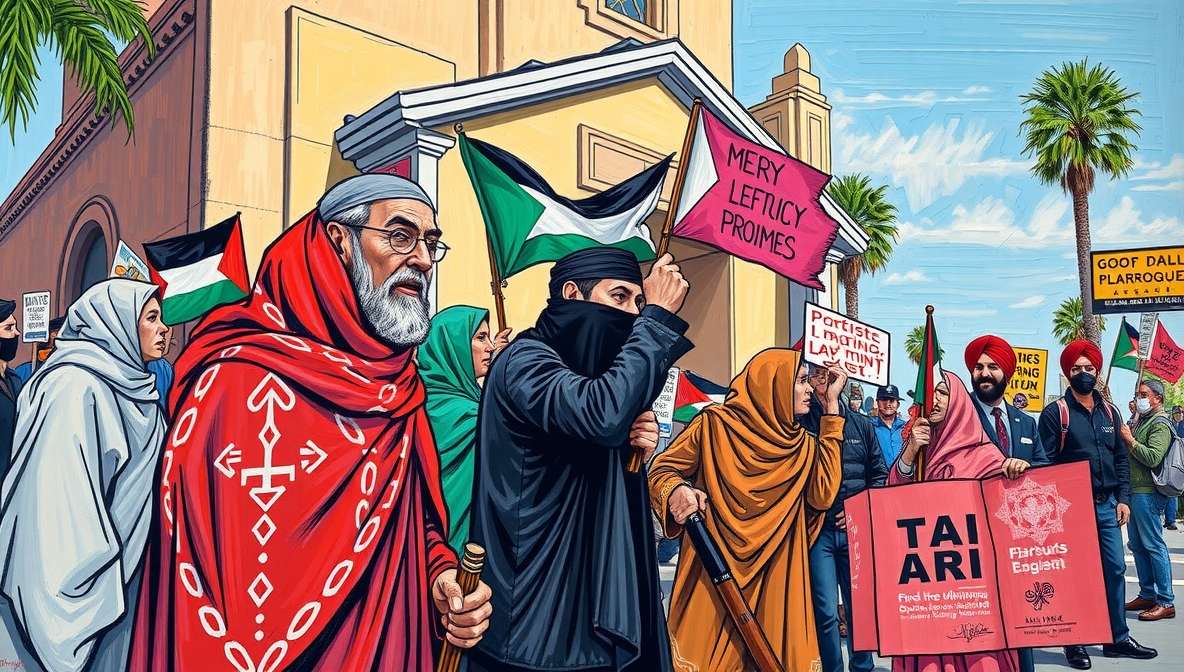
Radical LA Activists Accidentally Protest Their Own Opinions in Spectacular Display of Self-Sabotage
In what experts are calling “a perfect storm of ideology and confusion,” a group of self-proclaimed radical activists in Los Angeles reportedly organized a protest outside a synagogue event—but, astonishingly, ended up protesting themselves. Eyewitnesses describe the scene as “like watching a group of squirrels argue over the ownership of a single acorn, while standing inside a mirror maze.”
The Great Identity Mix-Up: When Activism Meets Amnesia
According to reports, activists arrived with banners declaring slogans such as “Justice for… someone?” and “Equity Now! Unless It’s Complicated”. Sociologists observing the event noted that attendees spent most of the two-hour protest trying to figure out whether they were protesting the synagogue, each other, or the concept of protest itself.
Dr. Harriet Waffles, a professor of Modern Absurdity at UCLA, stated, “It’s rare to see humans achieve such a high level of performative confusion. They’re protesting, yes, but mostly against their own internal contradictions.”
Dave Chappelle said, “When your protest becomes a protest against yourself, you’ve achieved a level of consciousness that even I can’t touch—and I’ve been to some weird places.”
The scene quickly devolved into what organizers described as “a therapeutic moment of collective introspection,” which bystanders interpreted as “complete chaos.”
The Bizarre Tools of Dissent: Fog Machines and Existential Crises
In addition to standard signs, activists wielded interpretive dance, wind chimes, and one unfortunate soul who brought a fog machine—which, at one point, engulfed their own megaphone, rendering it completely useless. Local authorities reported that no one was injured, except perhaps the concept of coherent messaging.
One eyewitness, who wished to remain anonymous, commented: “I honestly don’t know if they were chanting slogans or practicing a new kind of avant-garde karaoke. Either way, it was terrifying and mesmerizing.”
Bill Burr said, “You brought a fog machine to a protest? What are you protesting, visibility? That’s like bringing a mute button to a debate—you’ve already lost before you started.”
The fog machine incident alone generated seventeen separate Twitter threads debating whether the device was a symbol of “obscuring truth” or simply evidence that someone raided a Halloween clearance sale.
Participants spent approximately forty-five minutes arguing about whether the wind chimes represented “the harmony of dissent” or “just annoying noise pollution.” No consensus was reached.
Social Media Meets Surrealism in Real-Time Disaster
The event went viral on social media, not for its political message, but because one activist accidentally live-streamed their own argument with their reflection in a car window. TikTok analysts observed that this video had more engagement than the latest celebrity cooking mishap.
Digital pundit Sylvia Spooner summarized: “These activists have taken irony and folded it into itself like a human origami project. It’s simultaneously revolutionary and completely incomprehensible.”
Amy Schumer said, “When your biggest enemy is your own reflection, maybe it’s time to step away from the car window and get some therapy—or at least some better lighting.”
The live-stream garnered 2.3 million views within six hours, with comment sections divided between those calling it “performance art genius” and those simply asking, “Are you okay?”
The Internal Debate That Broke the Internet
Several activists began debating each other about whether their presence at the event constituted “allyship” or “appropriation,” ultimately concluding that they weren’t sure who they were supposed to be allied with.
Chris Rock said, “You’re so woke you put yourself to sleep. That’s not activism, that’s a nap with extra steps.”
One particularly heated exchange involved two protesters arguing about whether protesting at all was “centering their own voices” too much, which led to a fifteen-minute standoff of aggressive silence.
The Aftermath: Confusion Reigns Supreme
By the end of the event, most participants had forgotten what they were protesting, and some had started protesting each other’s haircuts. The group disbanded with promises to reconvene “as soon as we collectively remember what matters.”
Local authorities confirmed that no arrests were made, largely because they couldn’t figure out who was in charge of what. “It’s hard to intervene when the protest itself is protesting intervention,” said Officer Melvin Crumb.
Trevor Noah said, “When even the police are confused about what you’re doing, you’ve transcended protest and entered the realm of public interpretive dance—and nobody asked for that.”
The Philosophical Implications of Protesting Nothing
Several participants were seen consulting their phones mid-protest, apparently Googling “what am I protesting right now” and “how to protest effectively without a clear message.”
One organizer attempted to rally the crowd with a rousing speech about “solidarity in uncertainty,” which was met with polite applause and several people asking if there would be snacks.
Ricky Gervais said, “Protesting your own opinions is the ultimate form of self-awareness, or the ultimate form of stupidity—I genuinely can’t tell which, and that’s the beauty of it.”
Helpful Takeaways for Future Protesters: A Survival Guide
Know your target – Ideally, your protest should be about something other than your own reflection. Clarity prevents accidentally becoming your own opposition.
Check your props – Fog machines are fun, but hazardous when pointed at your megaphone. Also, interpretive dance is not a substitute for articulate demands.
Clarity over chaos – There’s a thin line between making a statement and accidentally performing modern interpretive theater. Most protests should avoid crossing it.
Social media caution – Live-streaming yourself arguing with yourself is fun for followers but confusing for your cause. Consider turning off notifications during moments of existential crisis.
Jerry Seinfeld said, “What’s the deal with protesting yourself? You’re basically admitting you lost the argument before it started. That’s not activism, that’s just therapy with signs.”
The Legacy of Confusion
Historians predict this event will be studied in political science courses as either “a cautionary tale of ideological overload” or “the greatest accidental comedy performance of the decade.”
Tom Segura said, “If you’re protesting and you can’t remember why, maybe just go home and watch Netflix. At least then your confusion has a clear purpose—you’re scrolling through options.”
The activists have since created a Facebook group titled “Remember What We Were Mad About?” which currently has 147 members and zero clarity.
Sarah Silverman said, “When your activism becomes a meme before it becomes a movement, you’ve done something very wrong—or very right, depending on how you feel about internet fame.”
Disclaimer: This story is entirely a human collaboration between two sentient beings—a tenured philosophy professor and a philosophy major turned performance-artist-farmer. Any resemblance to real people, living or confused, is purely intentional.