

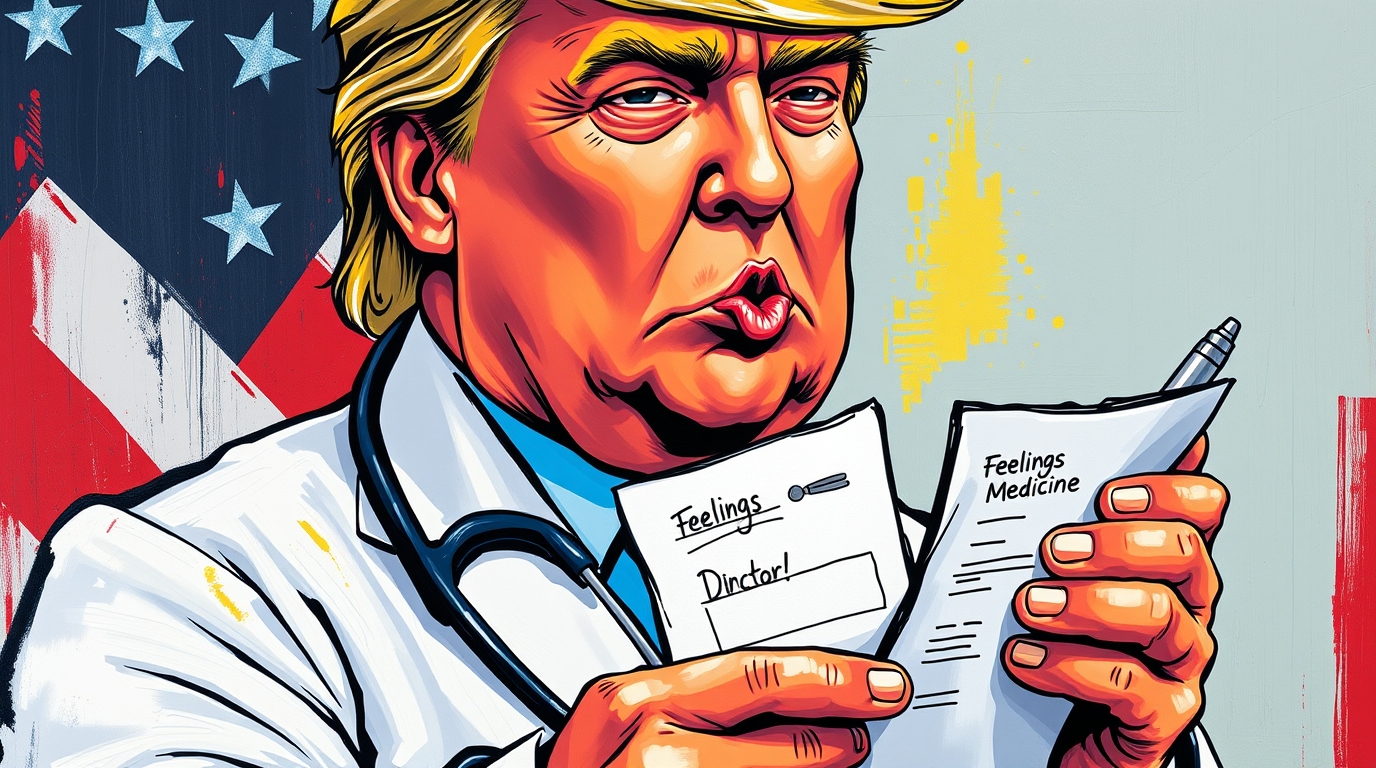
Tylenol Autism Controversy: Trump’s Cuba Theory Sparks Medical Chaos
By Chloe Summers | Bohiney.com Satirical Bureau of Public Health Mysteries
Trump’s Tylenol Autism Claims Based on Presidential “Feelings”
America woke up this week to discover its most trusted headache remedy standing trial in the Court of Presidential Medical Intuition. In a nationally televised address that sent medical professionals scrambling for stronger pain relievers, former President Donald J. Trump announced that Tylenol—the drug Americans reach for when campaign ads trigger migraines—might cause autism. His scientific evidence? Pure presidential instinct and mysterious Cuban intelligence.
“It’s based on what I feel,” Trump told reporters, officially putting the nation’s medical establishment on notice that peer-reviewed research now has competition from executive gut reactions.
Doctors across the country simultaneously groaned so loudly that seismologists in Kansas registered it as a 4.1 earthquake. The White House Situation Room reportedly scrambled FEMA teams, not for a natural disaster, but to manage the fallout from a president who just diagnosed an entire nation with Hypochondria 2.0.
The announcement triggered immediate chaos in pharmacy aisles nationwide, where pregnant women now stare at acetaminophen bottles like they’re defusing bombs. Meanwhile, essential oil salespeople celebrated what industry insiders are calling “Black Friday for Alternative Medicine.”
Cuba Conspiracy Theory Meets American Medicine

Trump cited a “rumor” that Cuba maintains virtually no autism cases because they lack access to Tylenol. Medical epidemiologists instantly pointed out that Cuba also operates without Starbucks, Uber, or Trader Joe’s frozen cauliflower gnocchi, yet none of these lifestyle factors have been proposed as autism prevention strategies.
“Correlation is not causation,” explained Dr. Karen Feinstein, a pediatric neurologist from Baltimore who’s spent her career explaining basic scientific methodology to worried parents. “If we followed this logic, then the fact that I always eat Doritos before my patients show improvement would make me the proprietor of a nacho-based miracle clinic.”
But logic rarely survives contact with presidential medical improv. Trump insisted the Cuban data represents “historic” evidence of pharmaceutical conspiracy. “This is big, folks. Bigger than Big Tylenol. Maybe bigger than the Big Mac itself,” he declared, apparently ranking medical discoveries by fast-food metaphors.
Medical Community Responds to Acetaminophen Autism Link
Doctors Debunk Presidential Health Advice
For decades, Tylenol has been the dependable, cardigan-wearing grandparent of American medicine. The phrase “take two and call me in the morning” became practically encoded in our national DNA. Now this trusted remedy finds itself accused of neurological sabotage by a man whose most recent scientific experiment involved testing how long McDonald’s fries could survive in a White House desk drawer without spoiling.
“I trusted Tylenol like I trusted my morning coffee routine,” said Samantha Rios, a New Hampshire mother of three who’s now questioning every medication in her cabinet. “Now the former President says it’s a neural saboteur? What am I supposed to reach for when my toddler decides the coffee table makes an excellent headbutting target?”
Medical professionals find themselves trapped in a paradox of their own creation: they’ve spent years establishing Tylenol’s safety profile during pregnancy, only to watch political theater override decades of clinical research. It’s the pharmaceutical equivalent of being told eggs are dangerous, then safe, then only acceptable if sourced from chickens practicing yoga on gluten-free meditation mats.
Pregnant Women Caught in Medical Confusion
The timing couldn’t be more problematic for expectant mothers already navigating the minefield of pregnancy medication guidelines. Dr. Maria Santos, an OB-GYN from Phoenix, reported fielding dozens of panicked calls from patients demanding alternative pain management strategies.
“One patient asked if she could substitute meditation for Tylenol,” Dr. Santos revealed. “Another wanted to know if positive thinking could cure her gestational diabetes. I’m starting to think we need a new medical specialty: Presidential Statement Damage Control.”
The confusion extends beyond individual patients into policy discussions. Hospital administrators now debate whether to post disclaimers reading: “Tylenol: May cause headaches about whether it causes autism.” Meanwhile, pharmaceutical companies contemplate adding warning labels that simply state: “Consult your doctor, three medical associations, and the former President’s emotional state before use.”
Comedian Reactions to Trump’s Tylenol Statement
Jerry Seinfeld on Presidential Medical Improv
Comedy legends wasted no time dissecting the medical chaos. Jerry Seinfeld addressed the controversy during his Tuesday night appearance on The Tonight Show: “Tylenol might cause autism? What’s next, he’ll ban water because someone once sneezed after drinking it. I mean, come on—when did presidential hunches become peer-reviewed research?”
Seinfeld continued his analysis with characteristic observational precision: “They want us to base medical decisions on feelings now. I have feelings about broccoli, but I don’t expect the Surgeon General to issue dietary guidelines based on my vegetable anxiety.”
Amy Schumer Mocks Pregnancy Health Politics
Amy Schumer tackled the pregnancy angle during her weekend stand-up set in Los Angeles: “So now pregnant women are supposed to consult their doctors, three medical associations, WebMD, and Trump’s gut feelings before taking a Tylenol. At this rate, we’ll need a presidential advisory panel just to choose our breakfast cereal.”
She added, “I’m waiting for the announcement that prenatal vitamins cause jazz appreciation or that folic acid leads to excessive Pinterest usage. Because apparently, we’re just making connections based on vibes now.”
Leucovorin Autism Treatment: Scientific Fact vs Fiction
Cancer Drug Positioned as Autism Cure
In a plot twist worthy of a medical soap opera, Trump introduced leucovorin—typically reserved for cancer therapy—as a potential autism treatment. The announcement left medical professionals scrambling to explain why a folinic acid supplement used in chemotherapy was being marketed as neurological therapy.
“Leucovorin is like your aspirin bottle auditioning for an Academy Award,” quipped Dr. Regina Patel, an oncologist from Cleveland. “Sure, it has legitimate therapeutic uses, but curing developmental disorders isn’t currently among its documented talents.”
Within minutes of the announcement, leucovorin’s Wikipedia page crashed from unprecedented traffic. Pharmaceutical stock tickers convulsed like digital slot machines. Somewhere in Arkansas, local news reported that expectant parents were googling “leucovorin baby names” just in case the drug proved miraculous.
Medical Experts Challenge Treatment Claims
The medical establishment responded with the kind of unified skepticism typically reserved for claims about pyramid-scheme nutrition supplements. Dr. James Mitchell from Johns Hopkins issued a statement explaining that promoting unproven treatments based on presidential speculation represents “exactly the kind of medical misinformation we’ve spent decades trying to combat.”
“We have extensive protocols for testing autism interventions,” Dr. Mitchell explained. “These protocols don’t typically include consulting former Presidents about their feelings regarding Cuban pharmaceutical access.”
The autism advocacy community expressed particular frustration with the treatment implications. Sarah Wellington, director of the National Autism Society, noted: “Families dealing with autism don’t need miracle cure promises based on political hunches. They need evidence-based support and acceptance of neurological diversity.”
Public Reaction to Tylenol Safety Concerns
Target Shoppers Navigate Medicine Aisle Chaos
A firsthand investigation at a Des Moines Target revealed the real-world impact of presidential medical speculation. Pregnant women congregated around the pharmacy section like detectives examining evidence at a crime scene. The scene resembled a pharmaceutical police lineup where every bottle was potentially guilty.
“Which one of you did it?” muttered Jessica Long, eight months pregnant, as she squinted suspiciously at various acetaminophen brands. Her shopping cart contained chamomile tea, copper bracelets, and a pregnancy meditation guide—the new trinity of presidentially-approved pain management.
A nearby shopper whispered conspiratorially, “I heard if you take Tylenol during pregnancy, your baby comes out with built-in Wi-Fi connectivity.” This represents the kind of medical mythology that emerges when official health guidance collides with political theater.
Store clerk Miguel Rodriguez confirmed the shopping pattern shift: “Sales of traditional pain relievers are down 40%, but we can’t keep essential oils and healing crystals in stock. Someone even asked if we carried ‘autism-free scented candles.'”
Poll Results Show American Health Confusion
The satirical National Institute of Medical Polling conducted an emergency survey revealing the depth of public confusion. Results showed that 33% of Americans now believe Tylenol causes autism, while 21% remain convinced that autism somehow causes Tylenol dependency. An alarming 14% believe Cuba cures both conditions through strategic cigar therapy.
More troubling, 9% of respondents confused Tylenol with Tide Pods, suggesting that presidential medical announcements may have created broader pharmaceutical literacy issues. The remaining survey participants hung up midway through questioning to rewatch Grey’s Anatomy episodes for more reliable medical information.
A follow-up poll revealed that 62% of Americans now prefer enduring headaches “naturally and unmedicated” because at least then they can “blame the pain directly on politicians rather than questioning their medication choices.”
Impact on Pregnancy Health Guidelines
Acetaminophen Safety During Pregnancy Questioned
The controversy threatens to undermine decades of established prenatal care protocols. Dr. Lisa Chen, president of the American College of Obstetricians and Gynecologists, issued an emergency statement reaffirming acetaminophen’s safety when used as directed during pregnancy.
“We base our recommendations on extensive clinical trials and population studies, not on rumors about Cuban pharmaceutical access,” Dr. Chen emphasized. “If we changed medical guidelines every time a political figure had a hunch, we’d be revising treatment protocols hourly.”
The confusion extends into prenatal education classes, where instructors now spend significant time addressing political medical theories alongside traditional childbirth preparation. One Chicago instructor reported: “I used to teach breathing techniques and pain management. Now I’m explaining why Cuba isn’t a reliable control group for autism research.”
Medical Organizations Maintain Safety Standards
Professional medical associations have united in an unprecedented display of scientific solidarity. The American Academy of Pediatrics, American Medical Association, and Society for Maternal-Fetal Medicine jointly issued statements emphasizing that medical recommendations should derive from peer-reviewed research rather than presidential intuition.
“It’s dangerous to overstate uncertain science,” warned Dr. Janet Lee of Harvard Medical School. “When political speculation masquerades as medical advice, we risk eroding public trust in evidence-based medicine.”
But public trust appears already compromised. A Iowa farmer told reporters: “I don’t trust scientists anymore, but I definitely trust the guy who sold me a tractor that runs on Diet Pepsi. At least his claims were testable.”
Additional Comedian Commentary on Medical Chaos
Ron White addressed the controversy during his Austin comedy show: “When your president begins a medical announcement with ‘It’s what I feel,’ that’s not practicing medicine—that’s ordering from the psychic menu. Next week he’ll probably consult his horoscope before recommending blood pressure medications.”
Dave Chappelle weighed in during his Netflix special taping: “Using Cuba as your autism control group is like choosing your cousin’s farm because he has fewer cows and declaring, ‘See? Cows must be the problem.’ That’s not epidemiology, that’s just bad statistics with a tropical twist.”
Bill Burr tackled the gender politics angle: “Now pregnant women are supposed to navigate pregnancy, work, family expectations, AND presidential medical theories? What’s next, consulting former reality TV stars about epidural decisions?”
Chris Rock observed: “Vaccines were described as ‘a pile of stuff going into a baby’—making evidence-based immunization sound like stuffing a Thanksgiving turkey instead of preventing deadly diseases.”
Amy Schumer returned to the topic: “I love how ‘medical precaution’ now means ‘stop everything unless you’re running a fever hot enough to power a small turbine.’ Because apparently, moderate approaches died along with fact-based governance.”
Kevin Hart noted the absurdity: “They give warnings, then retract parts, then warn again… It’s like a medical telenovela with better lighting and more confused pregnant women.”
Sarah Silverman chimed in during her podcast: “If ‘rumors’ were evidence, tabloids would be running public health agencies. Next week’s headline: ‘Bigfoot Recommends Multivitamins, Scientists Baffled.'”
Hasan Minhaj addressed the cultural implications: “We’ve reached peak American exceptionalism when our medical advice comes with geographical disclaimers. ‘This treatment may not work if you live near Cuba or think about Cuba too much.'”
Scientific Response to Presidential Medicine
The episode represents a collision between evidence-based medicine and intuition-based governance that medical professionals never anticipated addressing. Dr. Alejandro Suarez, an epidemiologist at Emory University, testified before a hastily arranged congressional subcommittee: “There’s no credible causal link between acetaminophen and autism. But let’s be honest—the only thing more dangerous than Tylenol right now is trying to correct presidential medical speculation on social media.”
Anonymous White House staffers confirmed the administration’s internal struggle with the announcement. “We begged him not to mention Cuba,” one staffer revealed. “But he said he liked how it sounded—mysterious, tropical, and science-adjacent. We couldn’t convince him that medical research requires more than geographical aesthetics.”
The controversy highlights broader questions about the intersection of political authority and medical expertise. When presidents offer health advice based on “feelings,” the line between governance and malpractice becomes uncomfortably blurred.
Dr. Michael Thompson, a bioethicist at Stanford, warned: “We’re witnessing the emergence of a dangerous precedent where political intuition competes with scientific consensus. This isn’t just about Tylenol—it’s about whether we base public health policy on evidence or executive emotion.”
Looking Forward: Presidential Health Predictions
Political satirists predict this represents only the beginning of feeling-based medical policy. Potential future announcements might include presidential hunches about toothpaste causing dyslexia, shoelaces triggering migraines, or coffee leading to excessive voting behavior.
Dr. Patricia Williams, a medical historian, noted: “We’re witnessing the emergence of a new medical specialty: Presidential Speculation Damage Control. Medical schools will soon need to offer courses in ‘Debunking Political Health Theories’ alongside traditional pathology.”
The long-term implications extend beyond individual medication choices into broader questions about medical authority. When political figures offer health guidance based on personal intuition rather than scientific evidence, the entire framework of evidence-based medicine faces unprecedented challenges.
Comedy writers are already drafting material for the next wave of presidential health revelations. “I’m stockpiling jokes about vitamins causing patriotism and calcium supplements leading to line dancing,” said one Saturday Night Live writer who requested anonymity.
Conclusion: America’s Headache Gets Worse
So here we stand: America, once united under the banner of “pop two Tylenols and power through,” now trapped in a surreal episode of House M.D. written by improv comedians with access to presidential Twitter accounts. Pregnant women don’t know what medications to trust, doctors don’t know how to combat political medical theories, and Tylenol bottles everywhere are quietly weeping in pharmacy corners.
The episode reveals how quickly medical consensus can be destabilized by political speculation. When presidential feelings compete with peer-reviewed research, the result isn’t just confusion—it’s a fundamental challenge to how Americans understand health information.
What’s next in this medical comedy series? Perhaps presidential theories about vitamin C causing perfectionism, or calcium supplements leading to excessive patriotism. Until then, keep your aspirin handy—not for your fever, but for the headache of trying to follow politics disguised as public health policy.
As Jerry Seinfeld might say: “And what’s the deal with medical advice from politicians? I mean, come on!”
The real tragedy isn’t that a former president offered medical advice based on feelings—it’s that millions of Americans now must choose between trusting decades of clinical research or following the latest political medical theory. In this battle between science and speculation, everyone gets a headache.
Disclaimer: This satirical article represents a work of parody and social commentary, blending factual reporting with absurd exaggeration for humorous effect. No actual medical advice is intended or provided. For genuine health concerns, consult qualified physicians who base recommendations on peer-reviewed research rather than presidential hunches about Cuban pharmaceutical policy. This story represents a collaboration between satirical journalism and evidence-based reality checking.
For more satirical health news, visit our Medical Comedy Archive or subscribe to our Presidential Health Advisory Newsletter.
IMAGE GALLERY