

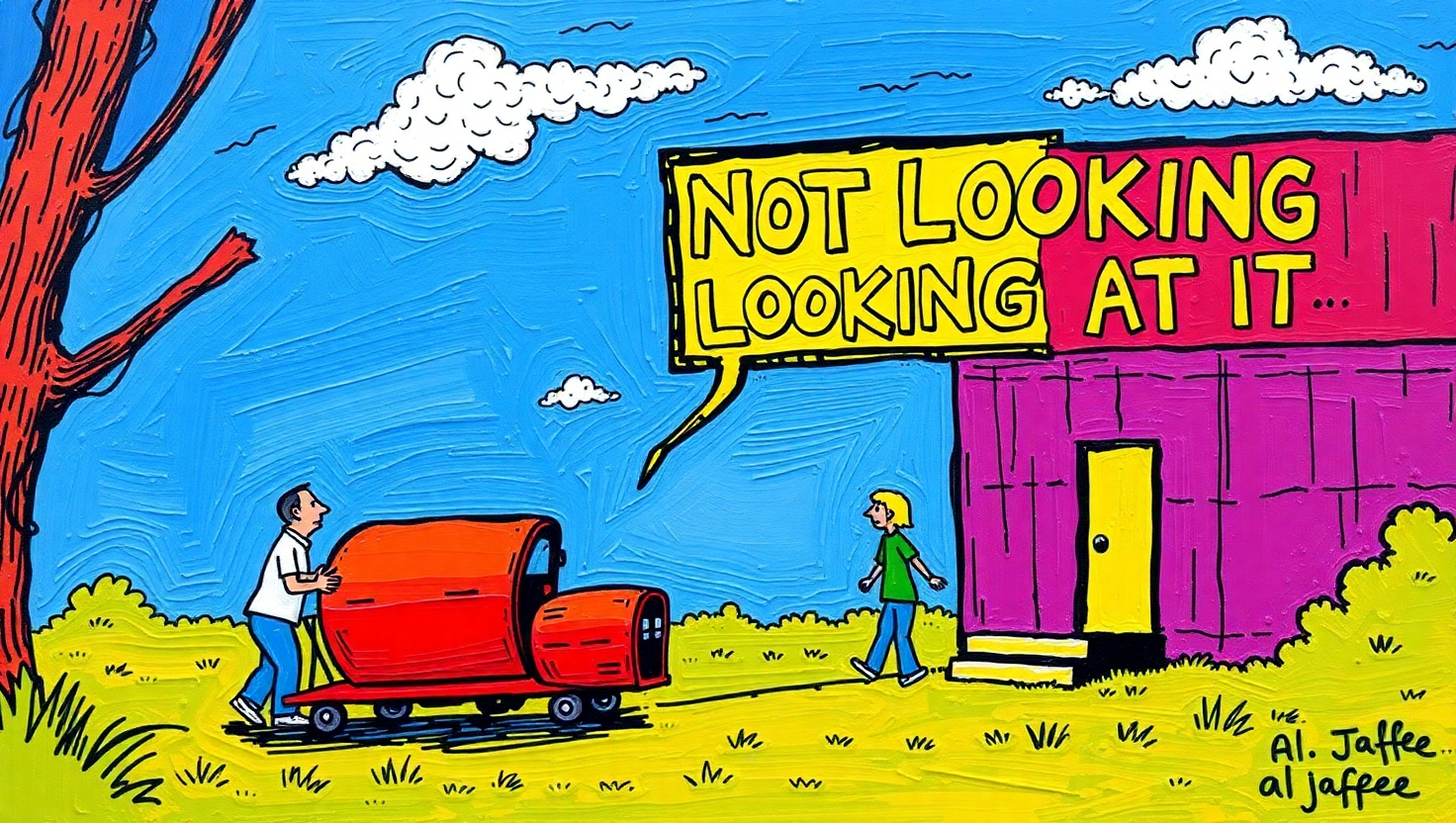
Texas City Discovers Revolutionary Problem-Solving Technique Called “Not Looking At It”
Scientists Confirm What Your Ex Already Knew: Ignoring Problems Makes Them Disappear
In a groundbreaking study that surprised absolutely no one who’s ever avoided opening their credit card statement, psychologists have officially documented what they’re calling “The Ostrich Effect” – the human tendency to avoid information that might make us uncomfortable, upset, or force us to acknowledge that we’re adults who should probably know better by now.
The research, published in the Journal of Things We Already Knew But Needed Academic Validation For, confirms that humans have perfected the art of selective blindness to such a degree that we’ve essentially evolved backwards into having retractable heads.
As Jerry Seinfeld once observed, “The thing about avoiding problems is that they’re like relatives at Thanksgiving – they’re still there whether you acknowledge them or not, and they’re getting louder.”
The Art of Professional Ignorance: How America Became a Nation of Ostriches
Politicians Perfect the Head-in-Sand Technique
Our elected officials have transformed the ostrich effect into high art. When faced with uncomfortable polling data, they don’t just stick their heads in the sand – they’ve excavated elaborate underground mansions complete with WiFi and catering.
Take climate change, for instance. Rather than confront the mountain of scientific evidence, many politicians have adopted what experts are calling “Selective Reality Disorder” – a condition where inconvenient truths simply cease to exist through the power of positive thinking and strategic campaign contributions.
The beauty of this approach is its simplicity. Why address rising sea levels when you can simply relocate the measuring stations? It’s like Amy Schumer said: “I don’t ignore my problems, I just reschedule them indefinitely until they become someone else’s problems.”
One congressman recently defended his climate stance by explaining, “I don’t look at thermometers because numbers are just liberal propaganda with decimal points.” This revolutionary approach to meteorology has been endorsed by the International Society of People Who Think Weather Happens To Other People.
Corporate America’s Innovation in Ignorance
Meanwhile, corporate executives have pioneered advanced ostrich techniques that make traditional head-burying look amateur. When presented with data showing their products might be harmful, they don’t just ignore the studies – they commission new studies specifically designed to prove the opposite, then ignore those too when they yield the same results.
The pharmaceutical industry has particularly excelled at this practice. As one executive explained, “We don’t suppress negative clinical trial data – we just file it under ‘Alternative Outcomes’ and store it in a facility that coincidentally doesn’t exist.”
Ron White perfectly captured this mentality: “You can’t fix stupid, but you can certainly give it a corner office and a generous severance package.”
Social Media: The Ostrich Effect Goes Digital
Social media platforms have revolutionized the ostrich effect by creating algorithmic echo chambers so sophisticated that users can now avoid uncomfortable information without even knowing it exists. It’s like having a personal assistant whose only job is to hide anything that might challenge your worldview or suggest you’re wrong about literally anything.
Facebook’s algorithm has become so advanced at predicting what users want to avoid that it’s started hiding information users didn’t even know they didn’t want to see. The platform recently introduced a feature called “Predictive Ignorance,” which automatically filters out facts that might cause users to question their life choices.
As Dave Chappelle noted, “Social media has made it possible to be wrong about everything while feeling completely right about it. It’s like stupidity with confidence and a like button.”
Personal Finance: The Olympic Sport of Not Looking
Americans Master the Art of Financial Denial
The ostrich effect reaches its peak performance in personal financial management, where Americans have transformed ignorance into an art form worthy of the Louvre. The average person’s relationship with their bank balance resembles a horror movie – they know something terrible is lurking in there, but they’re too terrified to look directly at it.
Credit card statements have become the modern equivalent of Pandora’s Box, except instead of releasing evil into the world, opening them releases the crushing reality of how much you spent on delivery apps last month. The psychological protection mechanism is so strong that many people have developed what financial experts call “Statement Blindness” – the ability to receive, open, and immediately forget the contents of financial documents.
Bill Burr summed it up perfectly: “I don’t check my credit card statement because I’m not ready for that kind of emotional trauma. I’d rather be surprised by bankruptcy like it’s my birthday party.”
One financial advisor reported that clients regularly ask her to “just handle the numbers part” of their financial planning, as if money were some abstract concept that doesn’t actually affect their lives. “They want to be wealthy,” she explained, “but they don’t want to know what that requires or what they’re currently doing wrong. It’s like wanting to be a chef but refusing to look at food.”
Retirement Planning: The Ultimate Head-in-Sand Experience
Retirement planning has become the crown jewel of American financial denial. Despite overwhelming evidence that Social Security alone won’t fund their golden years, most Americans approach retirement planning with the same enthusiasm they’d show for a root canal performed by a drunk woodpecker.
The average 401(k) balance suggests that most people are planning to retire sometime after they die, yet they continue to avoid looking at the numbers. It’s as if they believe retirement will be funded by a combination of lottery winnings, cryptocurrency miracles, and the kindness of strangers who apparently have nothing better to do than support other people’s lifestyle choices.
Chris Rock captured this perfectly: “People say they’re planning for retirement, but their plan is basically ‘I hope I die at work so I don’t have to figure this out.'”
Health: The Body’s Inconvenient Truth Campaign
Medical Denial: A National Pastime
The healthcare system has inadvertently created the perfect environment for the ostrich effect to flourish. Between insurance costs, deductibles, and the general terror of finding out what’s actually wrong with our bodies, Americans have developed superhuman abilities to ignore physical symptoms that would send most rational creatures fleeing to the nearest medical professional.
The modern approach to health maintenance resembles a game of medical Russian roulette, where people avoid doctors until their bodies literally force them to seek help. Chest pains become “probably just stress,” persistent headaches transform into “definitely not brain tumors,” and strange lumps evolve into “probably nothing worth bankrupting myself over.”
Tom Segura nailed it: “I don’t go to the doctor because I don’t want to find out I’m dying. I prefer to die surprised and uninformed, like my ancestors.”
Emergency rooms have become the primary healthcare provider for people who’ve perfected the ostrich effect, turning medical crises into expensive surprises rather than preventable conditions. The system is so perfectly designed for avoidance that many people consider their annual physical to be the medical equivalent of a horror movie – something they know they should do but keep postponing until Netflix stops asking if they’re still watching.
Climate Change: The Planet’s Most Expensive Magic Trick
Environmental Ostrich Syndrome Reaches Peak Performance
Climate change represents the ostrich effect’s greatest triumph – the successful avoidance of planetary-scale consequences through the simple expedient of pretending they don’t exist. It’s like ignoring a house fire while sitting in the living room, except the house is Earth and we’re all trapped inside arguing about whether the flames are real.
The psychological gymnastics required to maintain climate denial in 2025 would impress Olympic athletes. Between melting ice caps, record-breaking hurricanes, and temperatures that would make Satan consider air conditioning, maintaining the illusion that everything is fine requires dedication that borders on the superhuman.
Sarah Silverman observed, “Climate change deniers are like people who insist the Titanic is unsinkable while standing waist-deep in freezing water. The commitment is almost admirable if it weren’t, you know, potentially ending civilization.”
Politicians have elevated climate avoidance to an art form, creating elaborate policy frameworks designed to address global warming without actually acknowledging it exists. It’s like treating lung cancer by banning the word “tumor” – technically you’re doing something, just not anything remotely helpful.
The Economics of Environmental Ignorance
The fossil fuel industry has invested billions in perfecting the ostrich effect, creating a network of think tanks, studies, and experts whose entire purpose is to provide plausible-sounding reasons to ignore obvious reality. It’s the most expensive game of hide-and-seek in human history, except instead of hiding behind a tree, entire corporations are hiding behind carefully crafted doubt about basic physics.
The strategy is brilliant in its simplicity: fund enough contradictory studies to create the appearance of scientific debate where none actually exists. It’s like commissioning studies to prove that gravity is controversial while sitting in a airplane that’s flying because of the very principles you’re trying to discredit.
Gabriel Iglesias put it best: “Climate change deniers remind me of people who argue about the recipe while the kitchen is on fire. Technically you’re having a conversation about cooking, but maybe this isn’t the time.”
The Psychology of Willful Blindness
How Smart People Convince Themselves to Be Stupid
The most fascinating aspect of the ostrich effect isn’t that people avoid uncomfortable information – it’s the elaborate mental infrastructure they construct to justify their avoidance. Human beings have developed psychological defense mechanisms so sophisticated that they can maintain beliefs directly contradicted by evidence they’re looking at.
This requires what psychologists call “motivated reasoning,” which is essentially the intellectual equivalent of a contortionist act. The brain becomes so flexible in its interpretation of reality that it can twist any evidence to support predetermined conclusions, like a philosophical Cirque du Soleil performance.
Nate Bargatze captured this phenomenon: “People don’t want to be wrong, they want to be right about being wrong. It’s like being proud of getting lost – technically it’s still a destination.”
The process works by first deciding what you want to believe, then working backwards to find evidence that supports that conclusion while carefully avoiding anything that might challenge it. It’s the scientific method in reverse – instead of following evidence to conclusions, you follow conclusions to carefully selected evidence.
The Comfort of Constructed Ignorance
What makes the ostrich effect particularly powerful is that it feels rational from the inside. People don’t experience themselves as avoiding reality – they experience themselves as being discriminating about which reality to accept. It’s like being on a diet that consists entirely of birthday cake while maintaining that you’re being health-conscious by choosing vanilla over chocolate.
The psychological comfort of this approach cannot be overstated. Uncertainty creates anxiety, and the ostrich effect eliminates uncertainty by simply declaring that uncomfortable possibilities don’t exist. It’s mental peace through strategic ignorance – the psychological equivalent of noise-canceling headphones for reality.
Bert Kreischer perfectly described this mentality: “I don’t avoid bad news because I’m scared – I avoid it because I’m not ready to deal with it. It’s like emotional meal prep, except I never actually get around to the eating part.”
The Ostrich Effect in Relationships
Love is Blind, But the Ostrich Effect is Blindfolded
Romantic relationships provide the perfect laboratory for studying the ostrich effect in its natural habitat. People routinely ignore red flags so massive they could be seen from space, maintaining relationships that everyone except them recognizes as disasters in progress.
The dating world has become a masterclass in selective perception, where obvious incompatibilities transform into “quirks” and fundamental character flaws become “areas for growth.” It’s like choosing to live in a haunted house because you like the architectural details while ignoring the screaming ghosts.
Tiffany Haddish summed up this phenomenon: “Some people ignore red flags so hard they convince themselves they’re colorblind. ‘What red flags? All I see is a nice shade of gray that happens to be waving vigorously.'”
The ostrich effect in relationships is so powerful that people can maintain romantic partnerships while actively avoiding any information that might suggest their partner is, for instance, already married to someone else. The human capacity for romantic denial rivals our capacity for climate denial, except instead of ignoring rising sea levels, we’re ignoring rising credit card debt and mysterious late-night phone calls.
Technology and the Amplification of Ignorance
How Smartphones Made Us Dumber About Everything
Modern technology has transformed the ostrich effect from a personal coping mechanism into a scalable industrial process. Social media algorithms don’t just enable ignorance – they optimize for it, creating personalized echo chambers so effective that users can exist in completely different realities while living in the same physical space.
The result is a population that’s more informed than ever about topics they already agree with and more ignorant than ever about everything else. It’s like having access to the greatest library in human history but only reading the books that confirm what you already believe, while the rest of the collection spontaneously combusts from neglect.
Jo Koy observed, “We have all human knowledge in our pocket, and we use it to argue with strangers about things we could easily fact-check but refuse to because facts might prove us wrong.”
The tragedy is that the technology designed to connect us to information has instead become the most sophisticated ignorance-delivery system ever created. We’ve weaponized our own curiosity against ourselves, turning the internet into a confirmation bias machine that runs on advertising revenue and human stubbornness.
The Economic Impact of Professional Ignorance
How Much Does Not Knowing Cost?
The ostrich effect isn’t just psychologically interesting – it’s economically catastrophic. The collective cost of Americans avoiding uncomfortable financial, medical, and environmental realities runs into the trillions of dollars annually, making ignorance one of our most expensive national hobbies.
Consider healthcare alone: emergency room visits for conditions that could have been prevented through routine medical care cost the system billions annually. People avoid $200 check-ups and end up with $200,000 medical emergencies, like refusing to change the oil in your car and then expressing surprise when the engine explodes.
Louis C.K. captured this perfectly: “Americans treat their bodies like rental cars – ignore all the warning signs until something catastrophic happens, then act shocked that maintenance was apparently important.”
The financial services industry has built entire business models around customer ignorance, charging fees that people don’t notice for services they don’t understand. It’s a trillion-dollar industry based on the principle that if you make the terms and conditions long enough and boring enough, people will agree to anything.
Solutions: Treating America’s Addiction to Ignorance
Rehab for Reality Avoidance
Addressing the ostrich effect requires recognizing that ignorance has become a full-scale addiction. Like any addiction, it provides short-term comfort while creating long-term catastrophe, and breaking the cycle requires acknowledging that the temporary peace of not knowing isn’t worth the eventual consequences of remaining uninformed.
The first step is creating what psychologists call “graduated exposure therapy for reality” – slowly introducing people to uncomfortable truths in manageable doses, like a nicotine patch for facts. Instead of forcing people to confront everything they’ve been avoiding all at once, the process involves building tolerance for cognitive dissonance gradually.
Wanda Sykes put it perfectly: “The truth is like exercise – nobody wants to do it, everybody knows they should, and the longer you avoid it, the more it’s going to hurt when you finally start.”
The key is making uncomfortable information less threatening by providing context, support, and actionable steps for dealing with whatever reality people have been avoiding. It’s not enough to simply expose people to facts they don’t want to hear – you have to give them tools for processing those facts without their psychological defense systems kicking in.
The ostrich effect represents humanity’s greatest magic trick – the ability to make inconvenient realities disappear through the simple expedient of not looking at them. But like all magic tricks, the illusion only works if you don’t peek behind the curtain.
Unfortunately, reality has a way of demanding attention regardless of our preference to ignore it. Climate change doesn’t care if you believe in it, debt doesn’t disappear because you avoid opening statements, and health problems don’t resolve themselves through the power of positive thinking and strategic ignorance.
The solution isn’t to shame people for being ostriches – it’s to make being informed less terrifying than remaining ignorant. Because at the end of the day, the truth isn’t going anywhere. It’s just waiting patiently for us to pull our heads out of the sand and deal with it like the allegedly intelligent species we claim to be.
As Hasan Minhaj concluded, “Ignoring your problems doesn’t make you an ostrich – it makes you an ostrich with problems that are about to get much worse.”
For more information about the psychological mechanisms behind avoidance behaviors, visit the American Psychological Association. To learn about cognitive biases and decision-making, check out resources from The Center for Applied Rationality.
