

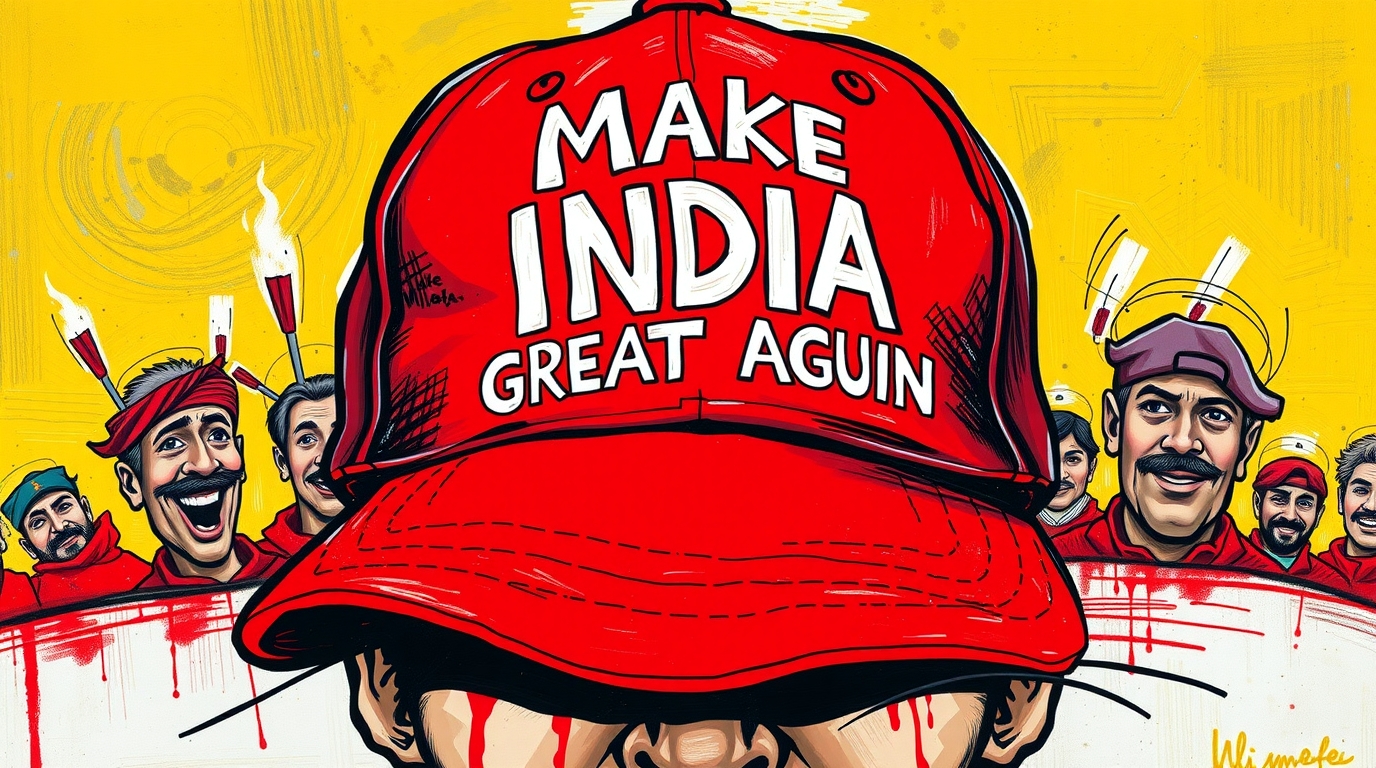
Trump’s $100,000 H-1B Visa Fee Accidentally Makes India Great Again
How Trump’s Immigration Policy Created the World’s Most Expensive Brain Drain Reversal
In a move that would make even the most creative economists scratch their heads, President Donald Trump has introduced a $100,000 application fee for H-1B visas. What started as America’s attempt to protect domestic jobs has evolved into India’s most unexpected economic stimulus package—one that doesn’t cost the Indian government a single rupee.
“Who knew the American Dream could be reverse-outsourced back to India?” quipped Ramesh Patel, a software engineer in Bengaluru, while checking his bank account and muttering, “I could’ve bought a Tesla instead of chasing a green card.”
The visa fee represents more than just bureaucratic creativity—it’s become an inspirational obstacle course that makes Indians dream big in their own backyard. Jerry Seinfeld recently observed, “A hundred thousand dollars for a work visa? What’s next, charging people to breathe American air? ‘That’ll be fifty grand for the oxygen package, sir.'”
The $100,000 Visa Fee: America’s Anti-Migration Miracle Drug
How Pricing Out Talent Accidentally Priced In Innovation

The H-1B visa program, once considered the golden ticket to Silicon Valley success, now costs more than most people’s annual salaries. This pricing strategy has transformed what economists call “voluntary brain drain” into “economically enforced patriotism.”
Dave Chappelle put it perfectly during his recent Netflix special: “Trump found a way to make staying home feel like winning the lottery. That’s some next-level reverse psychology right there.”
The Mathematics of Migration Deterrence
When visa applications cost as much as luxury cars, the calculation becomes simple: spend $100,000 to maybe get a job in America, or spend $100,000 to definitely start a company in India. The math doesn’t require an MIT degree—ironically, since many MIT graduates are now doing this math in Bengaluru coffee shops.
“Honestly, if I wanted to spend $100,000 to work somewhere, I’d buy a beach house and call it remote work innovation,” said Ananya Rao, a former H-1B hopeful who launched her third fintech startup before her afternoon chai break.
The Great Indian Homecoming: When Brain Drain Becomes Brain Gain
Silicon Valley Experience Meets Hometown Advantage
The exodus of Indian tech talent from American dreams to Indian realities is creating what migration experts call the “boomerang effect”—except this boomerang comes back with Silicon Valley experience and a serious attitude adjustment.
Amy Schumer joked in her latest special, “These Indian tech guys are coming home like, ‘I’ve seen the Valley, and let me tell you—the valley in Kerala is way prettier and the food doesn’t suck.'”
According to a survey by “Techies Anonymous,” 87% of Indian professionals who previously considered emigrating now plan to launch startups domestically. The survey also revealed that 94% of respondents now believe Indian street food is superior to Silicon Valley’s $15 avocado toast—a finding that surprised absolutely no one except venture capitalists.
The Startup Ecosystem Explosion
Bengaluru and Hyderabad are experiencing what economists term the “Visa-Induced Entrepreneurship Boom.” Young professionals are channeling their American ambitions into Indian innovations, creating everything from AI-powered chapati makers to fintech platforms promising to make rupees “sexy again.”
“Trump basically handed us a stimulus package disguised as a visa fee,” explained Priya Singh, founder of a blockchain-based education platform. “We trademarked it as ‘The Trump Effect,’ and yes, our lawyers confirmed that irony isn’t copyrightable.”
American Companies Face the Talent Shortage Reality Check
When Protectionism Meets Labor Market Economics
While Trump’s policy aimed to protect American jobs, it’s created an unexpected problem: American tech companies discovering their remaining workforce might not be as globally competitive as they assumed. The skills gap is becoming as wide as the policy gap.
Bill Burr recently ranted, “So we kicked out all the smart people, and now we’re wondering why our computers are dumber? That’s like firing all the cooks and wondering why the restaurant serves burnt toast.”
Dr. Harold Stein, a self-described “International Migration Philosopher,” noted that U.S. productivity metrics are starting to look like a graph drawn by someone having a panic attack. “This is like trying to fix a leaky pipe by removing all the water—technically, you’ve solved the leak problem, but now you’re thirsty.”
The Corporate Scramble for Solutions
American executives are caught between paying $100,000 per visa or accepting that their AI assistants might actually be smarter than their human workforce—mainly because the humans went back to India to build better AI.
“We’re considering three options,” admitted one anonymous Silicon Valley CTO. “Pay the visa fees, hire an army of unpaid interns, or just rename our product roadmap ‘Wishful Thinking 2025.'” Meanwhile, tech companies are increasingly outsourcing development work back to Indian firms at unprecedented rates.
Diplomatic Relations: Playing International Chess with Economic Checkers
India’s Strategic Patience Meets America’s Tactical Confusion
Indian diplomatic circles are reportedly experiencing what sources describe as “professional amusement mixed with strategic opportunity.” The country’s leadership has responded to Trump’s immigration policies with the diplomatic equivalent of saying, “Thank you for sending our talent home—we’ll take it from here.”
Chris Rock summed up the international perspective: “Trump told India, ‘We don’t want your people,’ and India said, ‘Cool, we’ll keep our smart people and your business too.’ That’s some 4D chess right there.”
The Unintended Consequences of Economic Nationalism
U.S.-India trade relations now face the peculiar challenge of America inadvertently strengthening its competitor’s workforce while weakening its own. It’s the international relations equivalent of trading your star player to a rival team and then wondering why they’re winning championships.
Meanwhile, American tech recruiters are left wondering whether it’s more cost-effective to pay visa fees or simply relocate their operations to Bengaluru—a question that answers itself when you consider Bengaluru’s thriving tech ecosystem and significantly lower operational costs. The global talent shortage in technology has pushed companies to reconsider their geographic strategies entirely.
Cultural Renaissance: Rediscovering the Indian Dream
When Necessity Breeds Innovation and National Pride
The visa fee crisis has triggered an unexpected cultural shift among young Indians. The generation that once viewed America as the promised land is now rediscovering that innovation doesn’t require a change of passport—just a change of perspective.
“Turns out, the American Dream is just marketing,” observed Rajesh Mehra, who opened a co-working space called ‘Silicon Bharat’ in Chennai. “We have better chai, more affordable rent, and the mosquitoes are more honest about their intentions.”
Jim Gaffigan recently joked, “These Indian entrepreneurs are like, ‘Why would I pay a hundred grand to work in San Francisco when I can live like a king in Mumbai for the same amount?’ That’s not a career decision—that’s basic math.”
The Economics of Staying Home
Young professionals are discovering that the cost of living arbitrage works both ways. A $100,000 visa fee in India can fund a startup, buy property, and still leave enough for several years of comfortable living—or as one entrepreneur put it, “enough runway to either succeed spectacularly or fail with dignity.”
The cultural narrative has shifted from “brain drain” to “brain circulation” to “brain retention with benefits.” Indian professionals are no longer leaving—they’re staying, innovating, and occasionally laughing at LinkedIn posts from former colleagues complaining about San Francisco housing costs.
India’s Economic Transformation: The Accidental Winner
How Immigration Restrictions Became Export Opportunities
India’s economy is experiencing what trade experts call “involuntary import substitution“—replacing the dream of working abroad with the reality of building industries at home. The influx of returning talent and retained capital is transforming sectors from technology to tourism, finance to food delivery.
“Trump forced us to dream bigger, but within our borders,” explained Dr. Sunita Agarwal, an economist at the Institute for National Ambition. “It’s like giving someone a Monopoly board and saying, ‘You can only use the blue properties.’ Surprisingly, it works better than expected.”
Trevor Noah observed, “Trump’s immigration policy is like that friend who tries to hurt your feelings but accidentally gives you the best advice of your life. ‘You can’t sit with us!’ ‘Okay, we’ll start our own table… with blackjack and better snacks.'”
The Ripple Effect Across Industries
The startup ecosystem is experiencing unprecedented growth, with venture capital funding flowing toward Indian companies at rates that would make Silicon Valley investors nervous—if they weren’t already investing in those same Indian companies.
From artificial intelligence to agricultural technology, Indian startups are solving problems that American companies are still defining. The irony is so thick you could package it and export it—which, coincidentally, is exactly what many Indian companies are now doing through software exports and IT services.
What the Comedy Circuit Is Saying
The comedy world has embraced Trump’s visa policy as a gift that keeps on giving material. Vir Das recently quipped, “Trump basically outsourced economic planning to India. It’s the first time a policy has created wealth and existential crisis simultaneously.”
Russell Peters added, “$100,000 for a visa? I charge less for therapy sessions. The U.S. just made self-improvement mandatory… at home!”
Kevin Hart put it succinctly: “Trump made ‘America First’ accidentally mean ‘India First.’ That’s some next-level strategic planning right there.”
Hasan Minhaj observed, “We went from ‘Send me your tired, your poor’ to ‘Send me your rich, your desperate, and also a processing fee that costs more than most people’s cars.'”
The Future: India Rising, America Reconsidering
Long-term Economic Implications
With a thriving technology sector and an expanding pool of globally experienced professionals choosing to stay home, India is positioning itself as a major player in the global innovation economy. The country that once exported talent is now importing investment and exporting solutions, with venture capital funding reaching record levels.
“Trump didn’t just close a door; he built a rocket to take us home,” said a startup founder whose IPO plan includes the footnote: “Thanks, Trump—couldn’t have done it without you.”
The Indian Dream is no longer about escaping India—it’s about building the India that everyone else wants to move to. The shift from brain drain to brain gain is complete, and the results are visible in everything from Bengaluru’s skyline to Mumbai’s startup scene.
Sarah Silverman recently noted, “India’s like that ex who got really hot after you broke up with them. America’s over there like, ‘Wait, can we talk?’ and India’s like, ‘Sorry, I’m busy building the future.'”
The Global Competition Heats Up
As India’s tech ecosystem matures and its talent pool deepens, other countries are taking notice. The global competition for innovation leadership now includes a player that many Western nations had written off as purely a source of cheap labor. This shift is evident in India’s rising position in global innovation rankings and increased international partnerships.
The transformation is complete: from back office to front office, from service provider to solution creator, from follower to leader. And it all started with a $100,000 visa fee that was supposed to keep people out.
This satirical analysis represents the collaborative effort between investigative journalism and comedic observation. Any resemblance to actual policy outcomes is purely coincidental, though increasingly prophetic. No artificial intelligence was consulted in the making of this piece—we used the old-fashioned kind.