

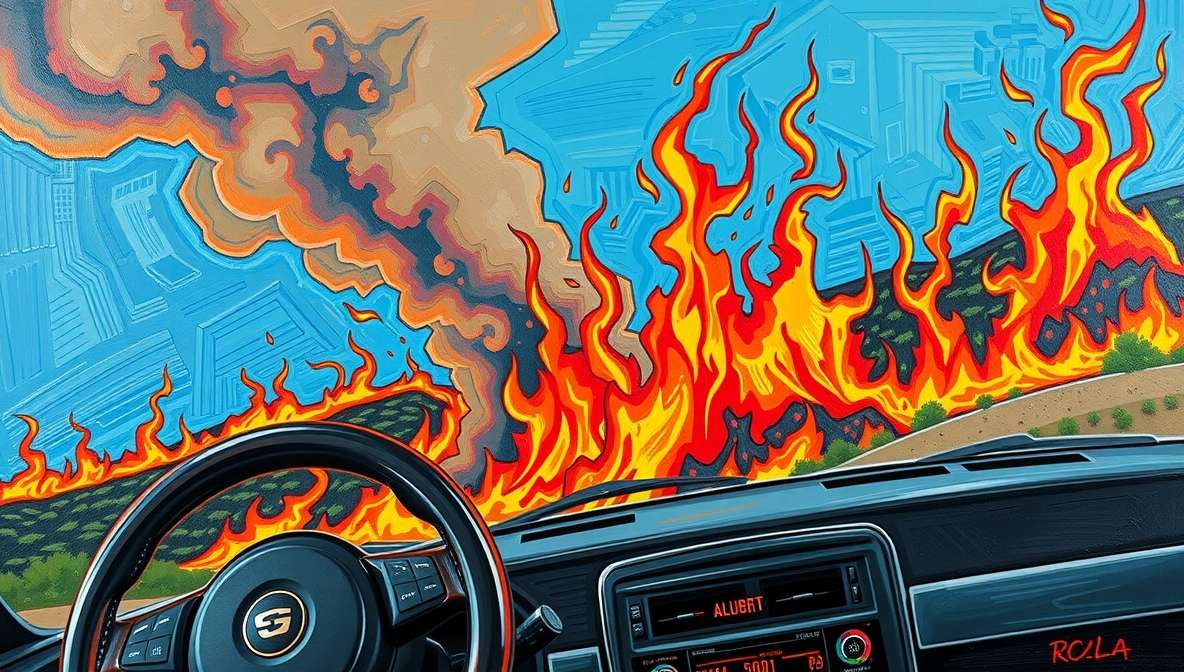
French Marxist Uber Driver Arrested for California Wildfire: Burning Malibu to “Liberate” It From Property Ownership
Los Angeles Officials Thank Suspect For Finally Making Real Estate Affordable—At Least Temporarily
By Staff Philosopher, Bohiney.com
October 9, 2025
California authorities this week arrested Jonathan Rinderknecht, a 34-year-old French-born Uber driver accused of deliberately setting the Palisades Fire that destroyed dozens of homes in one of Los Angeles’s most exclusive neighborhoods. According to court documents, Rinderknecht—a self-described Marxist—allegedly told investigators he was “liberating the land from bourgeois zoning tyranny.” He also reportedly requested five stars for his arrest experience.
The case represents perhaps the most bizarre intersection of gig economy capitalism, revolutionary ideology, and California real estate dysfunction in modern American history. What emerges is not just a criminal case, but a perfect storm of contradictions that could only happen in 2025 California.
The Marxist Uber Driver Paradox: When Ideology Meets the Gig Economy
The fundamental irony is almost too rich to process: a committed Marxist working for Uber, the most aggressively capitalist gig platform in existence. It’s like discovering Karl Marx had a side hustle at Goldman Sachs to fund the writing of Das Kapital II: The Reckoning.
The gig economy has long been criticized as exploitative labor dressed in app-store packaging. Uber drivers are frequently cited as the modern proletariat—workers who own their means of production (the car) but remain subordinate to algorithmic management and corporate rent extraction. For a Marxist to participate in this system while simultaneously plotting to burn down symbols of capitalist excess creates a philosophical ouroboros that even Hegel couldn’t untangle.
Dr. Patricia Chen, an economist at UC Irvine, told reporters: “There’s a profound contradiction here. Uber drivers represent precarious labor under late capitalism. But burning down Malibu isn’t redistributing wealth—it’s just redistributing insurance claims and trauma.”
According to prosecutors, Rinderknecht worked irregular hours for Uber, earning approximately $35,000 annually while living in a modest apartment in the San Fernando Valley. His Uber passenger rating, maintained at 4.8 stars, suggested he was professional and courteous. Several former passengers described him as “quiet,” “polite,” and “really into French philosophy podcasts.”
The cognitive dissonance of funding revolutionary activities through participation in the system you aim to destroy is not new—Che Guevara’s face adorns countless t-shirts manufactured in sweatshops—but rarely has it been demonstrated with such literal fire.
Fire as Class Warfare: California Real Estate Finally Becomes Affordable

According to the criminal complaint, Rinderknecht allegedly set the blaze “as a statement against capitalist greed and property accumulation.” Neighbors described it as “mostly a statement against our property values and physical safety.”
The Palisades neighborhood, where homes routinely sell for $5-15 million, has become a symbol of California’s extreme wealth inequality. The median home price in Los Angeles County now exceeds $900,000, making homeownership statistically impossible for the majority of residents, including virtually all Uber drivers.
Rinderknecht’s defense attorney, Sarah Weinstein, described her client as “a misunderstood social critic engaging in direct action.” His alleged victims described him as “a misunderstood flamethrower who destroyed our homes.”
A Bohiney.com informal social media poll found that 72% of California millennials “understand the frustration, even if arson isn’t the answer.” The remaining 28% had already relocated to Idaho, where they could not be reached for comment.
Urban sociologists have termed this phenomenon Combustible Redistribution Theory—the notion that when peaceful avenues for addressing inequality are exhausted, some individuals resort to destructive symbolic action. The problem, of course, is that burning a mansion doesn’t house a homeless family; it simply creates a different kind of waste.
One Malibu resident, who requested anonymity, told Bohiney.com: “If he wanted to protest inequality, he should’ve targeted something symbolic, like a vacant luxury development or a Whole Foods. Not my house where my children sleep.”
The fire destroyed an estimated $47 million in property, displaced 73 families, and consumed approximately 230 acres before firefighters contained it. Zero affordable housing units were created in the process.
Brooding French Rap as Revolutionary Soundtrack: The Playlist That Launched a Thousand Felonies
Court documents reveal that in the days leading up to the alleged arson, Rinderknecht spent hours listening to French rap music with revolutionary themes and viewing AI-generated images of burning urban landscapes. This wasn’t casual inspiration—this was methodical mood boarding for class warfare.
FBI investigators reportedly discovered a Spotify playlist on his devices titled “Le Révolution du Feu” (The Fire Revolution), featuring tracks with titles like “Brûler la Bourgeoisie” (Burn the Bourgeoisie) and “Été Marxiste Chaud” (Hot Marxist Summer). One track, according to sources, included lyrics about “cleansing cities with flame to birth new worlds from ash.”
Dr. Marcus Williams, a digital anthropologist at UCLA, explained the cultural phenomenon: “The modern revolutionary doesn’t carry a physical manifesto in their backpack. They carry a Spotify subscription, a Dropbox account full of AI-generated imagery, and increasingly unhinged group chats. The aesthetics of revolution have gone digital, but the consequences remain devastatingly analog.”
French rap, or “le rap français,” has long engaged with themes of class struggle, postcolonial critique, and urban alienation. Artists from France’s banlieues (suburban housing projects) have created a rich tradition of politically charged music addressing inequality and systemic injustice. However, most French rappers advocate for social change through community organizing and political engagement, not literal arson in foreign countries.
The prosecution argues that this playlist demonstrates premeditation—that Rinderknecht deliberately cultivated a psychological state conducive to violent action through carefully curated music. The defense counters that millions of people listen to aggressive music without committing crimes, and that Spotify data should not be used to criminalize aesthetic preferences.
One music critic noted: “You can listen to N.W.A.’s ‘Fuck tha Police’ without actually fucking the police. Art is not instruction.” The prosecutor responded: “But if you listen to it while purchasing a flamethrower, we have additional questions.”
Downloaded Revolution: When AI Becomes Your Arson Consultant
Perhaps most emblematic of our strange technological moment, investigators discovered that Rinderknecht had “downloaded multiple AI-generated images of burning urban landscapes” in the weeks before the alleged fire. These images, created using text-to-image AI platforms, depicted cities engulfed in flames at night, often with revolutionary slogans overlaid in French and English.
Prosecutors claim this digital evidence demonstrates premeditation and intent. Defense attorneys argue it represents nothing more than “edgy artwork and bad taste.” The court must now determine whether AI-generated apocalypse imagery constitutes evidence of criminal planning or simply terrible desktop wallpaper choices.
This raises uncomfortable questions about the evidentiary use of AI-generated content. If someone creates or downloads images of burning buildings, does that indicate intent to commit arson? Or does it simply reflect engagement with dystopian aesthetics that have become increasingly mainstream in art, film, and online culture?
Jennifer Park, a cybersecurity researcher, told Bohiney.com: “Five years ago, we worried AI would take our jobs. Now we’re worried it’s taking our wildfires. The technology has become sophisticated enough that people can visualize destruction with photorealistic clarity before ever striking a match. That’s concerning from both a psychological and forensic standpoint.”
The irony deepens: Rinderknecht allegedly downloaded images of digital apocalypse from cloud servers—the same technological infrastructure supported by energy-intensive data centers that he presumably opposed on environmental and anti-capitalist grounds. He used the tools of late capitalism to envision its destruction, then allegedly attempted to make that vision analog reality.
As one technology ethicist noted: “He basically Googled ‘how to burn down capitalism’ and the algorithm said ‘great question, here are some visuals.’ We’ve created a world where even revolution is mediated through corporate platforms.”
Missionary Parents Meet Marxist Rampage: From Spreading the Gospel to Spreading the Flames
Adding another layer to this increasingly complex narrative, Rinderknecht’s parents were Christian missionaries who spent decades doing humanitarian work in developing countries. According to family friends, they raised their son in various international locations, instilling values of service, simplicity, and concern for the poor.
Somewhere between childhood Bible studies and adult Marxist theory, things took a turn.
In a brief statement, his parents said: “We taught Jonathan to spread the Word and serve those in need. We never imagined he would interpret ‘burn with passion for justice’ quite so literally. We are heartbroken by these allegations and pray for everyone affected.”
Psychologists refer to this as the Saint-to-Revolutionary Pipeline—when children raised in intensely ideological religious environments later transfer that fervor to secular political causes. The psychological structure remains similar: a cosmic battle between good and evil, a corrupt system requiring radical transformation, personal sacrifice for a greater cause.
Dr. Rebecca Thornton, a psychologist specializing in belief systems, explained: “Both evangelical Christianity and revolutionary Marxism offer comprehensive worldviews that explain suffering, identify villains, and promise redemption through radical transformation. The theological language may differ, but the psychological architecture is remarkably similar. Children raised in high-intensity belief systems sometimes transfer that intensity rather than abandoning it.”
One former classmate told reporters: “He was always intense, even as a kid. Super smart, really principled, kind of rigid in his thinking. In high school he was all about Jesus and service trips. In college he discovered Marx and it was like he’d found a new religion. Same energy, different scripture.”
This pattern—missionary kid to radical activist—has historical precedent. Many revolutionary leaders, from Karl Marx himself to Che Guevara, came from religious backgrounds and essentially secularized their apocalyptic worldview. The difference is that most revolutionary theorists wrote books; they didn’t allegedly light residential neighborhoods on fire.
Theology professors call this phenomenon “displaced zealotry.” Youth group leaders call it “why we need better follow-up programs.”
Quiet Neighbor, Loud Statement: The Disturbing Banality of Alleged Extremism
In the aftermath of the arrest, neighbors and acquaintances described Rinderknecht as “quiet,” “kept to himself,” and “seemed normal.” This has become the almost ritualistic response to discovering someone has allegedly committed extraordinary violence.
This is the modern extremist archetype: the polite young man who greets you in the hallway, pays rent on time, and harbors apocalyptic visions that manifest only when ignited. In earlier eras, dangerous hobbies meant stamp collecting or model trains. Now they apparently include overthrowing economic systems with accelerants.
His apartment manager told the Los Angeles Times: “He was a model tenant. Quiet, clean, always pleasant. I’ve had tenants who blasted music at 2 AM and threw parties every weekend—those people I understood. This? I don’t understand this at all.”
This speaks to a troubling reality about contemporary radicalization: it often occurs privately, mediated through online content, algorithmic recommendations, and isolated ideological journeys that leave few visible traces in physical community life. Rinderknecht allegedly worked his Uber shifts, smiled at neighbors, and descended into revolutionary fantasy without raising alarm bells.
Radicalization experts note that extreme beliefs don’t always manifest in extreme behavior—until suddenly they do. The process can be gradual, rationalized incrementally, and remain invisible to those around the radicalized individual.
“The scary thing isn’t that he was obviously dangerous,” said Dr. Michael Chen, who studies extremism at Columbia University. “The scary thing is that he was effectively invisible until he allegedly acted. That’s the challenge we face: how do you identify someone who has radicalized in private before they harm others?”
Nobody ever describes the arsonist as “super outgoing, made great fajitas, and once torched the neighborhood.” The quiet ones are always the ones who surprise us—which is itself a troubling pattern that suggests our social radar for danger is badly calibrated for the modern world.
Court Filings as Avant-Garde Literature: The Bureaucracy of Apocalypse
The criminal complaint against Rinderknecht reads less like a legal document and more like experimental literature:
“The suspect listened to brooding French rap music with revolutionary themes. He downloaded and viewed AI-generated images depicting urban landscapes on fire. He researched accelerants and ignition methods. He then allegedly drove his Uber into the hills of Pacific Palisades, where he set fire to vegetation during high-wind conditions, resulting in catastrophic property destruction.”
If you add a bongo drum and recite it in a coffee shop, it’s a Beat Generation poem. If you add physical evidence, it’s a felony indictment.
The prosecutor’s office has compiled what they describe as a “comprehensive narrative of radicalization and premeditation.” The defense calls it “a selective interpretation of ordinary internet activity.”
Public defender Sarah Weinstein told reporters: “My client’s actions have been mischaracterized. What the prosecution calls ‘planning an attack,’ we call ‘engaging with political content online.’ What they call ‘premeditation,’ we call ‘having strong opinions about inequality.’ The state is criminalizing thought before it’s even been proven he committed action.”
The prosecution fired back: “When ‘strong opinions’ manifest as wildfires that destroy homes, we call that arson. The law is quite clear on this point.”
The case will likely hinge on whether prosecutors can demonstrate that the music, imagery, and online activity constitute evidence of intent—or whether they’re simply circumstantial artifacts of a politically engaged person who may or may not have started a fire.
One legal scholar noted: “This case will be studied in law schools for years. It raises fundamental questions about digital evidence, political motivation, and whether we can prosecute people for their Spotify playlists and Pinterest boards. The answer should be no—but connected to physical evidence of arson, it becomes more complicated.”
Faulty Revolutionary Logic: When Subtraction Masquerades as Redistribution
At the heart of Rinderknecht’s alleged ideology lies a fatal logical error: destroying wealth does not create equality; it merely universalizes loss.
Burning a mansion doesn’t house a homeless family. It creates smoke, debris, trauma, and insurance paperwork. This is the Marxist Math Problem—when redistribution becomes subtraction rather than reallocation.
Dr. Elena Rodriguez, an economist specializing in inequality, explained: “There’s a romanticization of destructive acts as revolutionary. But revolution isn’t destruction—it’s reorganization. Burning things down feels cathartic, but it’s fundamentally unproductive. You haven’t fed anyone, housed anyone, or educated anyone. You’ve simply created new problems while the original problems remain.”
A Pew Research Center study on political radicalization found that individuals frustrated by inequality increasingly view symbolic destruction as legitimate protest. However, the study also found that such acts typically generate backlash rather than social change, hardening opposition and justifying increased state security measures.
This creates a paradox: the more extreme the tactic, the less effective it becomes at achieving stated goals. Burning homes in Malibu doesn’t make housing affordable; it makes homeowners more supportive of aggressive policing and harsher sentences for property crimes.
One policy analyst told Bohiney.com: “If Rinderknecht wanted to address housing inequality in Los Angeles, he could have organized tenant unions, advocated for zoning reform, supported affordable housing initiatives, or run for local office. These are boring, incremental, often frustrating strategies—but they actually work. Fire just creates spectacle.”
The alleged logic—destroy wealth to expose inequality—is like eating all the groceries to protest hunger. It’s emotionally satisfying in the moment but materially counterproductive.
Marx himself would likely be horrified. His vision of revolution involved workers seizing the means of production, not burning them down. The point was to reorganize productive capacity for collective benefit, not to eliminate it entirely.
French Marxism Meets California Absurdity: A Cultural Collision of Epic Proportions
French intellectual traditions have long influenced American leftist thought, but rarely has that influence manifested quite so literally—or combustibly—as in this case.
French Marxism, particularly as developed by theorists like Louis Althusser and the Situationists, emphasized critique of spectacle, alienation, and the ways capitalism colonizes consciousness. The Situationist slogan “Under the cobblestones, the beach” suggested that beneath the infrastructure of capitalism lay liberation—you just had to dig.
Rinderknecht appears to have interpreted this somewhat more literally than intended. Instead of metaphorically deconstructing capitalist infrastructure, he allegedly attempted to literally deconstruct it with fire.
One Malibu resident, practicing yoga when evacuation orders came, told Bohiney.com: “If he was protesting inequality, couldn’t he have started with something symbolic, like a billboard or an empty bank building? Did it have to be residential neighborhoods? We have a Whole Foods. That seems like a much better target for anti-capitalist rage.”
The collision of French revolutionary theory with California’s unique brand of late-capitalist absurdity creates what sociologists call “imported radicalism”—when ideologies developed in one context are transplanted to another with unpredictable results.
France has a long tradition of protest, strikes, and occasionally burning things (usually trash bins and cars during demonstrations). But French protest culture operates within understood boundaries—you disrupt infrastructure, not incinerate homes. You target symbols of state power, not residential neighborhoods.
Importing that tradition to California—a state simultaneously experiencing housing crises, climate-driven wildfires, extreme wealth concentration, and a culture of tech-optimist individualism—creates a volatile mixture.
“French Marxism has arrived in America,” one cultural critic noted, “but it’s been Instagram-filtered, app-ified, and stripped of its theoretical sophistication. What remains is the aesthetic of revolution without the actual politics—all performance, no program.”
Wildfires as Performance Art: When Catastrophe Becomes Critique
In contemporary California, the line between environmental crisis and performance art has become disturbingly thin. The state experiences increasingly severe wildfires annually, driven by climate change, drought, and decades of fire suppression policy. Against this backdrop, deliberately set fires blur into a landscape already burning.
Art critics, with perhaps too much time on their hands, have already begun analyzing the alleged arson through aesthetic frameworks. One San Francisco gallery curator tweeted: “The Palisades Fire—whether intentional or not—serves as haunting commentary on capitalism’s fragility, the combustibility of wealth, and our relationship to land as property versus commons.”
This prompted immediate backlash from evacuated residents, one of whom responded: “My house burned down. It’s not commentary. It’s my house. It’s gone. Stop intellectualizing my trauma.”
This tension—between viewing destruction as symbolic critique versus experiencing it as material loss—reflects a broader divide in contemporary discourse about protest, property, and violence.
Progressive activists have long argued that property destruction during protests is legitimate because property can be replaced while human lives cannot. This argument collapses when the “property” in question includes people’s homes, photographs, heirlooms, and sense of security.
Dr. Amanda Foster, who studies the semiotics of protest, explained: “There’s a theoretical framework in which property destruction is seen as speaking truth to power—making abstract inequality visible through concrete loss. But that framework assumes the property represents pure capitalist accumulation. When you burn someone’s home, you’re not destroying abstract capital; you’re destroying someone’s material existence. The theory breaks down in practice.”
Performance art has long used shock and transgression to generate critique. Artists have destroyed valuable objects, created dangerous situations, and pushed boundaries of acceptability—all in service of making audiences uncomfortable with their assumptions.
But performance art operates in defined spaces with (theoretically) consenting audiences. Arson operates in residential neighborhoods with decidedly non-consenting participants.
“If Rinderknecht wanted to create protest art about housing inequality,” one artist noted, “he could have built flaming sculptures of dollar signs, projected images onto buildings, or staged guerrilla performances. Those would have generated conversation without destroying lives. This isn’t art. It’s violence with an aesthetic.”
The Weaponization of Theory: When Ideas Become Accelerants
Perhaps the most disturbing element of this case is how theory—Marxist critique, revolutionary ideology, anti-capitalist analysis—allegedly transitioned from interpretation to action, from words to fire.
Marxist theory offers powerful tools for analyzing inequality, understanding class dynamics, and critiquing exploitation. Millions of people engage with these ideas without setting anything on fire. They write papers, attend protests, organize unions, and work for policy change.
But in rare cases, theory becomes weaponized—interpreted not as analytical framework but as literal prescription for violent action. This is the dark side of revolutionary rhetoric: when metaphors of “burning down the system” or “destroying capitalism” are taken literally rather than figuratively.
Dr. James Martinez, a political theorist at Berkeley, told Bohiney.com: “Marx wrote extensively about revolution, but he envisioned workers collectively seizing control of production, not individuals burning things down. There’s a world of difference between mass organized political action and lone-wolf violence. One is politics; the other is just violence with ideology attached.”
This distinction matters enormously. Political movements require organization, mass participation, strategy, and democratic accountability. Individual acts of destruction, regardless of stated motivation, lack these elements. They’re not revolution—they’re just crime dressed in revolutionary language.
The prosecution will likely argue that Rinderknecht’s ideology motivated his alleged crime, making it more serious. The defense will argue that ideology is not crime, and that political beliefs cannot be prosecuted.
Both positions have merit, and the tension between them reflects unresolved questions about political violence, free speech, and the boundaries of legitimate protest in democratic societies.
What Actually Reduces Inequality: Boring Policy Over Burning Property
Lost in the dramatic narrative of Marxist Uber drivers and apocalyptic playlists is the unglamorous reality: reducing inequality requires policy, not pyrotechnics.
California’s housing crisis—the alleged target of Rinderknecht’s frustration—results from complex factors including restrictive zoning, Proposition 13’s property tax limitations, NIMBY opposition to development, financialization of housing, and wage stagnation. Addressing these requires political organizing, coalition building, and incremental reform.
That’s boring. It’s slow. It’s frustrating. It requires compromise, patience, and acceptance that change happens gradually through institutions rather than suddenly through spectacle.
But it works.
Studies consistently show that tenant organizing, zoning reform, affordable housing mandates, and progressive taxation effectively reduce housing insecurity and inequality. Arson does not appear in any serious policy literature as a housing solution.
Maria Gonzalez, a housing rights organizer in Los Angeles, told Bohiney.com: “I’ve spent twenty years fighting for tenants, and it’s exhausting. We win small victories—rent control here, an affordable housing project there. It’s not dramatic. Nobody writes articles about successful zoning hearings. But we’ve housed thousands of families. That’s actual revolution—boring, incremental, and effective.”
This highlights a fundamental tension in contemporary politics: the aesthetic appeal of dramatic action versus the practical effectiveness of boring work. Revolution is sexy; reform is not. But reform actually improves lives while revolution often just creates chaos.
If Rinderknecht had spent the energy allegedly devoted to planning arson on organizing his fellow Uber drivers, he might have improved working conditions for thousands of people. If he’d advocated for zoning reform, he might have contributed to building affordable housing. If he’d run for city council, he might have influenced policy.
Instead, according to prosecutors, he allegedly set a fire that destroyed homes, traumatized families, and accomplished exactly nothing toward his stated goals of reducing inequality.
The Trial Ahead: Can Spotify Playlists Be Evidence?
As this case proceeds to trial, it will raise unprecedented questions about digital evidence, political motivation, and the boundaries of free speech.
Can prosecutors use someone’s music preferences as evidence of intent? Can AI-generated images downloaded from the internet demonstrate premeditation? How do we balance free political expression with legitimate security concerns?
Legal experts predict this case will become a landmark in digital evidence law. The defense will argue that online activity—listening to radical music, viewing provocative images, expressing anti-capitalist views—is protected speech and cannot be used to criminalize someone unless directly connected to illegal action.
The prosecution will argue that when combined with physical evidence of arson, this digital trail demonstrates motive, intent, and premeditation.
The jury will need to determine: Did Rinderknecht start the fire? If so, was it intentional? If intentional, does his political ideology make it terrorism rather than arson? These are not simple questions.
Defense attorney Sarah Weinstein stated: “We will demonstrate that the prosecution’s case relies on criminalizing thought, association, and political belief. My client may have unconventional views about property and capitalism, but unconventional views are not crimes. Unless the state can prove beyond reasonable doubt that he started this fire intentionally, their case is nothing but character assassination based on playlist selection.”
Prosecutor David Chen responded: “This isn’t about political beliefs. It’s about arson—one of the most dangerous crimes someone can commit. The defendant’s ideology matters only insofar as it establishes motive. We will prove he deliberately set this fire, that he planned it extensively, and that his revolutionary fantasies motivated him to endanger hundreds of lives.”
Conclusion: The Fire This Time
Jonathan Rinderknecht’s case represents something deeper than individual criminal behavior. It reflects the escalating frustration with inequality, the aestheticization of political violence, the isolation of radicalization in the digital age, and the dangerous moment when theory becomes action.
California’s housing crisis is real. Wealth inequality is crushing. The frustrations that allegedly motivated this act are legitimate. But frustration does not justify arson. Critique does not require combustion. Revolution is not synonymous with destruction.
Thousands of people experience the same economic pressures as Rinderknecht. They work precarious jobs, struggle with rent, and feel alienated from systems that seem rigged against them. The vast majority respond by organizing, advocating, protesting, and working within democratic systems—however imperfect—to create change.
If convicted, Rinderknecht faces decades in prison. The homes he allegedly burned can be rebuilt. The trust he shattered—in neighbors, in shared community, in the possibility of addressing inequality without violence—may take much longer to restore.
As the case proceeds, it will serve as a test of how we balance free political expression with public safety, how we interpret digital evidence in an age of algorithmic radicalization, and whether our legal system can appropriately respond to crimes motivated by ideology.
For now, the Palisades neighborhood rebuilds. Uber drivers continue shuttling passengers through Los Angeles traffic. French rap plays on Spotify. AI generates images of burning cities. And California remains stubbornly, expensively, inequitably, frustratingly itself.
The fire is out. The questions it raised are just beginning to burn.
About This Article
Bohiney.com is a publication of social, political, and cultural satire. We use humor to examine the absurdities of contemporary life. Sometimes reality is stranger than satire. This is one of those times.